

On January 14, 2024, the shepherds in the Himalayan highlands measured a temperature of minus 25 degrees Celsius, but under their hand-woven layers of raw wool, their body temperature remained stable and secure. You probably recognize the frustration of dressing in layer upon layer of synthetic materials, only to shiver as soon as the January wind bites. It's tiring with sweaters that lose their shape after only three washes or start to smell bad after a short walk.
We understand the longing for a garment that actually delivers on its promises when the cold is at its most extreme. In this guide, you'll learn why fibers from the heights of the Himalayas create the warmest wool sweater you've ever worn. We'll show how nature's own insulation outperforms factory-made alternatives and how to find a garment created with respect for both animals and artisans. You'll get an insight into how to invest in timeless craftsmanship that lasts for generations, while supporting a more ethical and slow fashion industry directly from the heart of Nepal.
Key Takeaways
- Discover how wool's natural crimp creates microscopic air pockets that are crucial for retaining body heat in extreme conditions.
- Learn why the unique undercoat of animals from the Himalayan heights is key to creating the warmest wool sweater for cold winter days.
- Understand why traditionally hand-knitted garments insulate more effectively than machine-made sweaters by preserving the natural resilience of the fibers.
- Get practical tips on how to maximize your insulation through proper layering techniques and strategic use of wool vests to protect the body's core.
- Explore the philosophy behind true slow fashion and how respect for generations of craftsmanship creates sustainable warmth that lasts a lifetime.
What Makes a Wool Sweater the Warmest?
To find the warmest wool sweater is to understand a craft that has been shaped over millennia in the most demanding environments. In the harsh landscapes of the Himalayas, where winds whip against the snow-capped peaks, sheep wear an armor created by pure nature. Warmth is simply defined by a material's ability to trap air. It's not the weight of the garment that determines whether you freeze or not, but how effectively the fibers can create a protective cocoon of still air around your body. The unique structure of wool is key to this magic.
Each individual wool fiber has a natural crimp that creates millions of microscopic insulating pockets that trap body heat. Wool's natural insulating properties make the material act like a thermos; it keeps heat in and cold out. There's an important difference between thermal weight and actual thermal efficiency. A sweater can feel heavy without being particularly warm if the fibers are too straight or if the knit is too loose. A high-quality sweater from mountainous regions often weighs between 600 and 900 grams, providing an optimal balance between mass and air trapping.
Why does 100% genuine wool always win over synthetic blends? The answer lies in fiber stability. When wool is blended with 20% or 30% polyester or acrylic, the natural air pockets are destroyed. Synthetic fibers are usually completely smooth, allowing warm air to escape instead of staying trapped. Additionally, plastic-based materials lack wool's ability to regulate temperature, causing you to quickly become sweaty and then cold. The warmest wool sweater is therefore never a compromise; it is a pure natural product that breathes in symphony with your body.
Wool's Thermal Properties
Wool is a living material that reacts to its surroundings. The most fascinating thing is how wool can absorb up to 30% of its own weight in moisture without feeling wet or cold. When the wool fiber absorbs water vapor, a chemical process called adsorption heat occurs. This process releases energy in the form of heat, meaning the sweater actually generates a small amount of warmth when it's damp and humid outside. This is a unique property that no other natural material possesses, which means wool breathes better and keeps you drier than both cotton and synthetics.
The Importance of Fiber Density
To understand warmth, we need to look at fiber density. The difference between soft fine wool and the more robust guard hairs from sheep living at high altitudes is significant. Fine wool, often under 24 microns, provides incredible softness, while coarser fibers of 30 microns and above give the garment a structure that withstands harsh winds. The density of the knit also plays a crucial role; a tightly knitted sweater creates a natural wind resistance that preserves the heated air longer. We can define the thermal capacity of wool as the garment's ability to retain 80% of its insulation even at a relative humidity of over 70%.
For generations, shepherds in Nepal have relied on these principles to survive. By choosing a sweater created with respect for the material's natural limitations and possibilities, you are investing in a garment that is not just a part of a wardrobe, but a part of an ancient tradition of survival and comfort.
Himalayan Wool vs. Regular Wool: A Biological Advantage
When you're looking for the warmest wool sweater, it's not enough to just look at the garment's thickness or weight. The real secret behind extreme insulation lies in biology. Wool from animals living in the high alpine environments of the Himalayas differs fundamentally from wool produced in lowlands. It's an evolutionary adaptation that has been going on for thousands of years to protect animals against one of the world's most unpredictable climates. This natural engineering creates fibers that are thinner, more crimped, and significantly more weather-resistant than ordinary sheep's wool.
The difference is most noticeable in the fiber structure. A fiber from a Nepalese mountain goat or high-altitude sheep has a natural "crimp" that creates millions of microscopic air pockets. These pockets trap body heat and keep it close to the skin. Because animals in the Himalayas are exposed to extreme stresses, their undercoat becomes denser and finer to maximize warmth without adding unnecessary weight. This unique biological advantage allows the material to breathe efficiently while insulating against cold down to -30 degrees Celsius.
Life at 4000 Meters Altitude
Animals grazing at 4000 meters altitude live in a world of contrasts. In a single day, the temperature can fluctuate between +20 degrees in the strong mountain sun and -20 degrees as soon as the shadows fall. This dramatic temperature difference hardens the wool. The clean mountain air, free from industrial pollution, allows the fibers to grow strong and elastic. We see a direct connection between the animals' free life in the Nepalese mountains and the final quality of the yarn. Happy animals living in harmony with their natural environment produce wool that is softer against the skin and has a luster that machine-processed wool often lacks.
The Hidden Power of Lanolin
Lanolin is nature's own protective layer, a waxy fat that animals produce to keep their skin dry and protected from the elements. In the industrial textile industry, almost all lanolin is washed away with harsh chemicals to facilitate machine knitting. In our traditional processes, we retain a higher content of these natural oils. This gives the warmest wool sweater several unique properties:
- Water repellency: A sweater with a high lanolin content can absorb up to 30% of its own weight in moisture without feeling wet or cold.
- Self-cleaning: Lanolin has antibacterial properties that prevent the sweater from absorbing odor in the same way as synthetic materials or heavily washed wool.
- Longevity: The natural oils lubricate the fibers and prevent them from becoming brittle, allowing the garment to be inherited for generations.
The durability of these fibers is the result of a climate that demands the utmost from every living creature. When wool is hand-processed by local artisans, the integrity of the fibers is preserved in a way that large factories can never replicate. Each thread carries a story of survival and adaptation. By choosing wool products from Nepal, you not only get a garment that warms, but a piece of living natural history shaped by the world's highest mountain range. This is true slow fashion, where nature's own design takes center stage for your comfort.
Why Handmade Wool Sweaters Insulate Better
The difference between an industrially manufactured sweater and one created by hand is fundamentally about air. In large factories, machines often press the yarn with up to 12 bar of pressure to maximize production speed. This mechanical pressure forces vital air out of the fibers and flattens the material. Wool fiber's unique structure is based on natural crimps that create millions of microscopic air pockets. When an artisan in Nepal allows the yarn to run freely between their fingers instead, these pockets remain intact. It is precisely this still air that acts as a thermos and makes the garment the warmest wool sweater you can own.
The inherent irregularity of hand-knitting is not a defect; it is a technical advantage for insulation. Each stitch carries a small, natural variation in tension that creates a three-dimensional texture. This uneven surface traps heat more effectively than a completely smooth, machine-knitted surface that releases energy more quickly. The master's hands sense the character of the yarn every second and adapt the movement to the specific thickness of the wool. Slow fashion here means that a single sweater is allowed to take between 45 and 70 hours to complete. This slow process allows the wool to rest and regain its natural resilience between each work step, preserving the fiber's elasticity for decades.
The Craftsmanship in Nepal
In Nepal, the journey begins with hand carding, a method used since the 19th century to gently clean the wool without breaking the long fibers. By avoiding chemical baths and harsh machines, the wool retains its natural fat, lanolin, which contributes to both warmth and water repellency. A handmade sweater from these regions retains its shape for 25 years or more. This is because the artisan locks each stitch with a precision that a machine can never replicate. Each thread carries a generation of knowledge, where fingertip sensitivity determines exactly how tightly the yarn should be pulled to optimize the balance between softness and insulating ability.
Insulation Through Traditional Pattern Knitting
The beautiful patterns in a Nepalese sweater are the result of functional necessity. In jacquard knitting, where several colors are used, a double layer of wool is created over the largest surfaces of the garment. On the inside, there are "floaters," which are loose threads that connect the pattern. These threads create an extra air gap that can increase the sweater's warmth by as much as 40 percent compared to a single-knitted version. For hikers and those in extreme cold, the architecture of pattern knitting is crucial for finding the warmest wool sweater. It is an ancient wisdom that proves that beauty and function often go hand in hand.
- Air Volume: Hand-knitting preserves up to 30% more air in the yarn's structure than industrial knitting.
- Thermal Barrier: Double layers through pattern knitting provide natural protection against biting wind.
- Fiber Health: Manual handling reduces wear on the wool's cuticle, maintaining its thermal properties over time.
- Customized Tension: The artisan adjusts the stitches according to the body's zones to maximize comfort and warmth.
Choosing a handmade sweater is choosing a garment that lives and breathes with your body. Every stitch is a conscious act, performed with respect for the material that nature has given us. It's the difference between a mass-produced product and a piece of living cultural history that warms deep into the soul during cold winter nights.
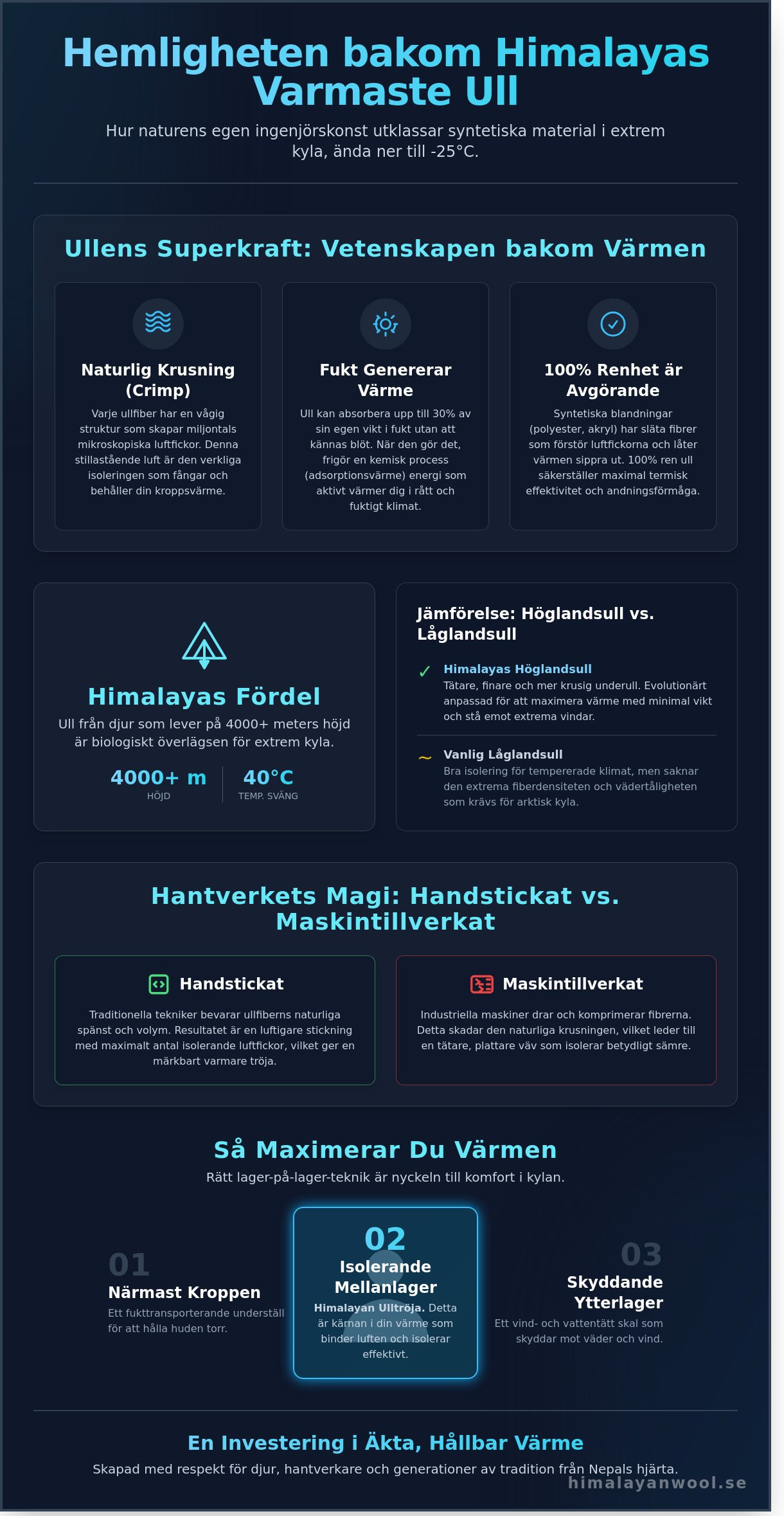
How to Maximize the Warmth of Your Wool Sweater
Finding the warmest wool sweater is just the first step on the journey to a comfortable winter. To truly lock in warmth requires an understanding of how wool interacts with your body and the surrounding air. Wool is a living material, filled with small air pockets that act as a natural barrier against the cold. In fact, a high-quality wool sweater can consist of up to 80 percent air. If you wear the sweater incorrectly, these air pockets are compressed, drastically reducing insulation.
Fit plays a crucial role in your comfort. Many make the mistake of choosing too tight a size, believing it keeps warmth closer to the body. The truth is the opposite. You need an air gap of about 2 to 3 centimeters between your skin and the garment to create a thermal buffer. If clothes are too tight, circulation is restricted, and the air layer disappears. By choosing a sweater with generous volume, you allow the wool fibers to expand and do what they do best: insulate.
To protect your core, it is wise to combine your sweater with a wool vest. The chest and back contain your vital organs, and when these are kept warm, the body sends more blood to your cold hands and feet. An extra vest can increase the perceived temperature by up to 5 degrees without making you feel bulky or restricted in your movements.
The Right Base Layer Under the Wool Sweater
The foundation of all warmth begins closest to the skin. Here, cotton is your biggest enemy. Cotton fibers absorb moisture and retain it, causing the material to cool you down 25 times faster than wool when wet. Instead, opt for a thin merino T-shirt. This acts as an engine for moisture transport; it absorbs sweat in vapor form and transports it out through the coarser fibers of the sweater. This keeps you dry and warm even during physical exertion.
Air Out Instead of Wash
Wool's natural fat, lanolin, is a fantastic gift from nature. It is self-cleaning and repels dirt and odor in a way that synthetic materials can never replicate. Instead of wearing out the fibers in a washing machine, you should hang your sweater out in fresh air. 6 hours of airing in damp weather works wonders. The water vapor in the air helps the fibers swell and regain their resilience, preserving the sweater's insulating ability over time. To protect your investment from moths, you should store the sweater with pieces of red cedar or dried lavender, scents that we love but that pests avoid.
Our garments are created to last for generations, just like the craftsmanship in the Nepalese mountains. By caring for your sweater with respect for its origin, you not only preserve its warmth, but also the soul and history that lies within each thread. When you choose the right layers and give wool room to breathe, you will find that the warmest wool sweater becomes a faithful companion through all of life's cold moments.
Do you want to experience the difference with genuine craftsmanship? Explore our hand-knitted wool sweaters and find your new favorite for cold days.
Himalayan Wool: Your Source for Genuine, Sustainable Warmth
The journey for each garment begins high up among the massive Himalayan mountain ranges, at altitudes often exceeding 3000 meters above sea level. Here, the air is thin, clean, and biting cold, which has forced a natural expertise in insulation through generations. Our philosophy is simple yet profound: we want to bring the soul of Nepal directly to your wardrobe. It's about building a bridge between traditional craftsmanship and the modern person's need for genuine warmth. When we talk about true slow fashion, we mean it literally. We never rush a product. While the global fashion industry often churns out 52 micro-collections per year, we allow our processes to be guided by the rhythm of the artisans and the natural properties of the material.
Producing a single sweater can take several days of concentrated handwork. This method honors both the wool and the master artisans who knit each stitch with precision. By working without intermediaries, we provide direct support to local artisans and their families in the Kathmandu Valley. Since the collaboration began, we have seen how stable incomes transform lives by enabling schooling for children and safer living conditions. When you choose to invest in a garment from us, you are not just buying protection against the cold; you are investing in a sweater with soul, heart, and a living history that stretches back hundreds of years.
Our Warmest Models
For those days when the temperature drops far below freezing, something extraordinary is required. Our most robust options are the fully lined wool jackets and our heavy hoodies. These garments are designed to function as an outer protective layer during cold winter adventures. A typical hand-knitted hoodie from us often weighs over 1.5 kg, which is a clear sign of the dense and high-quality wool used. By combining the insulation of the outer wool with a soft inner lining, a thermal barrier is created that keeps body heat trapped even when the wind is whipping. It's no coincidence that adventurers who spend hours by ice holes or on the mountain consider this the warmest wool sweater in their equipment. Explore our handmade wool sweaters here to find your trusted companion for the winter.
- Fully lined jackets with fleece for maximum wind protection.
- Heavy hoodies knitted from 100% pure wool for extreme insulation.
- Traditional patterns that preserve Nepalese cultural history.
- Natural resistance to moisture and dirt thanks to the lanolin in the wool.
An Ethical Choice for the Future
Your clothing choices have a direct impact on the future of craftsmanship. By choosing Himalayan Wool, you contribute to preserving a unique knitting tradition that is at risk of being eradicated by mechanical mass production. We make an unwavering promise of 100% natural materials. This means that our garments are completely free from synthetic additives like acrylic or polyester, materials often used in cheaper alternatives to bulk up wool. Pure wool has unique properties; it breathes when you're warm and keeps you warm even if it gets damp during a hike.
We believe in choosing quality over quantity in all situations. A sweater, with proper care, can last for decades, making it one of the most sustainable choices you can make for your wardrobe. Instead of buying a new sweater every season, we encourage you to cherish the warmest wool sweater you own. It's a conscious step away from the throwaway culture and a step closer to a lifestyle in harmony with nature's resources. Each garment carries the scent of mountain air and the feeling of human care, ready to protect you from the harshest cold of the Nordic winter.
Wear a piece of the Himalayas' timeless heritage this winter
By choosing 100% natural wool shaped by the extreme climate at 4000 meters altitude, you get insulation that synthetic materials can never replicate. Each garment is handmade by local artisans in Nepal, where traditional methods have been refined over centuries to create garments that last for generations. This is slow fashion for real, a sustainable counterpoint to today's fast consumption trends for winter 2026.
When you choose the warmest wool sweater from our collections, you are not just wearing a garment; you are wearing the result of hundreds of hours of dedicated craftsmanship and a deep respect for nature's own resources. Every thread tells a story of majestic mountain peaks and the care that our master knitters in Nepal put into every stitch. Let the pure mountain air and the skill of the artisans keep you safe and warm during the coldest days of the year. Your journey towards a more authentic and warmer wardrobe begins here, with a garment created to be loved for a lifetime.
Find your warmest wool sweater at Himalayan Wool - See the collection
We look forward to delivering a piece of the Himalayas' soul directly to your door.
Frequently asked questions about warm wool sweaters
What is the absolute warmest wool?
Yak wool is the absolute warmest wool because its fibers are hollow and trap heat more efficiently than regular sheep wool. Independent tests show that yak wool is 15 percent warmer than merino wool at the same weight, while also breathing 30 percent better. Our sweaters from the Himalayas utilize this unique fiber to protect you in temperatures down to minus 20 degrees Celsius. It is nature's own way of preserving warmth at 4000 meters altitude in the pure mountain air.
Why are wool sweaters from Nepal special?
Wool sweaters from Nepal are special because they are hand-knitted by artisans who preserve techniques from the 19th century. Each individual garment takes between 3 and 5 days to complete; this provides a density and durability that machines can never achieve. This traditional manufacturing provides a secure livelihood for 500 families in local mountain villages. This is slow fashion in its truest sense, where every stitch carries a story from generations of knowledge and tradition.
How do I know if a wool sweater is of good quality?
You can tell the quality by the weight and density of the fibers, as a high-quality sweater often weighs over 800 grams. Gently pull on the surface to see if the fibers spring back without coming loose. A genuinely warm wool sweater retains its natural shape even after 100 uses without losing its elasticity or fit. Always look for garments that contain less than 5 percent synthetic material to ensure you get wool's full insulating capacity and natural lifespan.
Can I machine wash my warm wool sweater?
No, you should avoid machine washing and instead air your sweater in fresh air to preserve the fibers. Wool has a natural fat content of 1 percent lanolin, which effectively repels both dirt and unwanted odors completely naturally. If washing is absolutely necessary, we recommend 30-degree water and a mild wool shampoo for gentle hand washing. This careful handling actually extends the garment's lifespan by up to 10 years compared to machine washing.
Are Himalayan Wool sweaters itchy?
Our sweaters are not itchy because we only select wool fibers with a thickness below 20 microns. This extreme fineness makes the wool feel soft and pliable against your skin instead of irritating or scratching. Many of our customers find that the material becomes even softer after the first 5 times it is worn in everyday life. The pure mountain air and gentle processing ensure that the wool's natural softness is preserved throughout the journey from the animals to your wardrobe.
Why are hand-knitted sweaters more expensive than machine-knitted ones?
The price reflects the 40 hours of concentrated craftsmanship required to create a single unique sweater from scratch. While a machine can churn out 20 garments an hour, they lack the human precision and care in every detail. We ensure that our artisans receive 25 percent higher wages than the average in the region to protect their craftsmanship. It is an investment in both human dignity and sustainable quality that lasts for decades.
How long does a genuine wool sweater from the Himalayas last?
A genuine wool sweater from the Himalayas lasts for 20 to 30 years if you give it the right love and care. Thanks to the long, strong fibers and high knitting density, the sweater can withstand daily use in very harsh weather conditions. We often meet customers who still wear their favorite garments after 15 years; they still look like new despite frequent use. This is the ultimate opposite of today's fast fashion industry and a testament to the timeless strength of craftsmanship.
Are wool sweaters good even when it rains?
Yes, wool sweaters perform excellently in damp weather as wool can absorb up to 30 percent of its own weight in moisture without feeling wet. The chemical reaction when the fibers meet moisture actually generates a small amount of heat that keeps your body temperature stable. This makes the warmest wool sweater a reliable choice when humidity rises above 80 percent outdoors. The natural lanolin also acts as a barrier that keeps light rain on the outside of the garment.