

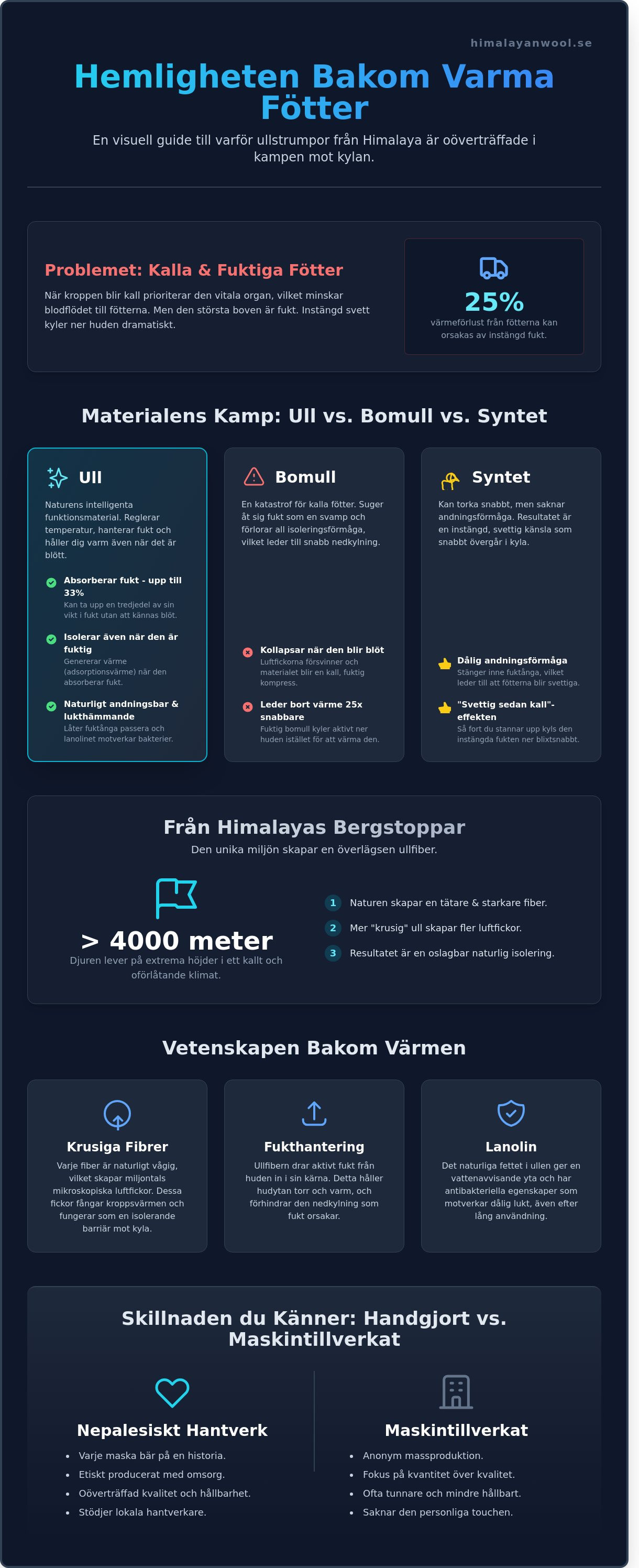
Imagine a January morning when the cold penetrates deep through the floorboards and your regular socks feel like damp paper against your skin. According to textile measurements, feet lose up to 25 percent of their warmth through trapped moisture, making the choice of material absolutely crucial for your well-being. To achieve lasting and natural comfort, genuine warm wool socks are required, created with the wisdom cultivated for generations on the majestic mountain peaks of the Himalayas where the air is clear and the winters bitter.
You have probably experienced the frustration of socks that lose their shape after just a few washes or leave your feet cold even though they look thick. In this guide, you will learn why wool from Nepal is the ultimate secret for consistently warm and dry feet, and how to identify the quality required for your garments to last for many years. We take you on a journey from the shepherds' care for the animals to the finished craftsmanship, so you can choose an ethical alternative that provides warmth for both body and conscience for a long time to come.
Key Takeaways
- Discover the science behind how nature's own fibers regulate your temperature and why wool's insulating properties are superior to cotton's in cold climates.
- Learn how the harsh life on the Himalayan peaks creates a unique and dense wool fiber that protects animals – and your feet – from extreme cold.
- Get practical advice for choosing the right warm wool socks based on thickness and use, so you always walk with warm and comfortable steps.
- Explore the tangible difference between machine-made and Nepalese craftsmanship, where every hand-knitted stitch carries a history of tradition and quality.
Why do our feet get cold? The science behind warm wool socks
When the cold creeps along the floors or bites at your toes during a winter walk, it's the body's own survival mechanism kicking in. Our feet act as the body's thermostats. When the outside temperature drops, the brain prioritizes keeping the vital organs in the chest and abdomen warm. By constricting blood vessels in the hands and feet, warm blood is directed inwards, leaving our extremities cold and vulnerable. To break this natural reaction, more than just a protective layer is needed; a material that works in harmony with the body's biology is required.
Here, warm wool socks play a crucial role. It's not just about thickness, but about how the fiber handles energy and moisture. Wool has evolved over millennia on the rugged slopes of the Himalayas to protect animals from extreme temperature fluctuations. It is a living material that understands the difference between sedentary rest and active movement.
Wool's unique thermoregulation
Wool's main strength lies in its physical structure. Each small fiber is naturally crimped, creating millions of microscopic air pockets in the fabric. These pockets act as an effective barrier, trapping body heat and keeping it close to the skin. In these technical properties of wool, we find the explanation for why the material insulates so effectively. Unlike other fiber types, wool retains its structure even when subjected to pressure or moisture.
Another secret is lanolin, the natural fat found in genuine wool. It gives the sock a water-repellent surface and acts as a natural shield against both moisture and unwelcome odors. By carefully selecting materials, we can take advantage of nature's most advanced functions. You can delve deeper into how this works in our article on the properties of wool.
Synthetics vs. Natural Materials – a damp history
Many people make the mistake of choosing socks based on softness or price, often in the form of cotton or cheap synthetic blends. Cotton is a disaster for cold feet because it soaks up sweat like a sponge. When cotton gets wet, it loses all its insulating capacity and instead conducts heat away from the skin 25 times faster than air. Synthetic materials may dry quickly, but they lack the ability to breathe actively, often leading to a stuffy feeling where feet first become sweaty and then ice-cold as soon as you stop moving.
- Moisture transport: Wool can absorb up to 33% of its own weight in moisture without feeling wet, keeping the skin dry.
- Warmth when wet: Through a chemical process called adsorption heat, wool actually releases small amounts of energy when it becomes damp.
- Breathability: Natural fibers allow moisture vapor to pass through the material before it condenses into sweat.
To truly be called warm wool socks, the product should have a high proportion of natural fibers. It is in the meeting of traditional craftsmanship and wool's natural intelligence that true warmth arises, far beyond what chemically produced materials can achieve.
From the Himalayan mountain peaks: What makes our wool unique?
Here, at altitudes often exceeding 4,000 meters, sheep and goats live in one of the world's most unforgiving yet beautiful climates. The air is thin and the nights are freezing cold. It is in this specific environment that the foundation is laid for what we call the secret of the Himalayas. To survive these extreme conditions, the animals have developed a wool unlike any other. Nature is wise; it creates a fiber that is denser, stronger, and more insulating than wool from animals grazing at lower altitudes.
Life at high altitude – nature's own insulation
The climate in Nepal demands extreme biological adaptation. To understand the need for truly warm wool socks, one can look at the physiological explanation for why feet get cold, which often involves how the body's blood vessels constrict in the cold. In the Himalayas, this is a constant challenge for both humans and animals.
The wool fibers from these high-altitude animals are naturally more crimped than regular wool. This crimp is not just a visual detail; it creates millions of microscopic air pockets in the yarn. These pockets act as an effective barrier, trapping body heat and keeping it close to the skin, while also shutting out the biting cold from the mountain peaks. "Nature in the Himalayas demands the best insulation, and that's what we knit into our socks."
Fiber quality and durability in every thread
There is a crucial difference between the industrial merino wool that dominates the global market and the hand-picked wool from Nepal. In large-scale industry, animals are often machine-sheared at a high pace, resulting in shorter fiber lengths and more waste. Our wool is handled with reverence by local shepherds who have followed their family traditions for generations.
- Longer fibers: By sorting the wool by hand, we can preserve the longest fibers. This results in a yarn that is extremely durable and suffers significantly less pilling over time.
- Natural lanolin: We avoid the harsh chemical washing processes often used industrially. By preserving some of the wool's natural fat, lanolin, we maintain the fibers' water-repellent and self-cleaning properties.
- Genuine craftsmanship: Every thread is part of a larger context where we care for both animal welfare and the conditions of the artisans.
This focus on quality and tradition is the cornerstone of all Himalayan wool clothing. It's about slow fashion for real, where the journey from the pure mountain air to your wardrobe is as short and honest as possible. When you choose warm wool socks created under these conditions, you are investing in a garment that breathes the soul of Nepal and is built to last for many years.
By understanding the origin of wool, it becomes clear that it is not just about a material, but about a vital function born from nature's own engineering. If you want to experience this unique warmth yourself, you can explore our hand-picked selection here.
Guide: How to choose the right wool socks for your needs
Finding the perfect pair of warm wool socks is about understanding the balance between activity and stillness. Your feet carry you through all stages of life, and in the cold valleys of the Himalayas, it has been known for generations that the right protection is crucial for well-being. Before choosing, you should consider where you will use them. Is it for a demanding hike along rugged trails, or is it about staying warm on a drafty wooden floor on an early December morning?
The thickness of the sock plays a crucial role in how warmth is retained. A common misconception is that the thicker the sock, the better it performs. The truth is more nuanced. In a tight boot, a too-thick sock can actually make you cold because it compresses the insulating air. It is precisely that small air gap between the skin, the wool, and the shoe that creates the thermal barrier. Therefore, choose a size that gives your toes room to move freely and maintain circulation.
Thickness and the layering principle
For truly cold days, layering is your best strategy. By wearing a thin wool liner sock closest to the skin, moisture is effectively wicked away from the foot. On top of this, you can then add our thicker, hand-knitted models. These masterpieces are created by local artisans in Nepal and possess a unique ability to trap body heat in their natural fibers.
- +5 to -5 degrees Celsius: A medium-thick wool blend sock is often sufficient for everyday use in the city.
- -5 to -15 degrees Celsius: Combine a thin wool sock underneath with a sturdy rag sock over it.
- Extreme cold (below -15): Choose our thickest hand-knitted wool socks and ensure your winter shoes have extra room for air.
Socks for hiking, everyday wear, and cold floors
When you're out in nature, you need socks with good elasticity and a fit that feels like a second skin. A sock that bunches up creates friction, which quickly leads to blisters during long treks. Our models are designed to follow the natural shape of the foot and stay in place all day without slipping down. For home use, however, you can choose a looser fit that allows your feet to relax completely after a long day.
Giving a pair of warm wool socks is giving a piece of care. It's the perfect gift for someone who is always cold, a reminder of the importance of craftsmanship and nature's genuine warmth. To complement your winter wardrobe, you can explore more winter accessories wool that protect against the north wind. Each garment carries a story from the majestic mountains, created to give you comfort and warmth in everyday Scandinavian life.
Handmade vs. Machine-made – The difference you feel
When you pull on a pair of warm wool socks from the slopes of the Himalayas, you immediately feel that this is not a product from a sterile factory. The difference lies in the soul of the craft and the human hands that have shaped every fiber. In a world where 100 billion garments are produced annually, Nepalese artisans represent something completely different. They embody an ancient tradition where knowledge has been passed down from grandmother to grandchild for centuries.
A machine-knitted sock is the result of high pressure and mechanical precision. This creates a textile that often feels stiff and lifeless. When a person knits by hand, a natural variation in stitch tension is created. This slight unevenness is actually a technical advantage. It creates small air pockets in the material that insulate against cold and allow the skin to breathe. The hand-knitted stitch provides an elasticity that conforms to your foot, rather than forcing your foot to adapt to the sock.
The masters' hands in Nepal
The process behind each pair begins long before the knitting needles are picked up. The wool is often hand-carded to remove impurities without damaging the delicate fibers. This gentle handling preserves the wool's natural lanolin, making the sock more dirt-repellent and durable. It is a painstaking process where a single artisan can spend over 10 hours on one pair of thick socks.
There is tangible pride in the small workshops in the Kathmandu Valley. Each artisan puts their personal stamp on the work, meaning no two pairs are exactly alike. We often say that there is Nepal's soul in every thread. It is the human factor that transforms simple wool into a garment with character and warmth that lasts for many years.
Slow fashion: Why quality takes time
Choosing handmade products is an active stance against today's throwaway culture. In the fast fashion industry, collections are replaced every four weeks, but our artisans work to the rhythm of nature and human hands. It is slow fashion for real. By investing in a pair of high-quality warm wool socks, you reduce the need to buy new ones every season. This saves the Earth's resources and your own wallet in the long run.
Your purchase also makes a direct difference to local families in Nepal. Production supports small-scale businesses where fair wages enable artisans to send their children to school and preserve their cultural heritage. If you want to delve deeper into how we can change the fashion industry, read more about slow fashion Sweden and how sustainable choices become part of your everyday life.
- Elasticity: Hand-knitted stitches provide superior fit.
- Durability: Traditional methods preserve wool's natural strength.
- Ethics: Every purchase contributes to the livelihoods of artisans in Nepal.
Find your new favorites at Himalayan Wool
Choosing the right pair of warm wool socks is about more than just function; it's an investment in personal well-being and genuine craftsmanship that spans continents. At Himalayan Wool, you'll find garments that carry a living history from the heart of Nepal. Every stitch is proof of the skill that local artisans have preserved for generations. By combining your socks with our soft scarves or knitted sweaters, you create a complete, warming look that withstands even the most biting north wind. We see our products as an extension of nature's own ability to protect and comfort.
Our collection of warm wool socks
Our assortment includes everything from classic, heavily knitted models to more pliable varieties for everyday home use. Because each pair is handmade, small, beautiful variations in stitch density and color shifts arise, making your socks completely unique. No machine can recreate the soul found in a pair of socks hand-knitted under the clear sky of the Himalayas. Over the past 12 months, our customers have primarily chosen models in earthy tones such as sand, slate, and natural white. These colors reflect the majestic mountain ranges where the wool was once harvested and have become absolute favorites for cold winter evenings.
For your wool products to last for decades and perhaps even be passed on to the next generation, careful care is required:
- Airing before washing: Wool is self-cleaning. Hang your socks out in fresh air to restore their resilience and cleanliness.
- Gentle cleaning: If washing is needed, use lukewarm water below 30 degrees Celsius and a mild wool detergent.
- Flat drying: Never wring out wool. Instead, press out the water with a towel and let the socks dry flat.
Himalayan Wool is the reliable choice for those who value quality over quantity. We call it slow fashion for real. By choosing our products, you support a sustainable production chain where the artisan's well-being is as important as the warmth of the final product. It's a circle of respect that begins with the grazing animals on the high plateau and ends at your feet.
A gift of warmth – perfect for cold souls
Giving the gift of warmth is one of the kindest gestures one can make as temperatures drop and darkness falls. Wool socks are a timeless gift that is always appreciated, whether it's for an adventurous hiker or someone who prefers a quiet moment in an armchair. We understand the importance of presentation and care, which is why our products are delivered with attention to detail. We work with fast deliveries to ensure that warmth reaches its destination precisely when it is most needed. It is a gift that not only warms the feet but also conveys a sense of human presence and tradition.
Discover our handmade wool socks here
Give your feet the warmth from the heart of the Himalayas
Choosing the right protection against the cold is about more than just material selection; it's an investment in crafting traditions preserved for generations. By wearing warm wool socks made from 100% genuine wool from animals at high altitudes, you get a natural climate filter for your feet. This fiber possesses unique properties that regulate temperature and efficiently wick away moisture. Each pair is handmade by local artisans in Nepal. This provides a quality and a personal touch that machines can never replicate.
This is slow fashion at its best. Every stitch carries a story from the majestic mountain peaks directly into your everyday life. By choosing these garments, you support sustainable production where people and nature live in harmony. From the mountains of Nepal to your wardrobe, it's about preserving a cultural treasure and valuing small-scale craftsmanship. Don't let winter's cold limit you when nature's most proven solution is available. Your feet deserve the comfort and genuine care that only genuine wool can offer.
See our full range of handmade wool socks from Nepal
Frequently asked questions about warm wool socks
Why are wool socks better than cotton socks in winter?
Wool socks are superior because wool fibers can absorb up to 30 percent of their own weight in moisture without losing their insulating properties. Cotton lacks this characteristic; when a cotton sock becomes damp from sweat or snow, it draws heat away from the skin 25 times faster than dry air. Our warm wool socks create a natural microclimate that keeps feet dry and comfortable all day long.
How do I wash my warm wool socks without them shrinking?
You best preserve the shape by washing your socks by hand in lukewarm water or using the machine's wool program at a maximum of 30 degrees. Always avoid the tumble dryer, as the high heat and mechanical processing will cause the fibers to felt and shrink by up to two sizes. Instead, let your warm wool socks air dry flat on a towel to maintain the natural elasticity that the artisans in Nepal have created.
Do wool socks from Himalayan Wool itch?
No, our socks do not itch because we use carefully selected wool with fibers thinner than 25 microns. This fineness means that the wool bends upon contact with the skin instead of pricking, as coarser materials often do. Each pair is hand-knitted by local artisans who understand the importance of softness. The result is a silky smooth feel suitable even for people with sensitive skin.
What type of wool is warmest for feet?
Wool from sheep living at high altitudes in the Himalayas is the warmest because the animals have developed an extremely dense undercoat to survive temperatures down to minus 40 degrees. This natural insulation is far superior to synthetic alternatives and common lamb's wool from lowland environments. The crimped structure of our fibers traps small air pockets that act as an effective barrier against the biting winter cold.
How long does a pair of handmade wool socks last?
A pair of handmade wool socks from us lasts on average 3 to 5 years with regular use and proper care. Because our artisans use traditional methods and tighter knitting than industrial machines, the material becomes more resistant to wear. By airing the socks instead of washing them after each use, you extend their lifespan and at the same time conserve natural resources.
Can I use wool socks in the summer too?
Yes, wool's unique properties mean it works excellent even during the summer months thanks to its natural temperature regulation. The material breathes and wicks away excess heat, keeping feet cooler than synthetic materials do when the thermometer rises above 20 degrees. Additionally, wool is naturally antibacterial. This means your feet stay fresh and odor-free even during long hikes in the summer sun.
What is the difference between wool socks and raggsockor (cabin socks)?
The biggest difference lies in thickness and material composition; traditional raggsockor are often coarsely knitted and contain a high percentage of synthetic fiber to withstand wear in boots. Our wool socks, on the other hand, focus on the warming properties of pure wool and a more flexible fit that works with regular shoes. While the raggsocka is primarily a work garment, our handmade socks are a combination of functional warmth and timeless Nepalese design.
Are your wool socks ethically produced?
Yes, each pair is produced according to slow fashion principles, where we work directly with 15 local artisan families in Nepal without intermediaries. We ensure that all workers receive fair wages that are at least 20 percent above the local average and work in a safe environment. By preserving these ancient traditions, we support the local community and ensure that the craft can be passed on to the next generation.