

Imagine a biting cold winter morning where frost has clung to the windowpane and drafts creep into every corner. Even though you've put on your thickest socks, the cold lingers as a reminder of materials that don't quite measure up. Many of us have grown accustomed to warm wool socks from mass production quickly losing their shape or wearing out at the heels, while worries about unethical production chafe as much as the synthetic fibers. We understand that longing for something genuine that truly makes a difference for both your frozen feet and the planet.
In this guide, you'll learn how to choose the right protection against the cold by understanding the difference between mass-produced goods and genuine craftsmanship from the slopes of the Himalayas. We promise to give you the tools to find socks that keep you warm all day and explain why the artisan's touch is crucial for durability. You'll gain insight into different wool qualities, the importance of material choices that balance warmth with durability, and how, in 2026, we can make conscious choices that combine traditional wisdom with modern comfort.
Key Takeaways
- Learn why wool's unique insulating ability surpasses synthetic materials and how its fibers keep your feet dry by effectively wicking away moisture.
- Discover how to choose the right warm wool socks based on your specific needs, whether for everyday peace or demanding winter adventures.
- Understand the profound difference between soulless mass production and genuine craftsmanship from the Himalayas, where every stitch carries a story of tradition and human care.
- Get practical advice on how to care for your wool garments by airing them more and washing them less, preserving the material's natural properties for generations.
- Gain insight into how the right fit and carefully selected materials promote good circulation, which is the most important factor for keeping frozen feet warm all day.
Why Warm Wool Socks Are Your Feet's Best Friend This Winter
When frost paints its white patterns on the window and the cold seeps through the floorboards, choosing socks becomes more than just about clothing. It's about creating a sanctuary for your feet. Many seek comfort in the thickest socks they can find, but thickness isn't always synonymous with warmth. A mass-produced synthetic sock might appear sturdy at first glance, but it lacks the soul and technical properties that nature has refined over millennia. Warm wool socks carry a quiet wisdom that allows them to regulate temperature in a way no human-made material can replicate.
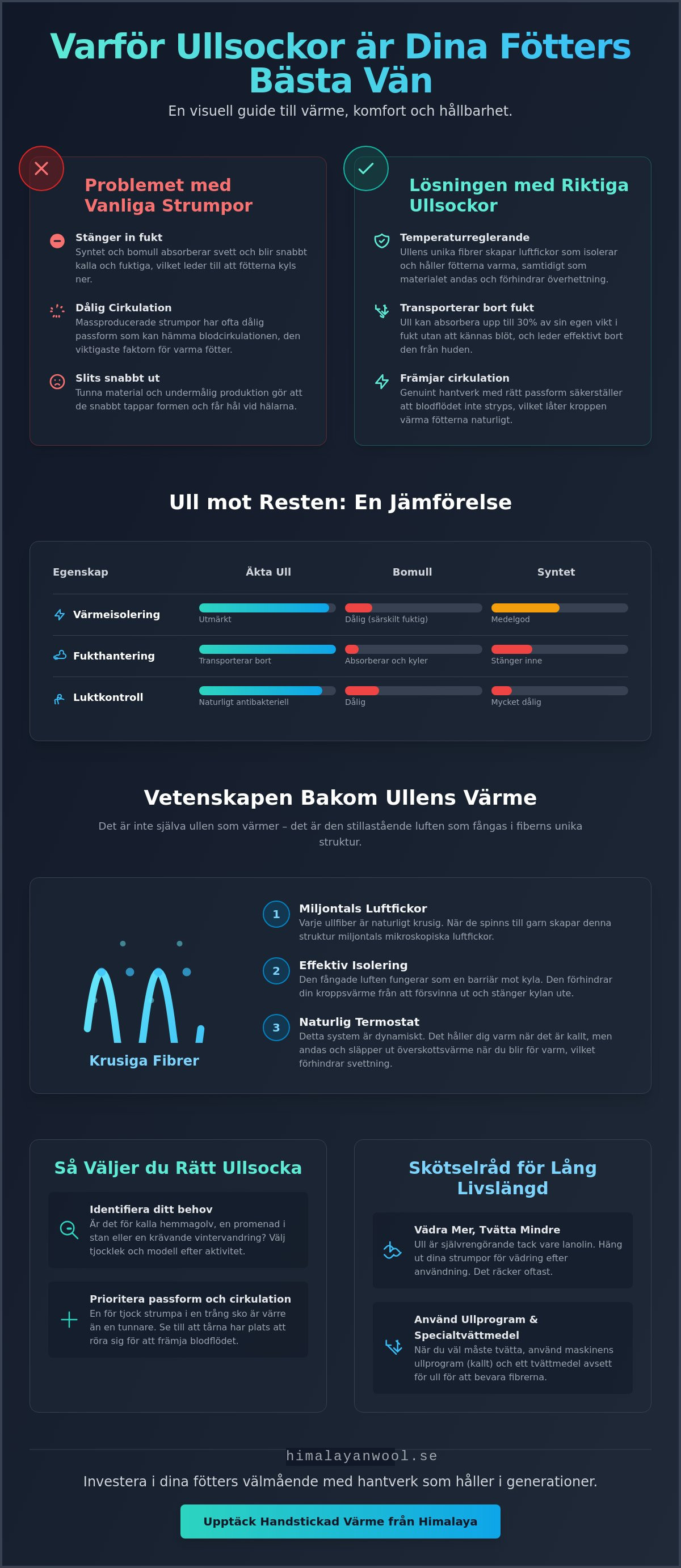
Synthetic fibers tend to enclose the foot in a tight casing, creating an environment where moisture has nowhere to go. When you get warm and start to sweat, the moisture stays against the skin. It quickly cools down, turning your socks into cold, damp wraps. This is where wool shows its true strength. Throughout humanity's long history and materials, we've learned that wool is unbeatable for retaining body heat while allowing the skin to breathe. It acts as a natural thermostat, keeping you warm without overheating.
The Science Behind Wool's Warmth
The secret lies in the unique structure of the wool fiber. Each fiber is naturally crimped, creating millions of microscopic air pockets in the yarn. It's not the wool itself that warms, but the trapped air in these pockets that acts as effective insulation. For those sitting still at a desk or with cold stone floors at home, this is crucial. Wool reflects your own body heat back to the skin instead of letting it escape into the cold room. Additionally, wool can absorb up to a third of its weight in moisture without feeling wet. This means your feet remain dry and warm even if you switch between being outdoors and indoors.
Wool vs. Cotton: An Uneven Battle
Cotton is a fantastic fiber for warm summer days, but in winter, it becomes a direct enemy to your feet. As soon as cotton gets damp, it loses all its insulating properties. It collapses and absorbs liquid, causing heat to be literally drawn from your body. Wool fibers, on the other hand, are covered with a thin layer of lanolin, which makes them water-repellent on the surface but absorbent in the core. This also makes wool naturally antibacterial. It breaks down the bacteria that cause bad odors, meaning you can wear your warm wool socks for several days in a row simply by airing them out. To understand more about nature's magic, you can delve into wool's properties and see how they function as an advanced performance material directly from the pasture.
How to Choose the Right Wool Socks: A Guide to Materials and Thickness
Choosing the right companion for your feet is an art that requires both careful consideration and an understanding of the details of craftsmanship. It's not just about buying a garment; it's an investment in your daily comfort and in a more sustainable lifestyle. To truly understand wool's unique properties, we need to look beyond just the surface. A common misconception is that the thicker the sock, the warmer it will be. The truth is more nuanced. If you force a pair of thick, warm wool socks into a boot that's already snug, the cold will paradoxically bite harder. When circulation is inhibited, the body loses its ability to warm itself. Therefore, your choice always begins with identifying where and how you will use them.
Consider your day. Is it a quiet morning at home on cold wooden floors, or a brisk walk through slush on the way to the office? Each situation requires its specific structure. A well-chosen sock should feel like a natural extension of your foot, never an impediment. By exploring our range, you can find the perfect balance between traditional craftsmanship and functional design for all of life's changes.
Different Types of Wool Socks for Different Occasions
Ragg socks are the classic symbol of Nordic winter warmth. They are often coarsely knitted and roomy, making them ideal for cold cabins or as an extra layer inside spacious boots. For modern city life, thin wool socks are often a wiser choice. They slip easily into elegant shoes but retain wool's ability to wick away moisture during a long workday. For the most extreme days, when the mercury plummets deeply, there are lined wool socks. These often combine different knitting techniques to create maximum air gaps, providing insulation that few other materials can match.
Reading the Label
When you examine the label, you'll often encounter various material blends. While pure wool is fantastic for the soul, 100% wool is not always the most practical for socks exposed to heavy wear in shoes. A blend with about 25% polyamide or nylon significantly increases the sock's lifespan and helps it retain its shape after washing. This is also where you can distinguish craftsmanship from mass production. A hand-knitted sock from a skilled artisan often has a natural elasticity and density in its stitches that a machine can rarely replicate. In 2026, we also see a clear trend where traceability is becoming increasingly important. Choosing wool certified by the Responsible Wool Standard (RWS) ensures that animals have been treated with respect and that the land they graze on is managed responsibly. Your warm wool socks thus become not only a source of warmth but also an expression of your values.
The Difference Between Craftsmanship and Mass Production: The Story from the Himalayas
In a world spinning ever faster, where factory lines churn out identical garments in rapid succession, there are places where time is allowed to move slower. In the valleys of the Himalayas, knitting is not just a way to produce clothes; it's a social fabric and an ancient tradition that binds people together. The difference between a mass-produced sock and hand-knitted warm wool socks from Nepal is about more than just material. It's about the human presence in every stitch. When a craftsman lets the needles glide through the yarn, a care is transferred that a machine can never replicate. Machine precision is cold and linear. The human touch, instead, creates an organic structure that breathes and lives with the wearer.
The journey begins high up among the mountain peaks where sheep graze in an environment that demands nature's most resilient protection. Sustainable and ethical choices here are about a symbiosis between humans, animals, and nature. By choosing small-scale production, we directly support local artisans, giving them the opportunity to preserve their cultural heritage while receiving fair conditions. It's a circular journey from the rugged beauty of the Himalayas to your everyday life in Sweden. Each pair of socks carries the scent of mountain air and the sound of diligent hands, giving the garment a soul that mass production lacks.
Slow Fashion and Warm Wool Socks
For us, sustainability is not a buzzword but a way of living and operating. By embracing slow fashion Sweden, we encourage a wardrobe built on quality rather than quantity. It's about choosing garments that have a history and are made to last over time. When you invest in handmade warm wool socks, you're opting out of the throwaway culture that depletes the earth's resources. Instead, you choose a craft that only grows more beautiful with age and carries a timelessness that resists fleeting trends.
The Craft Behind Every Stitch
Every pattern, every color choice, and every stitch in Nepal carries traces of generations of accumulated wisdom. These techniques have been refined over centuries to withstand the harshest climates on Earth. Hand-knitted socks have unique breathability because the stitches are not compressed by mechanical force; the yarn retains its natural elasticity and airiness. You can discover our entire collection of wool clothing from the Himalayas to see how this tradition permeates everything we create. It's craftsmanship you feel with every step you take, a reminder that quality requires time and human care.
Care Instructions for Your Wool Socks: How They Last for Generations
When you hold a pair of hand-knitted socks in your hand, you also hold hours of human diligence and craftsmanship. Caring for these garments is a way to show reverence for the work put in and for the animal that provided its wool. Wool is a living material. It breathes, moves, and has an amazing ability to self-clean. The biggest mistake many people make is treating their warm wool socks as if they were made of synthetic fibers. By understanding the nature of wool, you can extend their lifespan by decades.
Airing is your very best friend. Often, simply hanging the socks outside in fresh air on a damp morning is enough. The moisture helps the fibers rise, and the lanolin, wool's natural fat, effectively neutralizes bad odors. This saves both the earth's resources and the garment's delicate structure. If a stitch unexpectedly breaks after years of faithful service, don't see it as the end. A beautiful mend with needle and thread gives the socks character and tells a story of a garment worth preserving. It is the ultimate form of respect for craftsmanship.
Step-by-step: How to Wash Your Warm Wool Socks
When airing is no longer enough, it's time for a gentle wash. Follow these steps to preserve softness:
- Always use a mild wool detergent without enzymes. Regular detergents can break down wool's natural proteins and make the socks brittle.
- Wash in lukewarm water, never above 30 degrees Celsius. Avoid rubbing or wringing the garment as this can cause felting.
- After rinsing, flatten the socks on a dry towel. Roll up the towel to press out excess water, then lay them flat to dry.
Never let your socks meet the violent heat of the dryer; it's the fastest way to destroy the fibers and cause them to shrink beyond repair.
Storage and Protection
Between seasons, wool needs security. Store your socks clean and dry, preferably in a tightly sealed box or bag to protect them from moths and moisture. It's also wise to let the socks rest for a day between uses so the fibers have time to regain their natural elasticity. For those who want to deepen their knowledge of how to match their socks with other garments, there's much to learn in our guide on winter accessories wool. With proper care, your garments become not just a part of your wardrobe, but a part of your heritage.
Invest in quality that withstands the test of time by choosing our hand-knitted wool socks.
Discover Warm Wool Socks from Himalayan Wool: Hand-knitted Love from Nepal
Every pair of warm wool socks from Himalayan Wool carries a story that stretches from the snow-capped peaks of Nepal right to your doorstep. It's not just a garment for cold feet; it's a link between two worlds. Our customers often seek something deeper than what mass production can offer. They want warmth that touches the soul, created by hands that understand all the nuances of wool. By choosing our ethically produced accessories, you become part of an ecosystem that cherishes the artisan's pride and the animals' well-being.
Your choice makes a tangible difference. Every purchase supports local artisans in Nepal, often women who, through their work, gain economic independence and the preservation of their unique cultural heritage. To create a cohesive style that meets all of winter's challenges, you can combine your socks with a matching women's wool jacket. This creates a protective layer of natural materials that allows you to move freely and warmly through the landscape, whether you're on a forest walk or in the hustle and bustle of the city.
A Gift That Warms
Giving a pair of hand-knitted socks is giving care in its purest form. It's the perfect gift for someone you care about, a reminder that they deserve the very best nature has to offer. Each product comes with a story of its origin, making the gift personal and meaningful even before it's unwrapped. For those who want to give a complete experience of winter comfort, the socks can be advantageously complemented with our mittens and hats made of the same genuine wool. It becomes a kit that withstands both the test of time and the bite of the north wind, an investment in well-being that lasts for many years.
Order Your Socks Today
We strive to make your journey towards a more sustainable wardrobe as simple as possible. Through our personalized service and a well-thought-out ordering process, you can confidently choose your favorites from our range. We guarantee the craftsmanship in every stitch, which provides reassurance for those who value quality over quantity. By choosing us, you take a clear step away from fast consumption and become part of our community for slower, more conscious fashion. Let your feet experience the difference that genuine craftsmanship makes and welcome the most warm wool socks you've ever owned into your life.
Choose Warmth That Makes a Difference for Both Feet and Soul
When winter's chill bites, the choice of socks is more than just a practical detail; it's a conscious decision about what marks we want to leave in the world. We've seen how nature's own fibers and wool's unique insulating ability far surpass the synthetic materials of mass production. By understanding the importance of choosing the right materials and how careful care allows your garments to be inherited for generations, we build a wardrobe that withstands the test of time. It's about reconnecting with genuine craftsmanship and respecting processes that require time and human presence.
Your feet deserve garments created with a deeper purpose. Our products are carefully handmade by local artisans in Nepal and made from 100% natural wool from high-altitude animals. By choosing us, you actively support Slow Fashion and ethical trade that cares for both people and nature. It's an investment in quality that warms far beyond the walls of your home.
Explore our hand-knitted and warm wool socks here
Let every step you take this winter be filled with both comforting warmth and pride in having chosen a more sustainable path forward.
Frequently asked questions about warm wool socks
Why are wool socks better than cotton socks in winter?
Wool socks insulate even when they get damp, unlike cotton, which cools the foot as soon as it gets wet. Wool fibers create natural air pockets that effectively retain body heat. This makes wool a superior functional material during the most biting winter days because it wicks away moisture instead of absorbing it.
Do your wool socks feel scratchy against the skin?
Our socks are made from soft, carefully selected wool that feels gentle against the skin. Since each pair is the result of genuine craftsmanship, the fibers retain their natural softness without being scratchy. Many people experience a sense of comfort and earthiness rather than irritation when the material meets the foot, especially after they have been worn for a short time and molded to the wearer.
How often do I need to wash my warm wool socks?
You rarely need to wash your warm wool socks thanks to wool's natural self-cleaning ability. It's usually enough to hang them out to air in fresh air on a damp morning for them to feel like new again. The lanolin in the wool breaks down bacteria in a way that means the washing machine is rarely needed, which saves both the environment and the garment's fibers.
What size should I choose for my rag socks?
Choose your usual shoe size, but keep in mind that rag socks should preferably have a little extra room to create insulating air layers. Since our socks are hand-knitted by artisans in Nepal, each pair has a unique character and natural elasticity. A sock that is too tight inhibits circulation and makes you feel colder more easily, so roominess is an advantage.
Are your wool socks ethically produced?
Yes, every pair is part of an ethical production chain that supports local artisans and their families in Nepal. We believe in Slow Fashion where transparency and fair conditions are as important as the quality of the finished product. By preserving traditional methods, we create fashion that respects both people and nature, far from the anonymous factories of mass production.
Can I wear wool socks with my regular shoes?
It's perfectly fine to wear wool socks with regular shoes as long as there's room for your foot to move freely. For tighter city shoes, we recommend our thinner varieties, while the thicker socks are best suited for spacious boots or as cozy indoor socks. Remember that it's the air between your foot and the shoe that actually keeps you warm on cold days.
What do I do if my wool socks get a hole?
If your socks get a hole, we see it as an opportunity to give the garment new life through a beautiful mend with needle and thread. Mending a sock is a tribute to craftsmanship and extends its journey through life. It's a simple way to practice sustainability in everyday life and preserve a possession that carries a history.
Do wool socks help with bad odor?
Yes, wool is naturally antibacterial and effectively counteracts bad odor by breaking down the microorganisms that thrive in damp environments. Unlike synthetic materials that quickly start to smell, warm wool socks remain fresh for a long time. This makes them the perfect choice for long days on the go when you want to feel dry and secure.