

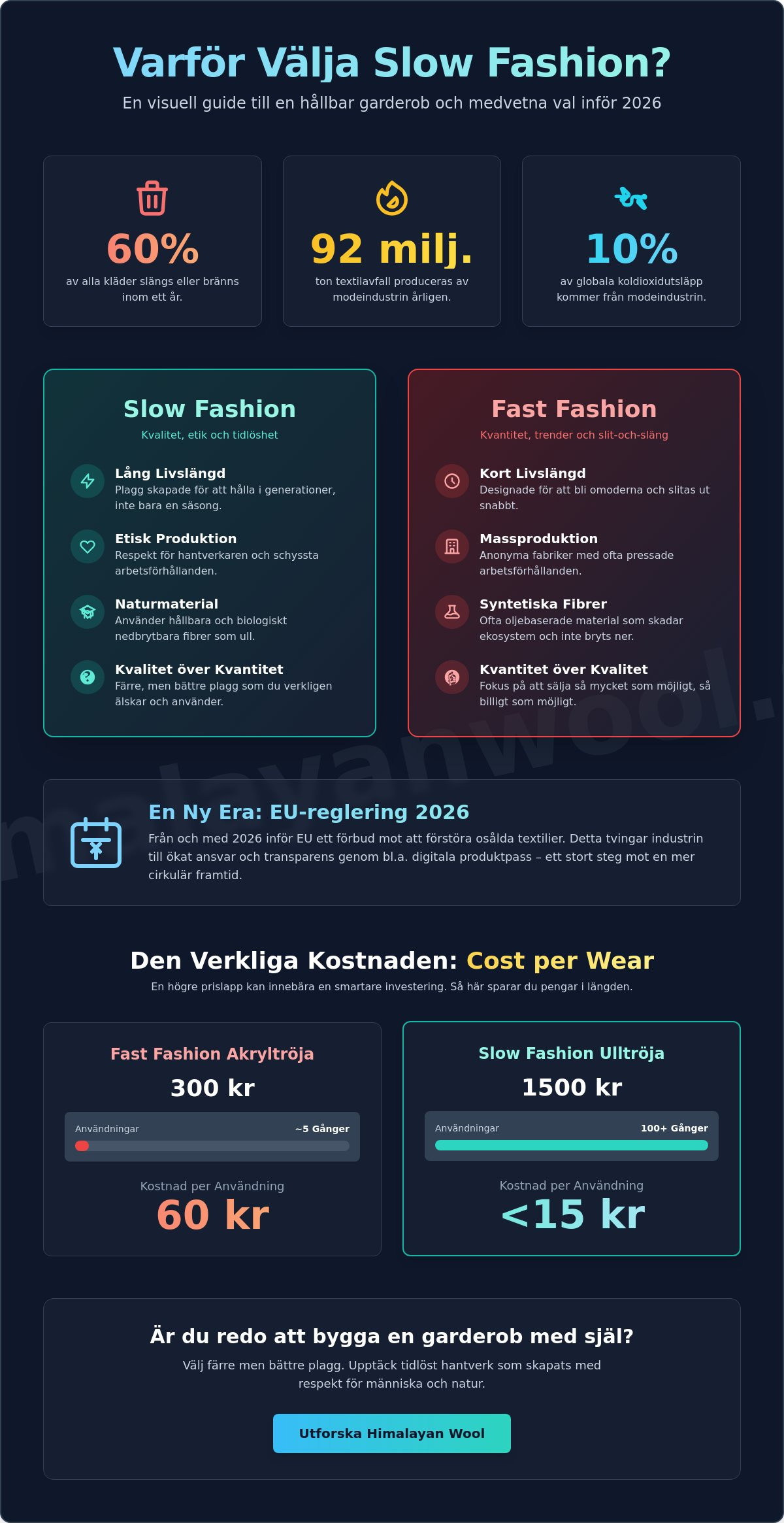
What if your wardrobe wasn't just a collection of fabrics, but a living story that breathes respect for both nature and the people behind the craft? Considering that 60 percent of all clothes today are thrown away or burned within a year, it's clear that something needs to change. You've probably felt the frustration of garments that lose their shape after just a few washes, or that strange feeling of having a full wardrobe but still nothing to wear. It's a sign that we've lost touch with the origin, material, and timeless quality of clothes.
In this guide, you will learn why choosing slow fashion is the key to creating a sustainable style that lasts for generations. We promise to show you how to transform your wardrobe from mass production to genuine quality with soul and history. We will go through the new EU rules for 2026 that will stop the destruction of unsold textiles and explain how to find garments that truly mean something to you. Join us on a journey from the majestic Himalayan peaks to your own wardrobe, where we explore the art of choosing fewer but significantly better garments crafted by master hands.
Key Takeaways
- Learn why choosing slow fashion is the most responsible choice for 2026 and how to transform your wardrobe from disposable to conscious quality.
- Discover the investment philosophy behind timeless garments in genuine wool that save money over time through their natural durability and unique sustainability.
- Understand the value of genuine craftsmanship where each handmade stitch carries generations of knowledge and respect for the people behind the product.
- Get practical tools to declutter your wardrobe with your heart and build a personal capsule wardrobe that makes it easy to choose the right outfit every morning.
- Be inspired by how clothes with soul and history create a warmer and more meaningful relationship with your own style and the world around you.
What is slow fashion and why does it matter in 2026?
Slow fashion is not just a buzzword; it's a whisper from the past that speaks of a future where we live in harmony with our surroundings. It's a philosophy that prioritizes quality, ethics, and a gentle production pace over quick profits. Many ask themselves why choose slow fashion right now, and the answer lies in a growing longing for something that actually matters. Instead of chasing the next short-lived trend, we choose clothes that carry a story, created by hands that revere the material and tradition.
The roots of this movement stretch back to the 1980s slow food movement in Italy, where people protested against the advent of fast food. In the same way, slow fashion is a protest against a fashion industry that annually produces 92 million tons of textile waste. By 2026, we will have reached a tipping point. After decades of overconsumption, we now see how conscious choices become a necessity rather than a luxury. Understanding what slow fashion is means looking beyond the price tag and instead valuing the hours of craftsmanship and the natural resources required to create a garment that lasts for generations.
Slow fashion vs. Fast fashion: A quick comparison
The difference between the two worlds is vast. Fast fashion relies on weekly collections and cheap, synthetic fibers that often end up in landfills within a year. In slow fashion, we work with timeless seasons and natural materials instead. Here, the properties of wool are central; a material that is self-cleaning, durable, and completely biodegradable. While mass production takes place in anonymous factories under pressured conditions, slow fashion emerges in small-scale craft cooperatives where every person and every stitch is respected.
The fashion industry's carbon footprint and our future
The year 2026 marks a new era of transparency. With the EU's new regulations, such as the ban on destroying unsold textiles from July 19, 2026, the industry is finally forced to take responsibility. The fashion industry accounts for a full 10 percent of global carbon emissions, but by investing in circular models, we can reverse the trend. Through digital product passports, you as the wearer now get full insight into the journey from the shepherd on the Nepalese mountain plains to the finished sweater in your hand. It's about protecting biodiversity and ensuring that the materials we wear closest to our bodies do not leave scars in nature, but instead return to the earth when their long journey finally ends.
Quality and longevity: Why slow fashion saves you money
Many people flinch at a higher price tag at first glance, but the true cost of a garment is only revealed after months and years of use. Choosing clothes with care is an investment philosophy that fundamentally means stopping throwing money away. This is where we find the most rational answer to why choose slow fashion: it's simply a better deal for your wallet over time. Instead of buying five cheap sweaters that lose their shape, color, and appeal after a few washes, you invest in a garment created by a master's hands and materials that only get more beautiful with age.
High quality often feels good directly against the skin and is visible in the details. It's about reinforced seams, traditional knitting techniques that prevent the garment from twisting, and a weight to the material that machine-produced garments rarely can imitate. By increasing our knowledge of materials and production, we can more easily create a sustainable wardrobe that doesn't require constant new purchases. When you choose garments with a soul and a history, you also choose to avoid the stress that a constantly changing and deficient wardrobe brings.
The art of calculating "Cost per Wear"
To understand the economic value of slow fashion, you can use the simple formula "Cost per Wear." If you buy a cheap acrylic sweater for 300 kronor and it pills and looks dull after two washes, each wear has cost you 150 kronor. A genuine wool sweater that costs 1500 kronor but is worn hundreds of times over several decades will instead cost a fraction of that per wear. Timeless design never goes out of style, which means the garment remains relevant in your wardrobe regardless of what the year's trend reports say.
Wool's natural durability
Wool is nature's most advanced functional material and a cornerstone of the slow fashion philosophy. The natural elasticity of the fibers allows clothes to regain their shape after use, minimizing the need for ironing or chemicals. Wool garments have a unique ability to age gracefully; they don't wear out, they evolve. Thanks to wool's self-cleaning properties, you also need to wash garments significantly less often, which saves both the fibers and the environment. You can see the difference in craftsmanship for yourself by exploring our handmade wool sweaters that are made to last for generations.
- Fiber resilience: Wool's structure protects against both stains and odors.
- Shape retention: Traditional knitting methods ensure the garment maintains its silhouette.
- Long-term value: A well-maintained wool garment can often be resold or inherited, unlike synthetic alternatives.
Ethics and craftsmanship: The difference between machine and human
Behind every garment is a person, a voice, and a story waiting to be told. In an era where mass production has made clothes anonymous and interchangeable, the choice of genuine craftsmanship becomes a deeply personal act. It is precisely here, in the invisible bond between the artisan and the wearer, that we find the heart of why choose slow fashion. A machine in a giant factory may churn out thousands of sweaters per hour, but it can never weave in the pride and cultural identity that a master artisan does.
Ethics in fashion are about much more than just numbers in a sustainability report. It's about ensuring that those who create our clothes work in safe conditions with fair, living wages. By choosing small-scale production, you support local communities and help preserve ancient methods that otherwise risk being forgotten. Every stitch becomes part of a larger context where people are valued more than profit margins and where craftsmanship is given the time it truly needs.
The artisans in Nepal: A living example
In the clear mountain air of the Himalayas, the tradition of working with wool has been lovingly preserved for generations. Here, knitting is not just work; it is an art form and a social hub. Through local craft cooperatives, women in Nepal are given the opportunity to strengthen their position in society and support their families under dignified conditions. There is an enormous difference between a sterile factory environment and a craft studio where laughter and conversation mingle with the sound of knitting needles. When you wear a sweater from here, you also carry with you a piece of Nepal's soul and the deep knowledge of its artisans.
Why "handmade" beats "mass-produced"
There is a unique beauty in what has been created by hand. A handmade wool sweater has small, subtle variations in the stitches that give the garment life and its own distinct character. Machines are programmed to optimize speed, while an artisan optimizes for beauty and durability. A master artisan sees and feels the material in a way that a digital sensor never can. They know exactly how much tension each thread needs for the garment to retain its shape for decades. Wearing such a garment gives a sense of security and authenticity that mass-produced clothes completely lack. These are clothes with a soul, created to be loved, repaired, and cared for throughout a lifetime.
How to create a sustainable wardrobe with a slow fashion philosophy
Transforming your style isn't about emptying your closet in one day and replacing everything with new items. It's a careful process of reflection where we learn to appreciate the garments we already own while becoming more selective about what we invite into our homes. The understanding of why choose slow fashion often begins in front of an overflowing wardrobe where nothing feels right. By shifting focus from fleeting trends to timeless quality, we create a collection of clothes that not only adorn the body but also soothe the soul.
A sustainable wardrobe is built on relationships. When we understand the work behind a hand-knitted sweater or the journey the wool has made from the slopes of the Himalayas, we care for the garment in a completely different way. It's about choosing natural materials like wool, linen, and organic cotton over synthetic alternatives that often lose their shape after just a few washes. By caring for your wool garments by airing them in fresh air instead of machine washing them, you extend the life of the fibers by several years and simultaneously save the Earth's resources.
Step-by-step: Your journey to a conscious wardrobe
Start by taking an honest inventory of what you actually wear. Declutter with your heart and identify which garments make you feel confident and comfortable. Instead of chasing the next fast trend, focus on building a capsule wardrobe with basic pieces that can be combined endlessly. A well-chosen women's wool jacket is an excellent example of a key piece that works across multiple seasons and only gets more beautiful with age. Let your style evolve slowly and allow yourself to invest in quality that will last for future generations.
Questions you should ask before every purchase
By 2026, transparency has become a given, but personal responsibility still rests with us as consumers. Before you let a new garment take its place in your life, pause and ask yourself these three questions:
- "Who made this garment?" Is there a person and a fair story behind the stitch?
- "Will I wear this at least 30 times?" If the answer is no, it's probably an impulse purchase that doesn't belong in a slow fashion wardrobe.
- "What happens to the garment when it's worn out?" Natural materials like pure wool are biodegradable and return to the earth, unlike synthetic fibers that leave traces for centuries.
By choosing clothes with care, you create a wardrobe that reflects your values and your unique personality. Explore our handmade wool clothing and find garments that are made to be loved and worn for a lifetime.
Himalayan Wool: Slow fashion for real – from the mountains to your wardrobe
Our journey begins where the clouds meet the majestic mountain peaks of the Himalayas. Here, in the clear and thin air, lives a tradition that has been lovingly nurtured for generations. At Himalayan Wool, we do not see wool as a simple raw material, but as a bearer of an ancient history and a deep respect for nature. When one pauses to consider why choose slow fashion, it ultimately comes down to rejecting the anonymous in favor of what has a soul. Every thread in our garments is spun with reverence for the animals living under the care of shepherds on the Nepalese highlands.
The path from the Nepalese mountains to your wardrobe is a methodical and gentle process. It is a journey that takes the time it needs, just as nature itself dictates. By working directly with local artisan families without intermediaries, we create a transparency that is rare in today's fashion world. It is not just a production chain; it is a human connection that spans continents and cultures. Our garments are more than just clothes. They are wool clothes from the Himalayas that carry the warmth of the artisans' hands and the purity of the crisp mountain air in every stitch.
Our promise of quality and ethics
We have chosen a path that goes against the demands for speed and volume of the fast fashion industry. We use traditional methods and completely avoid harmful chemicals, allowing the natural strength and luster of the wool to shine. Our collaboration is based on mutual respect and fair conditions for the master craftswomen who knit our collections. We often call ourselves "traveling sales representatives" because we personally visit the villages in Nepal, sit down with the artisans, and see how each sweater takes shape. This personal commitment is the foundation of our philosophy. It is slow fashion for real, where we refuse to compromise our roots to chase short-term profits.
Find your next favorite garment
Investing in slow fashion Sweden through Himalayan Wool means choosing a wardrobe with meaning and lasting value. We invite you to explore our handmade collections of warm jackets, soft sweaters, and timeless ponchos that are made to last for generations. Every purchase is a statement for a world where we value the artisan as much as the wearer. Discover our range of sustainable fashion and feel the difference of genuine wool that breathes the soul of Nepal in every thread. Let your clothes tell a story of quality, tradition, and a future in balance with our nature.
Choose a future with soul and timeless quality
The journey towards a more conscious wardrobe begins with a single step; a deliberate choice to look beyond fleeting trends and instead embrace what endures. We have explored how quality and natural materials not only save money over time, but also how craftsmanship gives clothes a unique identity. Understanding why choose slow fashion is fundamentally about reconnecting with nature and the people behind every stitch. It is a stand for a world where we value traditions and fair conditions as highly as beauty.
At Himalayan Wool, we are proud to bring the soul of Nepal directly to your wardrobe. Our garments are handmade by local artisans in Nepal using genuine wool from the Himalayan mountains; a timeless design created to last for generations. By choosing with your heart, you create a collection of clothes that exude comfort and authenticity, far beyond the anonymous shelves of mass production.
See our handmade wool clothing from Nepal and find your next loyal companion that will keep you warm for many years to come. Let us together celebrate craftsmanship and choose a style that truly makes a difference.
Frequently Asked Questions about Slow Fashion
What exactly does slow fashion mean?
Slow fashion is a holistic approach to fashion that prioritizes ethics, quality, and environmental sustainability over fast trends and mass production. It's about slowing down the entire process and giving the artisan the time needed to create something lasting. Instead of producing dozens of collections per year, the focus is on timeless garments that carry a story and are created to be cherished for a lifetime.
Is slow fashion always more expensive than fast fashion?
The purchase price of slow fashion is often higher, but in terms of the garment's lifespan, it is almost always the most economical choice. By investing in quality, you reduce the need for constant new purchases, which lowers your total clothing cost over time. There are many reasons why choose slow fashion, and the economic sustainability through a lower cost per wear is one of the most concrete benefits for your wallet.
How do I know if a brand truly works with slow fashion?
A genuine slow fashion brand is characterized by full transparency regarding its supply chain and production methods. Look for detailed information about where and by whom the clothes are made, as well as which natural materials are used in production. Companies that operate on a small scale, often in direct collaboration with local craft cooperatives and with timeless designs instead of weekly new arrivals, clearly show that they care about both people and the environment over quick profit.
Which materials are best for a sustainable wardrobe?
Natural materials such as wool, linen, hemp, and organic cotton are the absolute best choices for a wardrobe that will last a long time and be kind to the planet. These fibers are biodegradable and have natural technical properties that synthetic materials completely lack, such as wool's ability to regulate temperature and repel dirt. By choosing materials that age with dignity, you ensure that your clothes retain both function and beauty for many years to come.
Can slow fashion be trendy?
Slow fashion is more about personal style than fleeting trends, but that doesn't mean the clothes lack contemporary relevance or elegance. Timeless design is itself a form of trendless style that works regardless of what the major fashion houses dictate at the moment. By building a wardrobe with garments that have a clear character and high quality, you create an expression that feels both modern and genuine without having to chase the next short-term fashion fad.
How do I best care for my slow fashion wool garments?
The simplest and best way to care for your wool garments is to air them outdoors in fresh air instead of machine washing them. Wool has natural self-cleaning properties that quickly eliminate bad odors as soon as the fibers get oxygen. If you get a stain, it's best to spot-treat it gently with lukewarm water. Store your garments flat and consider using cedarwood in the wardrobe to protect the natural fibers from pests.
Why are handmade clothes better for the environment?
Handmade clothes consume significantly less energy than large-scale machine production and often generate less waste material during manufacturing itself. Since each garment is created with great care by human hands, the quality is higher, meaning the clothes don't wear out or need replacing as often. Understanding why choose slow fashion also means recognizing the value of production pace adapting to nature's and human conditions rather than the factory clock.
What is the difference between ethical fashion and sustainable fashion?
Ethical fashion primarily focuses on social aspects, such as fair wages and safe working conditions for artisans, while sustainable fashion has its main focus on environmental impacts and resource utilization. Slow fashion acts as an umbrella term that unites both these important elements into a common philosophy. This means taking responsibility for the entire chain, from animal welfare and the daily life of the herder to the material's biodegradability and the garment's final climate footprint on our planet.