

Imagine a place where the wind never rests and the cold bites so deep that only nature's toughest creatures survive. Here, on the Nepalese mountain plateaus 3,000 meters above sea level, a fiber is formed that is more than just textile; it is a biological protection system refined over millennia. Many ask the question: what is Himalayan wool and why does it feel so different from the wool we usually find on store shelves? The answer lies in the extreme environment and the traditional methods that preserve the fiber's natural strength and warmth.
We know how frustrating it is to invest in wool garments that still leave you cold, often due to blended materials that lose their shape after only a few uses. You deserve craftsmanship that is as ethical as it is durable. In this guide, you will learn all about the unique properties of Himalayan wool and why this material is the heart of authentic Nepalese craftsmanship. We will review the origin of our sweaters and socks, explain how to recognize true quality, and give you the confidence to choose garments that honor both the animals and the people who created them with their own hands.
Key Takeaways
- Discover how the extreme cold at 3,000 meters altitude forces animals to develop unique undercoat wool that provides unparalleled insulation and softness.
- Gain a deeper understanding of what is Himalayan wool and how its natural lanolin creates a self-cleaning barrier against both dirt and moisture in your daily life.
- Explore timeless Nepalese craftsmanship where hand-spun yarn and generations of knitting tradition preserve the fiber's natural strength in every sweater and sock.
- Learn to identify the difference between mass-produced materials and Himalayan wool's superior durability and exceptional warmth-to-weight ratio.
- See how the choice of genuine natural materials connects your wardrobe with a sustainable philosophy of slow fashion and respect for both animals and people.
What is Himalayan Wool? Definition and Origin
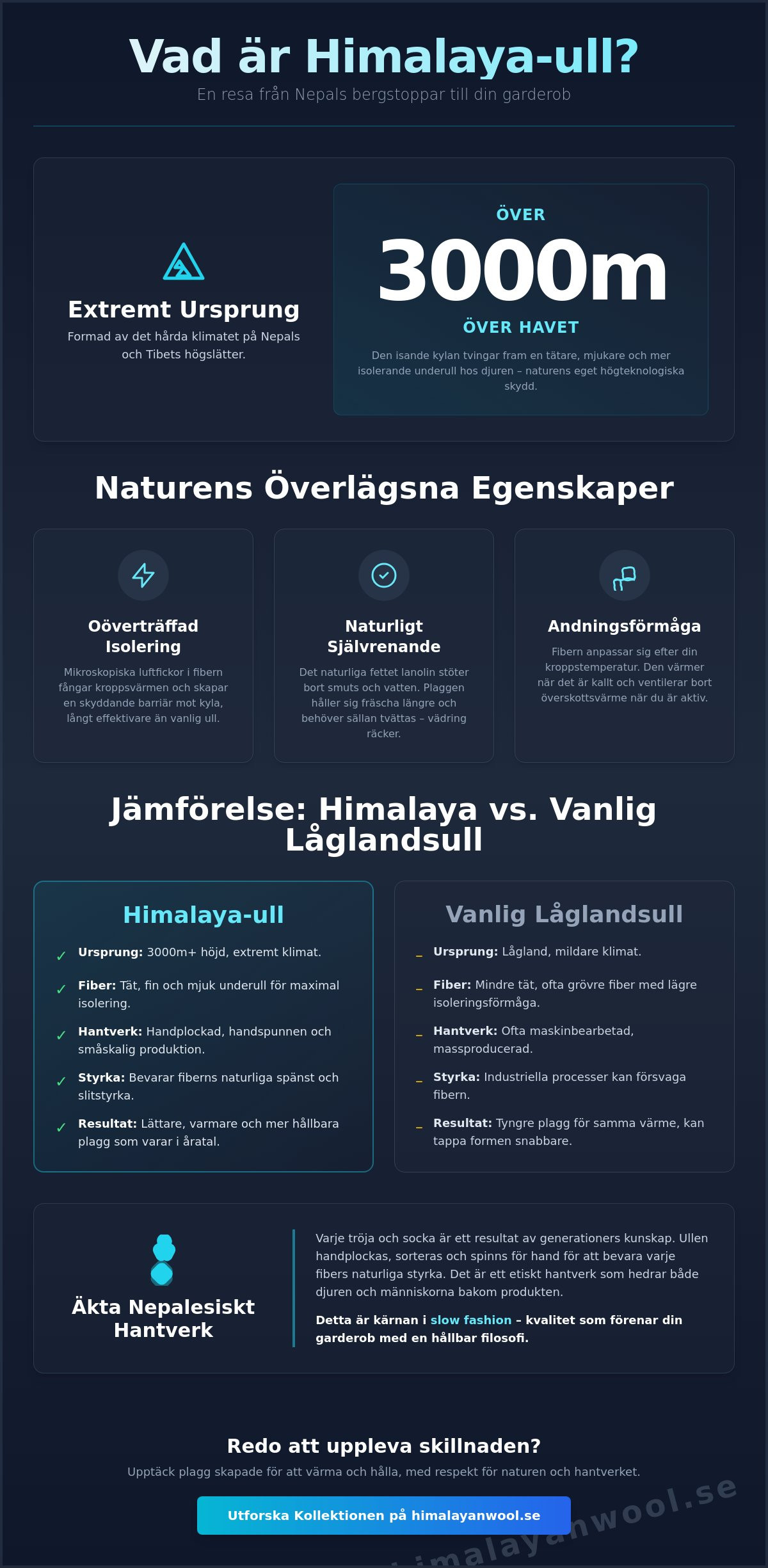
When we ask ourselves what is Himalayan wool, we touch upon something much deeper than just a textile fiber. It is a story of survival, tradition, and a unique symbiosis between humans and nature. This wool is harvested from lambs and goats, often of the Angora lineage, who live their lives on the vast high plains of Nepal and Tibet. Here, at altitudes often exceeding 3,000 meters, the air is thin and winters are unforgiving. It is precisely this extreme climate that is the secret behind the material's exceptional properties.
Unlike machine-processed wool from lowland areas, this fiber possesses a natural density that cannot be artificially replicated. It is the core of Nepalese textile tradition and an important pillar of what we call slow fashion. Each fiber is hand-picked and sorted with a care that machines can never imitate. It is interesting to draw parallels to other fibers from the same region. Just as Yak wool's properties are praised for its ability to regulate warmth under the most demanding conditions, the wool from Himalayan sheep and goats has evolved to function as a living protective barrier against the elements.
Life at 3,000 Meters Altitude: Why Location Matters
The geography of the location is crucial for quality. At 3,000 meters altitude, temperature fluctuations are dramatic. To survive the icy winds and biting cold, animals are forced to develop a coat that is radically different from that of animals in milder climates. Nature responds to the cold by allowing the animals to produce a denser and softer undercoat. This undercoat is nature's own way of creating a barrier against the cold while allowing the skin to breathe on sunny days.
Imagine the Nepalese mountain regions. Here, animals roam freely across vast lands, grazing on herbs and grasses that have grown slowly in the nutrient-rich soil. This freedom and natural diet are reflected in the strength and luster of the fibers. When we talk about what is Himalayan wool, we mean a fiber shaped by the landscape itself, a product of altitude, wind, and clean mountain air.
The Animals That Provide Us with Wool
It is primarily local sheep breeds and the characteristic Angora goats that provide us with this fantastic material. It is important to distinguish between the animals' guard hairs and the soft undercoat. The guard hairs are coarse and serve as an outer protection against rain and snow. Beneath these lies the coveted undercoat, the fine fibers we use to create our warming sweaters and soft socks. It is this undercoat that possesses the unique softness that characterizes genuine Nepalese craftsmanship.
Within small-scale Nepalese production, animal welfare is deeply rooted in the culture. Animals are not seen as a production unit but as part of the family and community. Herding follows ancient patterns where respect for the animals' natural rhythms is central. This ethical approach not only ensures the health of the animals but also that the wool retains its natural resilience and softness, far from the stressed production that often characterizes the mass market.
Nature's Own High-Tech Material: Properties
Himalayan wool is not just a fiber; it is a miracle shaped by thousands of years of evolution in the world's most demanding environment. When one asks what is Himalayan wool in technical terms, it refers to a fiber that possesses a natural complexity that synthetic materials can only dream of. While mass-produced wool often loses its most valuable properties in harsh industrial washes, Nepalese wool retains its integrity thanks to gentle handling and unique high-altitude conditions. This wool is created to protect, not just to cover.
It's no coincidence that the finest wool is found in these regions. According to a report from USDA Foreign Agricultural Service, higher quality wool is produced in regions bordering the Himalayas, where natural conditions force thinner and more elastic fibers. This natural elasticity means that garments not only provide better warmth than regular lowland wool but also retain their shape and resilience year after year, regardless of how much they are used.
Temperature Regulation and Breathability
The most remarkable property is how the material breathes. Inside each fiber are microscopic air pockets that act as a natural thermostat. When it's cold, these pockets trap your body heat, creating a protective aura of warmth around the wearer. When the temperature rises or when you move, the fibers allow excess heat and moisture to pass out through the material. That's why you never feel confined or sweaty in a truly high-quality sweater. If you want to delve deeper into the technology behind this, you can read more about wool's properties as nature's foremost functional material.
Self-Cleaning and Dirt-Repellent
Another secret behind what is Himalayan wool lies in its lanolin. This natural wool grease acts as an invisible protective film around each individual fiber. Lanolin makes it difficult for dirt and liquids to penetrate, meaning that a light rain shower or a spilled glass of water often just beads on the surface instead of being absorbed. For you wearing the garment, this means immense freedom in everyday life. Instead of wearing down the material with frequent machine washes, it's often enough to hang your sweater out to air overnight. The fresh air reacts with the fibers and neutralizes odors naturally.
This natural resistance is why a well-maintained wool sweater from Nepal can last for generations. It faithfully provides warmth even if it happens to get damp, as wool generates a small amount of heat through a chemical reaction when it absorbs water vapor. It's a reassurance that makes every garment a lifelong companion, whether you're on a windy mountain peak or in the quiet comfort of your sofa.
Craftsmanship in Nepal: From Mountain to Wardrobe
The journey from the windswept mountain peaks to a soft sweater in your wardrobe is a process that requires patience and deep knowledge. Here in Nepal, craftsmanship is not just a profession; it's a way of life. When we explore what is Himalayan wool in its finished form, we see the result of hands that have spun yarn for generations. Hand-spinning is a slow and meditative art form. By using spindles instead of industrial machines, the natural strength and resilience of the wool are preserved in a way that large-scale industry can never match. Machines tend to stretch the fibers too tightly, which can make them brittle, but the human eye and touch know exactly how much twist is needed to create a yarn that lasts for decades.
Knitting in these regions is a living cultural heritage. Patterns and techniques are not written down in manuals but are carried in memory and passed on through practical work. The difference in feel between a hand-knitted garment and a machine-made one is immediate. The handmade garment has a weight and a vibrancy in its structure that feels organic against the skin. It is slow fashion in its most genuine form, where the focus is on creating a few garments of the highest quality rather than an abundance of anonymous products. Quality takes time, and in Nepal, it is allowed to take the time it needs.
The Person Behind the Stitch
At the heart of the Kathmandu Valley and in remote mountain villages, artisan families gather. Here, production is deeply personal. We place great importance on working with fair conditions and unwavering respect for local traditions. It is the people behind every stitch who give the garments their unique character. By choosing genuine Himalayan wool clothing, you are not only supporting a craft but also the families who preserve these ancient techniques. Each sweater, hoodie, or pair of socks thus becomes a link between Nepalese culture and your own daily life.
Why Handmade is Better for Sustainability
The modern fashion industry often relies on rapid cycles and enormous waste. Our model is the exact opposite. Because we avoid mass production, we have total control over each garment, minimizing waste material and ensuring that nothing is created unnecessarily. Hand-knitting creates a unique structure that machines simply cannot imitate; the small, natural variations in the stitches make the material more stretchy and durable over time. Each garment carries a story and a human presence that makes it impossible to treat as a disposable item. Once you understand what is Himalayan wool when it has been refined by human hands, you realize that you have not just bought a piece of clothing, but a piece of timeless craftsmanship.
Himalayan Wool vs. Regular Wool: What's the Difference?
For those accustomed to conventional wool clothing from large chains, encountering Nepalese craftsmanship can be an eye-opener. It is only when you wear the material that it becomes clear what Himalayan wool is compared to wool produced at lower altitudes. The difference begins with the fiber itself. While industrial wool often comes from animals in milder climates, wool from the Himalayan mountain regions has a natural density and fiber length that is unique. These long fibers create a yarn that is exceptionally durable and possesses a warmth-to-weight ratio that few other materials can match. This means you get maximum insulation without the garment feeling heavy or bulky.
This balance between lightness and extreme warmth makes the material the obvious choice for more robust outerwear, such as a timeless women's wool jacket. Here, the resilience of lamb's wool is often combined with the softness of angora, creating a surface that is comfortable against the skin while resisting wind and cold. It is a quality that feels alive and adapts to your body temperature in a way that synthetic blends never achieve.
Durability and Lifespan
In industrial production, wool fibers are often thinned out or blended with acrylic to reduce costs, resulting in garments that quickly lose their shape or start to pill. Authentic Himalayan wool has a natural elasticity and strength that means it rarely pills in the same way as cheaper alternatives. Each garment is an investment for the future. Instead of buying a new sweater every season, you choose a craft that only becomes more beautiful with age. This is sustainability that is not just about the environment, but about respect for the material and the time it takes to create something that truly lasts.
Heat Capacity in Extreme Cold
When the Nordic winter bites hardest, a thin merino sweater is rarely enough. This is where Himalayan wool shows its true strength. By using wool that is made to withstand sub-zero temperatures at 3,000 meters altitude, you get natural protection adapted for the toughest conditions. The difference in heat capacity between a regular sweater and a robust wool sweater from Nepal is significant. The robust structure traps more air, providing deeper and more stable warmth that keeps you safe even during long days outdoors.
Do you want to experience the difference yourself and invest in a garment that combines tradition with unparalleled function? Explore our hand-picked assortment of hand-knitted wool clothing and find your faithful companion for many winters to come.
Himalayan Wool: Our Promise of Authenticity and Quality
Himalayan Wool is more than just a name on a label; it's a promise that the material you wear against your skin is the result of an unbroken trust between us, nature, and the Nepalese artisans. Many ask what is Himalayan wool really in a world saturated with mass production and synthetic blends? For us, the answer is simple. It is the purest form of craftsmanship, where every fiber has been selected directly from local sources in Nepal to ensure its unique character is preserved all the way to you. We choose our wool with an eye for detail that machines can never perceive, from the first gentle spinning of the yarn to the last, handmade stitch.
Our philosophy rests firmly on the principles of slow fashion Sweden, where we prioritize quality and timelessness over fleeting trends. At a time when the textile industry faces major changes, such as the new and stricter requirements in GOTS 8.0 from March 2026, we have already laid the foundation for responsible production. As Nepal prepares for its graduation from the least developed countries category in November 2026, we see it as our primary task to continue supporting local businesses by upholding international standards for both working conditions and environmental considerations. By choosing a product from Himalayan Wool, you can feel confident that you are wearing a garment created with respect for both people and the planet.
Our Journey from the Himalayas to Your Everyday Life
Our path has never been the easiest, but it has always been the most personal. We have chosen to work on a small scale to maintain close contact with the artisan families in the Kathmandu Valley. This transparency is your guarantee of authenticity. By avoiding anonymous intermediaries, we know exactly where the wool comes from and who has invested their time and soul into knitting your sweater or hoodie. It is this small scale that fosters quality. Every garment undergoes a meticulous inspection where we ensure that the wool's natural resilience and softness are intact, so you can enjoy its warmth for many years to come.
Find Your Signature Wool Garment
Whether you're looking for a robust wool jacket for cold winter walks or a soft sweater for cozy evenings at home, every piece in our collection carries a bit of the magic of the Himalayas. Understanding what Himalayan wool is also means understanding how to care for it. By following our simple advice on airing and gentle washing, you allow the wool's natural fats to continue protecting the fibers, which makes the garment only more beautiful over time. Do you want to complete your wardrobe with details that make a difference? Discover our entire collection of winter wool accessories and let nature's most warming craft become a part of your own story.
Wear a Story of Timeless Warmth
Choosing a garment created from nature's own protective system is a tribute to both the finesse of craftsmanship and the raw strength of the mountains. Now that you have a deeper understanding of what Himalayan wool is, you see that every sweater and hoodie carries a journey from 3,000 meters above sea level right to your own wardrobe. It's a fiber that not only insulates against Nordic cold but also breathes and lives with you through the years. By prioritizing handmade quality over mass production, you choose a path where sustainability and ethics are as self-evident as the softness of the wool.
We are proud to preserve this Nepalese cultural heritage and offer garments that are handmade in Nepal with a care that can be felt in every stitch. Experience the difference with genuine high-altitude wool and enjoy free shipping on purchases over SEK 1500. Let your next garment be more than just a piece of clothing; let it be a loyal companion that warms both body and soul.
Explore our handmade Himalayan wool clothing here
Frequently Asked Questions About Himalayan Wool
Is Himalayan wool itchy against the skin?
No, genuine Himalayan wool is often perceived as much softer than regular wool thanks to the fine undercoat from animals living at high altitudes. Many of our garments also contain a blend with angora, which provides a silky feel against the body. If you are extremely sensitive, a thin cotton shirt underneath can be a good complement, but most people appreciate the natural softness directly against the skin.
Why are clothes made of Himalayan wool more expensive than regular wool?
The price reflects the extensive manual labor and the extreme conditions required to produce the raw material. When you understand what Himalayan wool is, you quickly realize that it involves hand-spun yarn and hand-knitting that can take weeks to complete for a single garment. It is an investment in a craft that lasts for generations instead of a season, making it more cost-effective in the long run.
How do I best wash my Himalayan Wool product?
You should primarily air your garment outdoors instead of washing it, as the wool's natural lanolin is self-cleaning and neutralizes odors. If washing is still necessary, we recommend a mild wool shampoo and gentle hand washing in lukewarm water. Avoid wringing out the garment; instead, press out the water with a dry towel and let it dry flat to preserve its original shape and elasticity.
Is Himalayan wool ethically produced?
Yes, production takes place on a small scale where the animals live freely and are herded according to ancient traditions on the Nepalese high plains. We work directly with local artisan families to ensure fair conditions and animal husbandry based on mutual respect. This small-scale approach gives us full insight into the entire chain, from the pasture at 3,000 meters above sea level to the finished seam in your sweater.
What is the difference between angora wool and regular sheep wool?
Angora wool comes from Angora goats and is characterized by its extreme lightness and silky luster, while regular sheep wool is often more robust and curly in its structure. In our collections, we often combine these fibers to achieve a perfect balance between durability and softness. This creates a material that insulates effectively against cold without feeling heavy or bulky to wear.
Does Himalayan wool really protect against wind and rain?
The material has a natural resistance to the elements thanks to the natural lanolin that encapsulates the fibers and causes lighter rain to bead on the surface. The dense, hand-knitted structure also provides impressive protection against cold winds. Although it does not replace a technical rain jacket, the wool retains its unique ability to warm even if it gets damp during a walk.
Why is it called slow fashion?
It is called slow fashion because every step in its creation is allowed to take the time required to achieve the highest possible quality without shortcuts. From the hand-picking and sorting of the wool to its hand-spinning and knitting in Nepalese mountain villages, it is a process far removed from the pace of mass production. It's about creating timeless garments that are worn with pride and respect for the artisan for many years to come.
Can I wear Himalayan wool in the summer?
Yes, thanks to wool's natural ability to regulate temperature, thinner garments work excellent even on cooler summer evenings or by the coast. The fiber breathes and wicks moisture away from the body, making you feel comfortably tempered regardless of surrounding fluctuations. This is one of the most fascinating aspects when exploring what Himalayan wool is and its ability to adapt to the wearer's needs.