

What if your mittens could carry the story of the snow-capped peaks of the Himalayas and the diligent hands that carefully shaped each individual stitch? Many of us have experienced the frustration of constantly having cold fingers or feeling trapped in sweaty synthetic materials that quickly lose their shape and break. If you're looking for more than just a mass-produced accessory, handmade wool mittens from Nepal are the answer to your desire for both genuine functionality and a living history.
It's easy to understand why one seeks out nature's own solutions when winter's cold bites hardest. In this guide, you'll learn why these unique mittens are the ultimate choice for both your hands and our shared planet. We'll take you on a journey from the high mountain landscapes to the small-scale workshops of artisans; here you'll see how traditional knowledge and fair conditions create sustainable garments that truly last over time. By choosing craftsmanship over mass production, you give your hands warmth that not only feels good but also genuinely makes a difference.
Key Takeaways
- Learn how nature's own technology, through thermoregulation and protective lanolin, keeps your hands dry and warm even on the most demanding winter days.
- Discover why handmade wool mittens from Nepal offer a superior fit and durability compared to mass-produced alternatives, thanks to traditional knitting techniques.
- Understand the importance of ethical fashion and how your investment in genuine craftsmanship creates fair conditions for local producers in Nepal.
- Get practical guidance on how to choose the right model and care for your wool mittens so that they remain a faithful companion for many years to come.
Why choose wool mittens handmade in Nepal?
Craftsmanship in Nepal is deeply rooted in a daily life where nature sets the rules. It is here, in the shadow of the world's highest peaks, that the art of taming wool's raw power has been refined over centuries. When you choose handmade wool mittens from Nepal, you are not just investing in a garment for winter; you are wearing a piece of cultural history on your hands. Unlike mass-produced alternatives that often rely on synthetic blends, these mittens are made from pure natural materials shaped by human hands. It is a tribute to the slow and the authentic.
In a world that spins ever faster, Nepalese production represents a counterpoint to the throwaway culture. By working with small-scale groups of artisans, where organizations like Yes Helping Hand employ over 180 skilled individuals, garments are created with a soul that no machine can replicate. Every stitch is a conscious choice. This approach means that the mittens are not only beautiful to look at but also built to last for many years. It is the essence of a sustainable wardrobe where aesthetics and practical function merge into a timeless whole.
The difference between warmth and insulation
Many believe that the thickness of a material determines how warm it is, but the real magic lies in the fiber's structure. Wool is a living fiber with a natural crimp that creates millions of tiny air pockets. These pockets trap body heat and create an effective insulating layer against the cold outside. For those who want to deepen their knowledge of the fiber's unique structure, you can learn more about wool and its fantastic thermal properties. Synthetic materials often lack this ability; they may feel warm at first, but as soon as you get even slightly sweaty or if the mitten gets damp from snow, they start to conduct heat away from the skin. Wool, on the other hand, can absorb up to thirty percent of its own weight in moisture without losing its insulating properties, which means your hands remain warm and comfortable even under demanding conditions.
The soul of craftsmanship in every stitch
There is a tangible difference between a product churned out by a machine and a mitten knitted by hand. A machine-knitted mitten is often stiff and lacks the natural elasticity required for the garment to conform to the wearer. In Nepal, production is permeated by a deep respect for the raw material. The artisan senses the wool's variations and adjusts the tension of each stitch accordingly. This results in a fit that only gets better with time. By choosing these garments, you contribute to a movement that values craft traditions and the environment, something you can read more about in our guide on slow fashion Sweden. It is a choice that warms both the hands and the heart.
Wool's magical properties: Nature's own technology
The wind sweeping over the Himalayan ridges is merciless, and the cold penetrates deeply, but nature has, over millennia, developed a solution that no lab-made fiber can match. The sheep grazing on these barren slopes live in an environment where temperature differences between day and night are extreme, requiring an armor of wool that is both dense and full of life. It is this raw material that makes handmade wool mittens from Nepal one of the most effective protections for your hands. The fiber itself is Nature's own technology, created to preserve warmth and protect life in the most inhospitable environments known to man.
Wool from high altitudes differs significantly from the wool found in lower-lying areas. It is richer in crimped fibers that create a microclimate closest to the skin. By choosing handicrafts from Nepal, you get to experience the full potential of the material, where every fiber has been preserved in its natural strength. It's about breathability that actively counteracts stuffiness and moisture, preventing the sticky feeling that often occurs in acrylic or polyester mittens.
Thermoregulation for frozen fingers
Wool is not static. The fiber reacts to your body heat and the ambient temperature by expanding or contracting, creating a dynamic barrier that breathes in sync with your own needs. When the cold bites, the fibers close to trap warm air, while in milder weather, they open up to allow excess heat to escape. If you want to deepen your understanding of this phenomenon, you can read more about wool's properties here. It is this intelligence in the material that makes a pair of hand-knitted mittens feel equally comfortable during a damp autumn walk as in biting January cold.
Self-cleaning and odor-free
One of the most fascinating aspects of wool is lanolin, the natural fat that surrounds each fiber and acts as a protective barrier against dirt and moisture. Lanolin also has antibacterial properties that keep the mitten fresh even after long periods of use. Instead of washing your mittens, it is often enough to hang them out to air for a while; the moisture in the air helps the wool to clean itself and regain its natural resilience. This saves both the environment and the garment's lifespan.
Wool's chemical composition largely consists of the protein keratin, the same substance found in our own hair. What makes wool unique is its ability to neutralize odor molecules through its amino acids. In addition, the fiber core can absorb large amounts of water vapor without the material feeling wet against the skin.
Wearing a pair of mittens that breathe and care for your skin is a luxury that makes every winter day a little easier. You can explore our range of wool mittens to find a model that combines this ancient technology with your personal style.
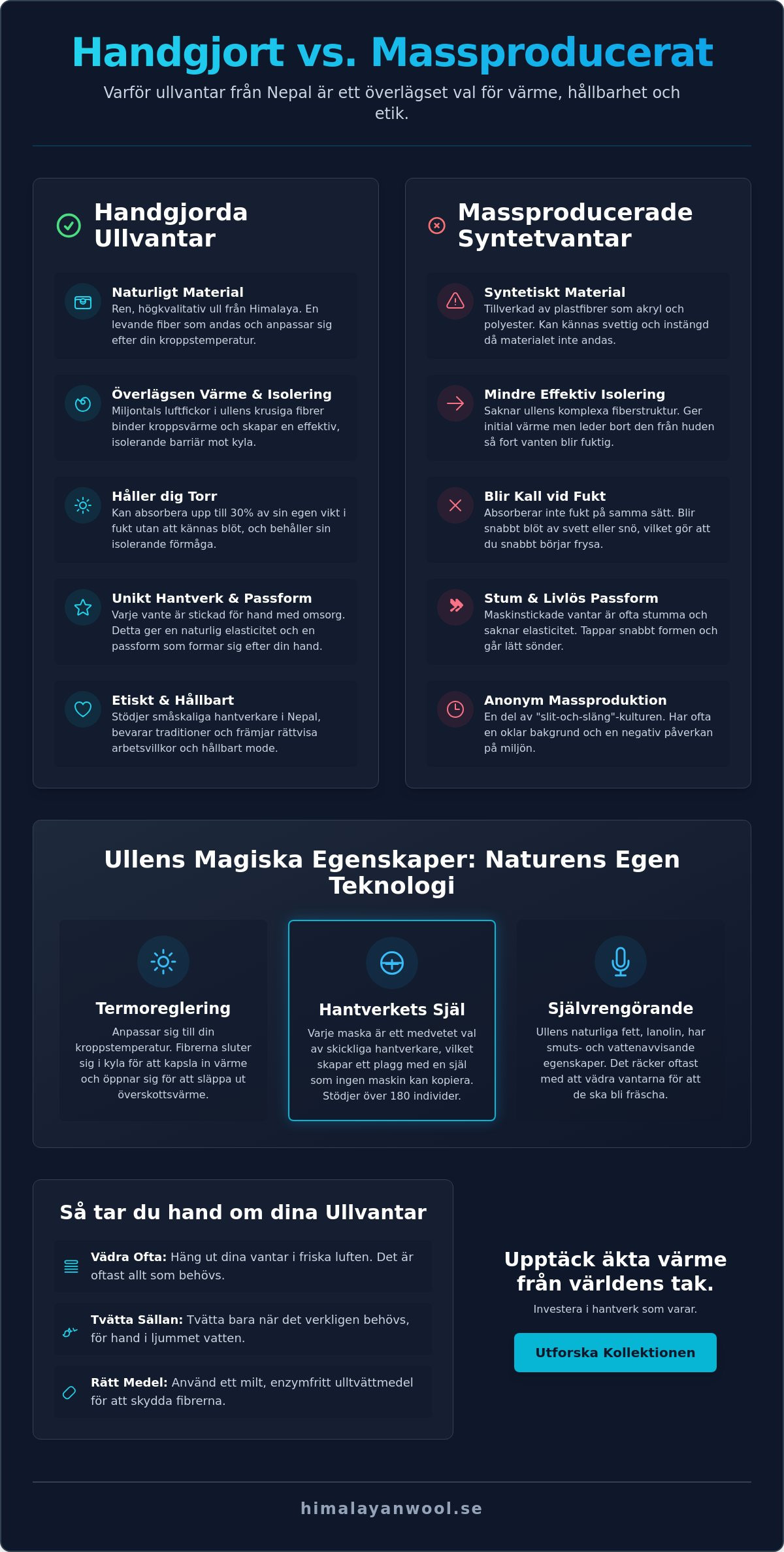
Craftsmanship vs. Mass Production: Why the details matter
In the fast-paced modern world, we often forget what it means for an object to have actually been created by a human. When you hold a pair of handmade wool mittens from Nepal, you immediately feel the difference from the mass-produced goods that roll off industrial lines in an endless stream. Mass production prioritizes speed and uniformity, often resulting in stiff garments that lack the ability to breathe and move with the body. Craftsmanship, on the other hand, is about understanding the unique character of the material and giving each mitten the time it deserves. It is a process where human presence replaces mechanical coldness.
There is something deeply meaningful in knowing that your mittens have grown stitch by stitch under diligent fingers in a remote mountain village. It creates an invisible link between you, the wearer, and the artisan behind the production. Ultimately, investing in quality is about respect; respect for the artisan's time, respect for the animals that provided the wool, and respect for your own wardrobe. By buying less but better, you ensure that your clothes are not just temporary guests in your life, but faithful companions that age with dignity and beauty.
Traditional methods from Nepal
In Nepalese villages, knitting is not just work; it is a social act and a cultural heritage that lives on through the hands of skilled artisans. The knowledge of how to best handle local wool is passed down from generation to generation, with each family often having their own specific patterns and techniques. By choosing these products, you contribute to preserving a craftsmanship that might otherwise be stifled by the global mass industry. For those who want to understand the broader context of these garments, there is more to read about wool clothing from the Himalayas and how it is interwoven with the concept of slow fashion.
Quality you can feel
A machine-knitted seam is often a weak link; it is programmed to be efficient but lacks the inherent strength of a handmade join. When a person knits, the tension of the thread can be adjusted to the natural variations of the wool, providing a density that effectively keeps out the wind without making the mitten stiff. Handmade mittens retain their elasticity significantly longer than industrial counterparts because the fibers have not been subjected to the harsh chemical treatment or mechanical stresses required in a factory. The softness of a handcrafted yarn is also more palpable, as it has often been spun with a gentleness that preserves the wool's natural lanolin and resilience in each individual fiber.
Choose the right wool mittens and care for them
Choosing the right pair of handmade wool mittens from Nepal is a personal journey that begins with understanding your own needs in facing the winter cold. It's about more than just size; it's about how the garment should interact with your daily life and movements. Wool is a living material that requires a touch of care to retain its soul and function over time. By giving your mittens the right care, you ensure they remain a faithful companion through many frosty mornings.
A unique characteristic of handmade wool mittens from Nepal is how they get to know your hand over time. At first use, they may feel somewhat stiff, but with body heat and movement, the fibers stretch and mold to your specific anatomy. It's an organic process that makes the mitten fit like a second skin after some wear. This is one of the main advantages of craftsmanship over mass production; the material is allowed to be elastic and supple in a way that industrial fibers rarely achieve.
Find your perfect model
The choice between different models is often governed by the balance between extreme warmth and practical dexterity. For truly cold days, mittens are the obvious choice. By letting the fingers rest together, a common heat source is created that effectively combats cold hands. If, however, you need precision, perhaps to handle keys or a phone during a city stroll, fingerless gloves offer a dexterity that makes everyday life easier without compromising the material's natural advantages. Many also choose to complement their wardrobe with other wool winter accessories to create a unified and protective ensemble against the elements.
Simple care instructions for a long lifespan
Wool's ability to self-clean is one of nature's most ingenious inventions. Instead of routinely washing your mittens, you should take advantage of damp weather. By hanging them out to air when the humidity is high, you help the fibers open up and release particles and odors. If an accident occurs and washing becomes necessary, always use lukewarm water and a mild wool shampoo.
- Hand wash gently in max 30 degrees without wringing the garment.
- Gently squeeze out excess water with a dry towel.
- Always dry the mittens flat to prevent them from losing their shape.
When the spring sun begins to warm and it's time to put away winter garments, storage is crucial. Wash the mittens one last time if they are dirty, as residual skin flakes can attract moths. Store them in a sealed bag or box, preferably with a piece of cedar wood. This protects the craftsmanship from unwelcome guests and ensures they are ready to warm you again when the first frost returns. Discover our entire range of sustainable garments at himalayanwool.se and invest in lasting quality.
Himalayan Wool: A journey from the roof of the world to your everyday life
The journey for a pair of handmade wool mittens from Nepal begins long before they reach your hands in the Scandinavian winter cold. It starts on the wind-swept slopes of the Himalayas, where nature's raw beauty meets a craft tradition preserved for generations. Our philosophy rests on the idea of combining this ancient Nepalese knowledge with the practical needs of our Nordic everyday life. It's about building a bridge between two worlds, where each garment carries a story of patience, respect, and human presence. Here, the product is not just an object; it is the result of a slow and meticulous process.
When you put on your mittens, you also carry the artisan's pride. Since each pair is hand-knitted, no two pairs are exactly alike. The small variations in the stitches are not flaws, but signatures from the person who created them. This creates a unique connection where the craftsmanship is allowed to be personal and authentic. By choosing these garments, you directly contribute to preserving a cultural heritage that might otherwise disappear in the shadow of mass production.
Warmth with a conscience
Transparency is at the heart of our business. We collaborate with social enterprises like Yes Helping Hand, an organization founded in 2011 that now provides meaningful employment for over 180 skilled artisans in Nepal. By adhering to the ten principles of Fair Trade, we ensure that production takes place under fair conditions, where artisans receive a fair wage and work in a safe environment. Your investment in handmade wool mittens from Nepal makes a tangible difference for local communities and helps create economic stability in regions where alternatives are often few. It is warmth that extends far beyond the material's insulating properties. For us, quality and ethics are inseparable, something you can read more about in our in-depth article on wool sweaters and quality.
Discover our range
We invite you to experience the difference of a material that has retained its natural power. Our most popular models include everything from classic mittens, providing maximum warmth on the coldest days, to flexible fingerless gloves for the city's pulse. Each pair is crafted to age with dignity and become more beautiful with each passing year. By choosing craftsmanship over fast consumption, you take a conscious step towards a more sustainable and meaningful wardrobe. Explore our handmade wool mittens here and find your next faithful companion for all of winter's adventures.
Embrace winter with warmth and meaning
Winter's chill doesn't have to be a hindrance; instead, it can be an invitation to pause and appreciate the authentic. By choosing handmade wool mittens from Nepal, you're embracing warmth deeply rooted in Himalayan traditions and nature's own intelligence. We've seen how wool's thermoregulating ability and lanolin's natural protective properties create a functionality that no laboratory-produced material can surpass. Simultaneously, every stitch carries a story of fair conditions and a living cultural heritage, where the artisan's diligent hands create something that industrial mass production can never replicate.
It's time to let your hands experience the difference between a soulless mass-produced item and a garment created with genuine care. With 100% natural wool from the roof of the world and a unique design that adapts to your movements, these mittens become a long-term investment for both your own comfort and for the local communities in Nepal that carry on the craft. Let winter's adventures begin with the security of materials that breathe and warm deeply, no matter how harsh the wind bites outside the door.
See our unique handmade wool mittens from Nepal
Frequently Asked Questions
Are wool mittens from Nepal scratchy against the skin?
Wool mittens from Nepal are usually perceived as very soft because Nepalese wool has a finer fiber structure than the coarse wool often used in mass production. Many of our models also feature a soft fleece lining to provide an extra comfortable feel against the skin. This means that even people with sensitive skin can enjoy the warmth of the craft without discomfort or irritation during cold winter days.
How do I choose the right size for handmade mittens?
You should choose a size that fits snugly upon first wear, as the wool naturally molds to your hand through body heat and movement. Handmade mittens have a unique elasticity that allows them to stretch slightly and create a personalized fit after just a few days of frequent use. If you are between two sizes, we usually recommend the smaller one to prevent the mitten from becoming too roomy over time.
Can I machine wash my Nepalese wool mittens?
No, you should avoid machine washing your handmade wool mittens, as the mechanical action and heat can cause the wool to felt and shrink unexpectedly. Hand washing in lukewarm water with a gentle wool shampoo is the safest way to preserve the craft's shape and the material's natural lanolin. Often, simply airing the mittens outdoors in fresh air is enough for them to regain their natural freshness.
Why are mittens warmer than gloves?
Mittens are warmer because your fingers share the same space and can warm each other through direct body contact inside the mitten. In gloves, each finger is isolated, causing them to cool down faster as they cannot benefit from the shared warmth of the hand. Additionally, a larger air gap is created in a mitten, which acts as an effective insulating layer against the external winter cold.
How long do a pair of handmade wool mittens last?
A well-maintained pair of handmade wool mittens from Nepal can last for many seasons thanks to the high quality of both raw material and manual knitting. Since the artisan manually adjusts the tightness of the stitches, the final result is more durable than industrially manufactured mittens, which often have thinner threads. By avoiding unnecessary washing and storing them protected from moths during the summer, you ensure they remain a faithful companion for a long time.
Is the production in Nepal ethically defensible?
Yes, our production is based on Fair Trade principles, where transparency and fair wages are central to our collaboration with artisans. We work closely with small-scale workshops and social enterprises in Nepal to guarantee good working conditions and promote women's economic independence in the region. Your investment supports local communities and helps preserve a valuable craft tradition that creates secure and meaningful employment for many families.
Do wool mittens still warm even if they get wet from snow?
Yes, wool's unique ability to trap air in its fibers means it continues to insulate and warm even when the material becomes damp. This natural material can absorb a significant amount of moisture without feeling wet against the skin, which is a huge advantage when playing in the snow or during damp winter walks. This distinguishes wool from synthetic fibers, which quickly lose their warming function and begin to conduct heat away as soon as they are exposed to moisture.