

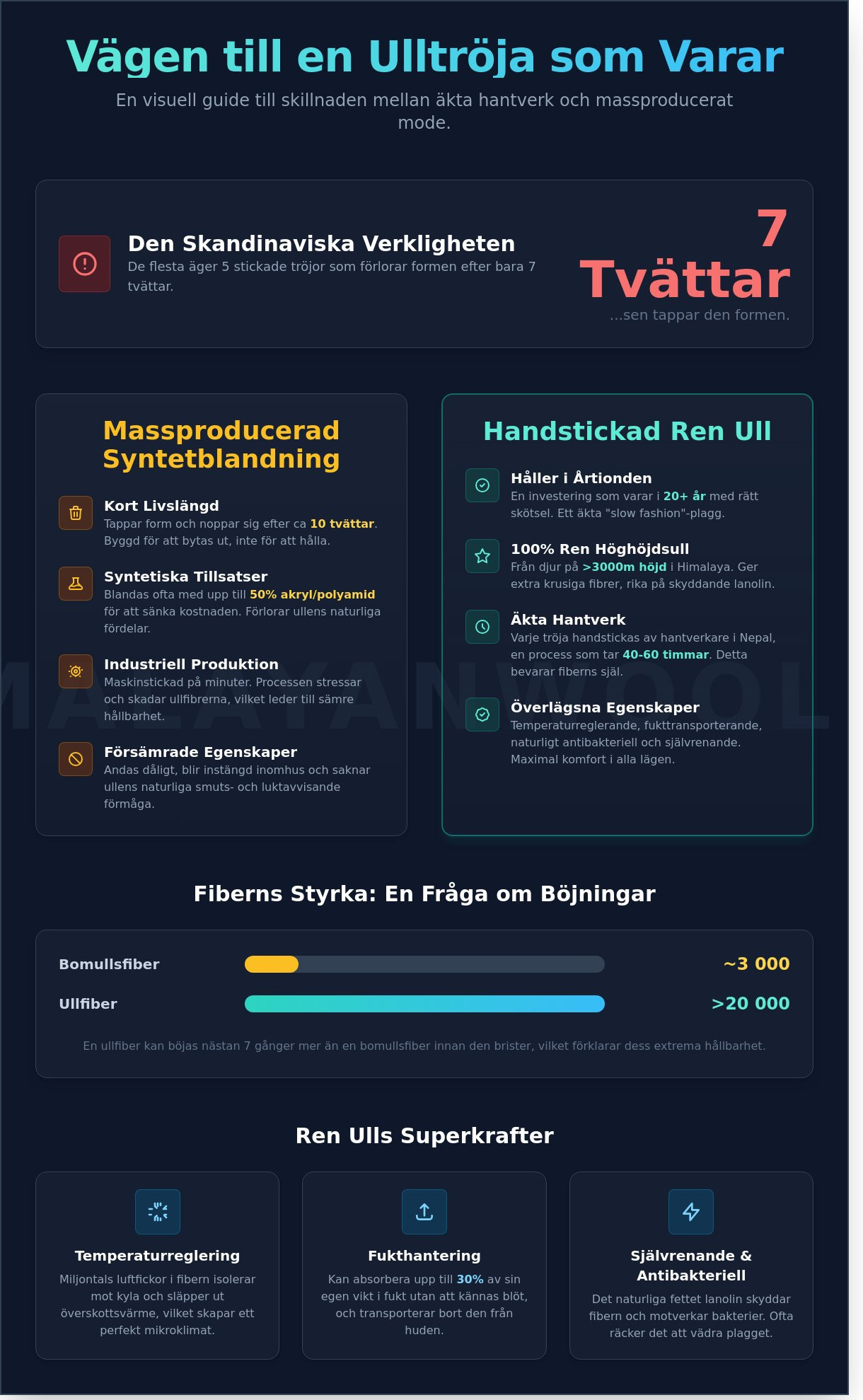
Most men in Scandinavia own, on average, five knitted sweaters that lose their shape after only seven washes; a truth that chafes more than the cheapest synthetic blend against the skin. This is the bitter consequence of a fashion industry that prioritizes speed over the craftsmanship required to tame nature's finest fibers in a men's wool sweater with zipper. We understand the frustration of garments that pill before the season is over, zippers that fail when the cold bites, and sweaters that feel stuffy as soon as you step into a warm environment.
In this guide, we show you the way to a garment that actually lives up to the promise of timeless quality and natural temperature regulation for 20 years or more. By understanding the difference between industrial mass production and the genuine craftsmanship from the master's hands in Nepal, you can make a choice that is both ethically sound and stylistically superior. We explain how the right material choice eliminates itchiness, why traditional methods create durability that outlasts fleeting trends, and how to find a sweater that carries the soul of Nepal in every thread.
Key Takeaways
- Learn how the right design makes it easy to regulate body temperature and why this is the ultimate garment for a versatile layering style.
- Discover the secret behind the craftsmanship from Nepal and why wool from high-altitude animals has unique properties that protect against cold.
- Get practical tips for choosing between half-zip and full-zip to find a men's wool sweater with zipper that perfectly suits your everyday life.
- Explore how to maximize the lifespan of your wool garments by utilizing the material's self-cleaning ability and proper washing methods.
- Understand the deeper meaning of slow fashion and how your sweater carries a story of fairness, tradition, and respect for nature.
Why choose a men's wool sweater with zipper?
A men's wool sweater with zipper is more than just a practical garment; it is a living craft that unites nature's raw strength with timeless aesthetics. The zipper offers unique flexibility in everyday life. It allows you to quickly regulate your body temperature when moving between chilly morning walks in -4 degrees Celsius and heated indoor environments. This versatility makes the garment an indispensable companion that works equally well over a crisp shirt in the office as a reliable mid-layer during a hike.
Wool's natural durability is a central part of its charm. A single wool fiber can be bent over 20,000 times without breaking, compared to cotton, which often gives way after only 3,000 bends. This is slow fashion in its truest sense. By choosing a men's wool sweater with zipper, you invest in a garment that resists dirt and odor in a way that synthetic materials can never match. Instead of frequent washing, it is often enough to let the sweater air out overnight to regain its original freshness.
The difference between natural materials and synthetic blends
In today's fashion industry, wool is often blended with up to 50% acrylic or polyamide to cut costs, but these blended materials quickly lose wool's primary advantages. Pure wool contains lanolin, a natural fat that protects the fibers from moisture and makes the garment naturally antibacterial. While a synthetic sweater often loses its fit and starts to pill after 10 washes, pure wool retains its structure and warmth for decades if cared for with respect.
Wool's natural temperature regulation
The crimped structure of wool fibers creates millions of microscopic air pockets that act as an effective barrier against both cold and extreme heat. The material has an outstanding ability to transport moisture; wool can absorb up to 30% of its own weight in water vapor without the fabric feeling damp against the skin. When your body temperature rises, the small scales of the wool fibers open up to actively release excess heat and regulate your personal microclimate. This keeps you dry and comfortably warm whether you are sitting still or moving.
The craftsmanship behind a knitted sweater with zipper
A machine-knitted sweater may at first glance look perfect in its symmetry. But beneath the surface, it often lacks the density and soul that only human hands can bring forth. When a skilled artisan in Nepal creates a men's wool sweater with zipper, the tension in each individual stitch is adjusted according to the natural variations of the wool. This creates a structure that machines can never replicate. Hand-knitting preserves the small air pockets in the fiber, which allows the garment to breathe more effectively and insulate better against biting cold.
The process follows the principles of slow fashion in an uncompromising way. It often takes between 40 and 60 hours to complete a single garment, from the sorting of the wool to the final zipper attachment being sewn into place. This time investment is a direct investment in the garment's lifespan. By avoiding the high speed of industrial production, the wear and tear on the fibers that often causes cheaper sweaters to lose their shape after just one season is also avoided.
Why the origin of wool matters
Wool from animals living above 3,000 meters in the Himalayas possesses properties that fundamentally differ from large-scale industrial wool. The extreme climate forces the development of a fiber that is extra crimped and rich in natural lanolin. This crimp creates natural elasticity and a superior ability to retain warmth. Himalayan Wool works directly with shepherds who allow their animals to roam freely in the clean mountain air. This results in a raw material that is free from the chemical treatments often used in mass production to conceal damaged fibers. Here, it is nature's own protective mechanisms that give the sweater its function.
The superior quality of hand-knitting
Choosing a hand-knitted men's wool sweater with zipper means you are wearing a piece of Nepal's cultural heritage. Every stitch is made by artisans, often women in local cooperatives, who manage knowledge passed down through generations. This human touch makes the seams more flexible and durable. Unlike machine-sewn seams, which can be stiff and prone to cracking, hand-knitting provides a suppleness that adapts to the wearer's movements. Each sweater is unique, with small variations that attest to the master's hands and the time invested in the craftsmanship. Discover the feeling of authentic craftsmanship by exploring our range of handmade wool clothing that combines tradition with Nordic style.
Buying guide: Half-zip vs. full-zip
The choice between a half and a full zipper is about more than just aesthetics; it's about how the garment breathes and moves with your body in everyday life. In the Nepalese mountains, where temperatures can drop 15 degrees in just an hour, versatility is crucial for comfort. A men's wool sweater with zipper acts as a living shield against the elements, but its construction determines how best to utilize wool's natural properties and thermoregulation.
When to choose a half-zip?
A half-zip, or sweater with a half zipper, is the classic adventurer's choice for layering. It gives a more dressed-up and neat impression, making it excellent over a shirt for more formal occasions. The major technical advantage is that you avoid a bulky zipper at the waist. This makes it ideal under a shell jacket or when carrying a backpack with a sturdy hip belt. During high-intensity activities, you can quickly pull down the zipper to ventilate the neck, where blood circulates close to the skin, which lowers body temperature without cooling the entire torso.
Advantages of a full zipper and pockets
The full-zip model functions more like a light wool jacket than a traditional sweater. It is invaluable during spring and autumn when the weather changes rapidly between sun and shade. You don't have to pull the sweater over your head, which saves both your hairstyle and glasses from unnecessary tangles with each temperature adjustment. Most full-zip models also include practical side pockets. These are not just for storage; they act as small warm havens for your hands when the chilly winds sweep in. For those seeking maximum flexibility and a garment that can be worn open, this is the obvious choice.
- Merino wool: With fine fibers of approximately 18.5 to 19.5 microns, this is the softest option that never pricks the skin.
- Lambswool: Provides a more robust texture and resists abrasion better, suitable for hard work and outdoor life.
- Moisture management: The unique structure of wool allows it to absorb up to 30 percent of its own weight in moisture without feeling wet or losing warmth.
The fit is the final piece of the puzzle for optimizing insulation. A men's wool sweater with zipper should fit snugly but still allow for a thin base layer underneath. It is the still air between the skin and the wool fibers that actually insulates. If the sweater is too tight, the air is forced out and the heat is lost. Choose a size where you can move your arms freely without the garment feeling tight across your back. By choosing the right fit, you honor the craftsmanship that has taken generations to refine, and get a garment that ages with dignity.
How to care for your wool sweater for lifelong durability
A well-cared-for men's wool sweater with zipper is not just a garment; it is a faithful companion that can pass through generations if given the right care. Wool from the high Himalayas possesses a natural magic that makes it almost self-sufficient when it comes to cleanliness. Instead of casually tossing the sweater into the washing machine, you should let it breathe. Hang your men's wool sweater with zipper outdoors in the fresh air on a damp morning. Wool contains lanolin, a natural fat that breaks down bacteria and odors when it comes into contact with oxygen. A night of airing saves up to 100 liters of water compared to a machine wash and spares the fibers from unnecessary wear and tear.
Washing and stain removal
When airing is no longer enough, it's time for a gentle wash. Always use a specific wool detergent enriched with lanolin to re-grease the fibers and preserve their softness. If you get a stain, spot clean it immediately with a little lukewarm water instead of washing the entire garment. For machine washing, choose a delicate wool program at a maximum of 30 degrees Celsius. Never spin dry vigorously. After washing, it is critical to let the sweater dry flat on a flat surface, preferably on a dry towel. If you hang a wet wool sweater, it risks stretching out by up to 8 percent of its original length due to the weight of the water.
Storage is as important as cleaning. You should never hang a heavy wool sweater on a hanger; it creates unsightly "horns" at the shoulders and permanently destroys the fit. Instead, fold it gently and store it flat in a drawer. To keep unwelcome guests like moths away, red cedar wood or small bags of dried lavender are nature's most effective defense. These scents are lovely to us but act as a natural repellent against pests that can otherwise destroy a handcrafted item in just a few days.
Long-term care and repair
Pilling is not a sign of poor quality, but a natural process where short fibers migrate to the surface due to friction. Use a wool comb or an electric lint remover with a gentle hand to restore the surface to like-new condition. If you discover a small hole, repair it immediately with a matching thread. A simple repair can extend the garment's lifespan by 20 years or more. Read our complete guide on how to best care for your wool sweater to learn more about preserving the craftsmanship.
Want to invest in a garment that only gets more beautiful with age? Explore our handmade wool sweaters from Nepal here.
Himalayan Wool: Authentic wool sweaters from the roof of the world
Our philosophy is simple yet profound. We draw warmth from the majestic mountain peaks of Nepal, where the air is thin and nature rules, to bring it directly to your wardrobe. Every men's wool sweater with zipper bearing our name began its life at over 3,000 meters altitude. Here, sheep live in harmony with a rugged landscape and are cared for by shepherds who have followed their family traditions for generations. We don't see wool as a raw material. We see it as a carrier of culture and history.
For us, sustainability is not a marketing term but a daily reality. We ensure fair wages that are 25 percent above the local average in the Kathmandu Valley. By respecting ancient craft traditions, we create garments that not only warm the body but also the soul. Every purchase becomes a personal choice. You support a family-owned business where we know every artisan by name. This is true slow fashion, far beyond the anonymous production of large factories.
Our range of men's zippered sweaters
Our fully lined wool jackets are designed to withstand both the biting cold of the Himalayas and the changing Nordic climate. We use a soft fleece inner lining that creates a thermal barrier, making the sweater work equally well as an outer garment in autumn and a warming layer in winter. The design focuses on timeless, natural color schemes such as gray, beige, and deep blue. Our customers choose a men's wool sweater with zipper from Himalayan Wool because they seek quality that lasts for ten years, not just one season. They appreciate the weight of the genuine wool and the robust YKK zippers that never fail.
Be part of the journey
We work with full transparency throughout the chain. From the first stitches laid by the master craftswomen in Nepal to the moment you unwrap your sweater at home in Sweden. Each garment takes up to four days to complete by hand. This creates a unique texture and character that machines can never replicate. Our promise is authenticity in every fiber and a quality that you feel as soon as you touch the material. We invite you to discover the difference between mass production and genuine craftsmanship.
Invest in a craft that carries the soul of Nepal
Choosing the right men's wool sweater with zipper is about combining practical function with a timeless and living heritage. By investing in 100% genuine wool from the rugged slopes of the Himalayas, you get a garment that breathes and warms on nature's own terms, completely free from synthetic additives. Each individual sweater is handmade by skilled local artisans in Nepal. This makes every stitch unique. It gives the garment a character that mass-produced clothing completely lacks. Our slow fashion philosophy guarantees ethical production where artisans receive the respect they deserve for their expertise. A knitted sweater of pure wool is an investment for the future that, with proper care, lasts for decades. It's time to let the clean mountain air and the skilled hands of masters move into your everyday life. You deserve a genuine warmth that you feel all the way to your soul and that truly makes a difference for both people and the environment.
See our handmade men's wool sweaters with zippers – From Nepal to you
Frequently asked questions about wool sweaters with zippers
Is a men's wool sweater with zipper in 100% wool itchy?
No, an authentic men's wool sweater with zipper from us is always knitted in 100 percent pure wool to preserve the material's natural properties. We do not use any synthetic blends, which means that 0 percent acrylic or polyester finds its way into the garments. Every thread comes directly from the sheep living in the fresh air of the Himalayas. This provides warmth that lasts for decades if you care for it properly.
How do I choose the right size for a knitted sweater with zipper?
You best choose the size by measuring an existing sweater at home and comparing the measurements with our specific chart. Keep in mind that natural material is alive and can stretch 2 to 3 centimeters with regular use. If you are between two sizes, you should choose the smaller one for a neater fit. Our artisans knit with a precision that ensures the measurements correspond well with European standards.
Are wool sweaters with zippers good for hiking?
Yes, a men's wool sweater with zipper is an optimal reinforcing garment for hiking in varying terrain and temperatures. The zipper allows you to quickly regulate your body temperature when your heart rate rises on steep climbs or when the sun goes behind clouds. Wool's unique ability to warm even if it becomes 30 percent damp is vital in mountain environments. Its natural breathability keeps you dry and comfortable throughout the day hike.
Why are hand-knitted wool sweaters more expensive than machine-knitted ones?
Hand-knitted sweaters have a higher price because it takes a skilled artisan approximately 25 to 30 hours to complete a single garment. A machine can churn out hundreds of sweaters in the same amount of time, but then the very soul and unique texture of the craftsmanship are lost. By paying for handmade labor, you support local families in Nepal who have preserved these techniques for 5 generations. This is slow fashion in its truest sense.
Can I machine wash my wool sweater with zipper?
We recommend that you primarily air your sweater in fresh air instead of using the washing machine. Wool's natural fat, lanolin, prevents dirt from penetrating the fiber in the same way as in cotton or synthetics. If you absolutely must wash it, use a 30-degree hand wash cycle and a mild wool shampoo. Avoid machine spinning entirely to prevent the garment from shrinking by 10 percent or more.
What is the difference between merino wool and regular wool in a zip-up sweater?
The main difference lies in the fiber thickness, where merino wool measures around 18 microns while our mountain top wool often measures 25 to 30 microns. The slightly coarser wool from Nepal is significantly more durable and provides stronger insulation against extreme cold. Merino wool feels softer directly against the skin, but our traditional wool creates a more robust sweater that can withstand tough conditions in nature for many years.
How do I prevent my wool sweater from pilling?
You reduce the risk of pilling by avoiding unnecessary friction from, for example, hard backpack straps or rough outer garments. If small pills still appear after 3 to 4 months of use, gently remove them with a wool comb or by hand. Pilling is a natural process where short fibers work their way to the surface, and it usually decreases significantly after the first 5 times of airing or washing.
Does a zip-up wool sweater keep the wind out?
A tightly knitted wool sweater blocks about 70 percent of the wind, but it works best as an insulating mid-layer under a shell jacket. In wind speeds over 8 meters per second, the wool needs the help of a windproof outer layer to maximize insulation of your body heat. However, the wool fibers retain heat in the small air pockets in the knit, creating a comfortable microclimate closest to the skin even when it's cold and windy outside.