

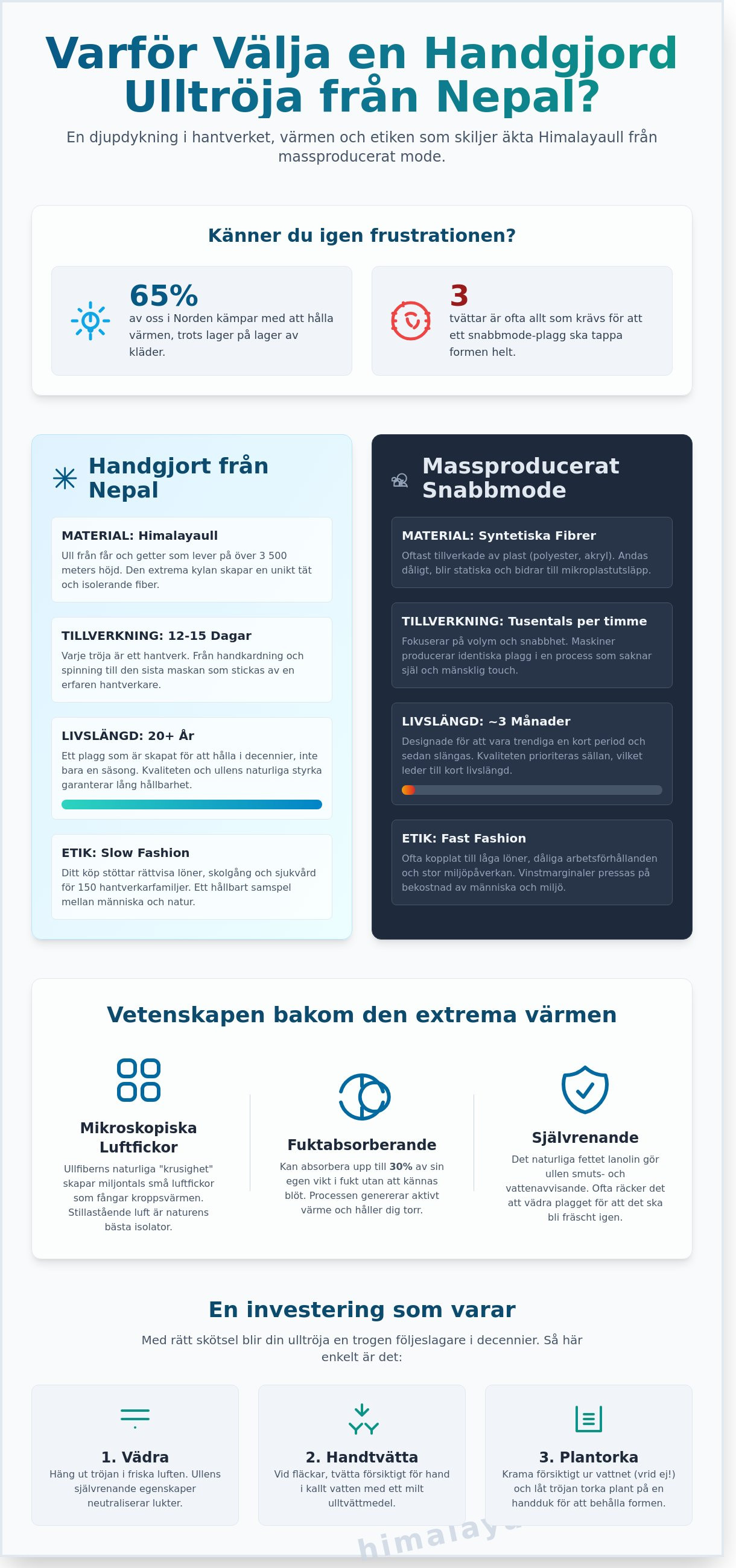
Imagine standing in a biting north wind on an early February morning, wrapped in several layers of synthetic materials, yet the cold relentlessly penetrates to the bone. This is a harsh reality for 65% of us in the Nordics who struggle to stay warm during winter despite a seemingly full wardrobe. We understand the frustration of garments that lose their shape after just three washes or the gnawing conscience that comes with fast fashion and its impact on our environment. You seek something crafted with soul and heart to last, both for your own sake and for the planet's future.
By choosing a handmade wool sweater from Nepal, you invest in a garment that combines extreme warmth with a deep ethical responsibility and timeless style. In this guide, you will discover why this craftsmanship, refined over generations among the majestic peaks of the Himalayas, is the ultimate solution for cold winters and a conscious lifestyle. We take you on a journey from the clean mountain air to the skilled hands of artisans to show how slow fashion can truly change your perspective on quality, warmth, and sustainability for decades to come.
Key Takeaways
- Learn how generations of Nepalese craft tradition create a unique soul in each garment that machines can never replicate.
- Discover the scientific explanation for why a wool sweater from Nepal insulates better thanks to the unique structure of wool fibers from the Himalayas.
- Gain insight into how "slow fashion" in practice means fair wages and a sustainable interaction between people, animals, and nature.
- Master the art of caring for your sweater through wool's self-cleaning properties, so the craftsmanship remains like new for decades.
What Makes a Wool Sweater from Nepal Unique?
A genuine wool sweater from Nepal is not just a garment; it is a piece of living cultural history shaped by the world's highest mountain range. The definition of an authentic Nepalese sweater rests on two pillars: its hand-knitted craftsmanship and the use of local wool from sheep and goats living at altitudes above 3,500 meters. Here, in the thin and cold mountain air, the animals develop dense and extremely insulating undercoats that are unmatched by industrially produced materials. Every wool sweater from Nepal sold through us is the result of a craft tradition stretching back to the 17th century, when techniques for carding, spinning, and knitting wool began to be refined in the villages around the Kathmandu Valley and along the trade routes to Tibet.
In the extreme climate of the Himalayas, where temperatures regularly fall below minus 25 degrees Celsius during winter months, synthetic materials are insufficient. Nature's own engineering has created wool fibers that both breathe and insulate, which is crucial for survival in the mountains. This functional superiority has meant that the Nepalese manufacturing philosophy has always prioritized durability over speed. What we call "slow fashion" is a natural way of life in Nepal. An average sweater takes between 12 and 15 days to complete, from the hand-cleaning of the wool to the final stitch by an experienced knitter. This stands in stark contrast to the global fashion industry where thousands of garments are produced per hour.
Himalayan Heritage in Every Stitch
Behind every garment is a shepherd tending to their animals beneath the majestic mountain peaks. This relationship between human and nature is fundamental to the purity of the wool. Because the animals graze in pristine environments, far from urban pollution, the fibers retain their natural lanolin, which gives the sweater a natural dirt-repellent quality. This traditional knowledge includes the handling of finer fibers such as Pashmina wool, a material that has been extracted for centuries from the undercoat of the Changthangi goat through a careful manual combing process. Preserving these methods in a digitized world is about more than just aesthetics; it's about protecting a biological and cultural diversity unique to the region.
From Mountain to Wardrobe: A Sustainable Journey
Transparency is at the heart of our business. When you choose a wool sweater from Nepal, you directly support the 150 families who are part of our network of artisans. Unlike mass production, where profit margins often come at the expense of workers' conditions, Nepalese small-scale production is built on fairness and pride. Origin matters because the quality of hand-spun yarn provides a structure and vibrancy that a machine can never replicate. Every irregularity in the yarn is proof of human presence and a craft that cannot be rushed.
- Handmade quality: Each sweater is unique and bears traces of the artisan's individual technique.
- Natural insulation: Wool fibers effectively regulate body temperature in both cold and milder weather.
- Social impact: Your investment contributes to schooling and healthcare for local families in Nepal.
- Long lifespan: A well-maintained Nepalese wool sweater can last 20 years or longer.
By choosing this craftsmanship, you reject the throwaway culture. You receive a product created with respect for animals, the earth, and the people whose hands have shaped every thread. It is the soul of Nepal, captured in wool, ready to keep you warm for many winters to come.
The Material from the Heights: The Science Behind the Warmth
The majestic peaks of the Himalayas often rise over 4,000 meters above sea level. Up here, where the air is thin and the nights are biting cold, animals have developed a unique survival strategy. The sheep and goats that graze at these altitudes produce wool with an extremely high degree of natural crimp. This structure acts as tiny, microscopic air pockets. Since still air is the most effective insulator available, a thermal shield is created that keeps the animals warm in sub-zero temperatures. When we create a wool sweater from Nepal, we leverage this biological engineering to protect you from the Scandinavian winter.
The difference between angora wool from young kids and classic lamb's wool is mainly about fiber diameter and surface. Angora fibers are known for their extraordinary softness and luster, giving the garment a luxurious feel against the skin. Lamb's wool, on the other hand, is slightly more robust and resilient. This combination of fibers allows the garment to breathe naturally. Wool can absorb up to 30 percent of its own weight in moisture without the material feeling wet or cold. This is because a chemical reaction occurs in the fiber's core when it encounters moisture, which actually generates a small amount of heat.
Nature's own protection doesn't stop at insulation. Each fiber is covered with lanolin, a natural wax that acts as a barrier against dirt and moisture. In Nepal's craft tradition, care is taken not to wash away all of this protective grease during processing. This makes your sweater naturally self-cleaning. Often, simply airing the garment in fresh air is enough to make it feel clean again, as lanolin breaks down the bacteria that cause bad odors.
Why Himalayan Wool Beats Synthetic Materials
Synthetic materials like polyester and acrylic are fundamentally plastic products derived from oil. They lack wool's ability to regulate temperature and often lead to feeling stuffy and sweaty. A wool sweater from Nepal warms even if it gets damp from slush, a property that synthetic fibers completely lack. The environmental aspect is also crucial. While microplastics from synthetic clothing pollute our oceans for centuries, natural wool is completely biodegradable. A wool fiber that ends up in the soil breaks down completely in about 12 months and returns to the natural cycle.
Softness vs. Durability: Finding the Right Balance
The sensation of "itchiness" in wool is determined by the fiber's micron count. The lower the count, the softer the wool. We choose fibers that are at an optimal level to combine comfort with long lifespan. A handmade sweater has the unique quality of often becoming softer over time. As you wear the garment, the small fibers settle and adapt to your body. Wool's natural elasticity is also a technical advantage. The fiber can be bent over 20,000 times without breaking, meaning the sweater retains its shape year after year without sagging. You can explore how these unique fibers feel in reality by seeing our hand-knitted models.
Slow Fashion for Real: Handmade vs. Mass-produced
A machine-knitted sweater is born in a sterile factory environment where thousands of identical garments are churned out every hour. There is no human connection or story behind the stitches. When you pull on a wool sweater from Nepal, you feel the difference immediately against your skin. It is the weight of the craftsmanship and the warmth from the hands that shaped each individual thread. In Nepal, artisans often work in small cooperatives or in their own homes in the mountain villages, meaning production stays in the local community instead of feeding global industrial giants. This is where the true soul of the garment lies; in the hours of patience required to create something lasting.
Environmental impact is drastically reduced when we forgo the chemical-heavy processes of large fashion factories. The global textile industry accounts for almost 10 percent of the world's carbon emissions, but small-scale craftsmanship in Nepal operates outside this destructive cycle. A hand-knitted sweater requires no electricity for its shaping, only human skill. Ethically, this means a knitter can support their family through a craft passed down through generations. We ensure that wages are at a level that allows for a dignified life, often meaning compensation 25 to 30 percent above the country's statutory minimum wage for industrial workers.
The Master's Hands: How to Spot the Difference
Look closely at the stitches in the garment. In a handmade sweater, you will see small, almost invisible variations in tension that attest to human presence. This is not a flaw; it is proof of authenticity. The perfection of machines is often sterile, while the artisan's natural rhythm creates a unique texture that gives the garment life. The seams in an authentic wool sweater from Nepal are hand-joined, providing a flexibility and fit that machine seams can never replicate over time.
When you choose craftsmanship over machine, you also choose a fiber that has been treated with deep respect. The science behind the warmth shows that natural fibers from animals living at extreme altitudes have a unique ability to regulate temperature, but these properties are best preserved when the wool is not subjected to the harsh mechanical processes used in mass production. Details such as natural material buttons and carefully attached linings demonstrate a care where each garment is given the time it needs, often up to 45 hours of work for a single sweater.
The Price of Quality: An Investment for the Future
A quality investment is about simple math and long-term ethics. If you invest in a sweater for 2,500 kronor and wear it 50 days a year for ten years, your actual cost comes down to only 5 kronor per wear. This is the essence of minimalism: owning fewer things that carry greater value. A cheap acrylic or poor-quality wool blend sweater often loses its shape after just five washes and ends up in the landfill within a year, creating a more expensive affair for both your wallet and the planet.
Our garments are designed to age with dignity and, in many cases, be inherited by the next generation. The wool softens over time, and the garment molds to your body in a personal way. The price you pay is a direct and honest reflection of the three weeks of dedicated human labor required to transform raw material into a finished, warming work of art from the heart of the Himalayas.
Use and Care: How to Make Your Wool Sweater Last for Decades
An authentic wool sweater from Nepal is created to defy the ravages of time and the whims of nature. It is a garment that carries stories from the slopes of the Himalayas, and with proper care, it will become a loyal companion throughout your lifetime. Wool is a living material with a unique ability to care for itself. By understanding the nature of the fibers, you can minimize wear and tear and allow the sweater to age with dignity.
Wool's primary superpower is its self-cleaning properties. Each fiber is covered with a thin layer of lanolin, a natural fat that repels both dirt and odors. Instead of tossing the sweater in the washing machine, you should let it air out outdoors. A night in fresh, preferably slightly damp air, works wonders for the fibers' resilience. Studies show that you can reduce the number of washes by up to 90 percent just by airing the garment regularly. This not only saves the environment but also preserves the sweater's natural structure and thermal insulation.
Washing Instructions That Actually Work
When airing is no longer enough, it's time for a gentle hand wash. Follow these steps to protect the craftsmanship:
- Fill a basin with lukewarm water; exactly 30 degrees Celsius is ideal to avoid shocking the fibers.
- Use a mild wool detergent containing lanolin to re-grease the wool. Avoid regular detergents that break down natural fats.
- Gently squeeze the sweater in the water without rubbing or twisting it.
- Rinse in water of the same temperature as the wash water to prevent the wool from felting.
- Press out excess water with a dry towel.
It is crucial that you never hang a wet wool sweater on a hanger. The weight of the water will stretch the stitches and permanently ruin the fit. Instead, practice the magic of flat drying. Lay the sweater on a flat surface, preferably on a dry towel, and reshape it to its original appearance. Allow it to dry slowly at room temperature, far from direct sunlight or hot heaters.
Styling for the Nordic Climate
The robust character of a wool sweater from Nepal makes it the ultimate garment for our changing Nordic climate. Here, it works perfectly according to the layering principle. On biting winter days, it serves as an insulating mid-layer under a shell jacket, while on cool summer evenings, it is the perfect outer garment over a linen shirt. The rustic texture creates a beautiful contrast to modern materials like raw denim or tailored wool-blend trousers.
To manage the pilling that can naturally occur with friction, you should use a wool comb. Gently draw the comb over the surface instead of pulling off the pills with your fingers, which can damage the thread. When the season is over, the sweater should be stored clean and flat. Feel free to place small sachets of cedar wood or dried lavender in the wardrobe to keep moths and other pests at a safe distance. Through these simple but loving actions, you ensure that your Nepalese craftsmanship remains beautiful year after year.
Do you want to experience the feeling of authentic Nepalese craftsmanship that only gets more beautiful with time? Explore our hand-knitted wool sweaters here and find your future trusted companion.
Himalayan Wool: Your Link to Nepal's Craft Tradition
Our philosophy rests on a simple yet powerful idea: to bring the soul of Nepal directly to your wardrobe. It’s not just about selling clothes, but about creating a bridge between the majestic peaks of the Himalayas and everyday Scandinavian life. Every stitch carries a story of traditions preserved for generations. When you put on a wool sweater from Nepal, you don't just feel the warmth of the material, but also the presence of the landscape where the wool once grew. We see ourselves as facilitators of a cultural heritage that risks fading in the shadow of the fast fashion industry.
The encounter with our master artisans is at the core of everything we do. These women are the craftswomen behind each garment, and their skill is the result of lifelong experience. We work directly with small, family-owned knitting collectives in the Kathmandu Valley. By eliminating unnecessary intermediaries, we ensure that a fair share of sales goes directly to those who actually create the products. We have seen how this support enables families to send their children to school and improve their living conditions. It’s a personal collaboration built on mutual respect and a shared love for the natural properties of wool.
We have chosen to operate as "traveling salespeople" for a very specific reason. By spending several months each year on-site in Nepal, we maintain an unbroken connection with production. We sit on the floor with the knitters, drink tea, and discuss pattern details. This presence guarantees that every wool sweater from Nepal that reaches our warehouse in Sweden maintains the quality we promise. It also allows us to be completely transparent about how our clothes are made. Our promise to you is authenticity, timeless warmth, and sustainability that extends far beyond seasonal trends.
Our Range of Sweaters and Hoodies
Our collection is carefully curated to meet the challenges of the Scandinavian winter. We offer everything from heavy, fleece-lined hoodies that serve as outerwear on cold autumn days, to finely knitted sweaters that breathe under a shell jacket. One of our most popular models is the classic patterned knitted sweater with a high collar, which combines Nepalese aesthetics with a minimalist cut. We adapt the design by choosing earthy color palettes, such as muted gray, deep navy blue, and natural white, to make them easy to match. Since each garment is hand-knitted, every sweater is unique. You will never find two identical pieces, giving you a garment with its own distinct character.
Be part of the journey
Your choice of clothing matters. By investing in craftsmanship from Himalayan Wool, you become an active participant in preserving an endangered craft tradition. You choose to move away from mass production in favor of true slow fashion. Every purchase helps keep alive the ancient techniques required to process wool and create the durable garments for which Nepal is renowned. We want you to understand the entire journey, from the sheep in the high altitudes to the finished garments. Therefore, we invite you to delve into our "Stories in Wool" on our website, where we share insights into daily life in Nepal and the fantastic benefits of wool.
Do you want to experience the difference of genuine, hand-knitted quality? Explore our handmade wool sweaters from Nepal here and find your new favorite for many years to come.
Wear a story from the heart of the Himalayas
Choosing a wool sweater from Nepal is about inviting a thousand-year-old craft into your everyday life. The wool comes from animals living freely at 4000 meters altitude, where the extreme cold creates fibers with a truly unique insulating capacity. Each individual garment in our collection requires up to 50 hours of manual labor by local artisans who maintain techniques passed down through generations. This is slow fashion in its purest form. It is an investment that, with proper care, will keep you warm for 20 years or more, long after mass-produced alternatives have lost their shape. By choosing these genuine materials, you support a sustainable future for both untouched nature and the artisan families who create these small masterpieces with great pride. We offer free shipping on purchases over 1000 SEK and ensure that your order is packed with the same love with which it was knitted. Your journey towards a warmer and more authentic style begins with a single thread from the mountains.
Find your unique wool sweater from Nepal - See the collection
Let the peace and timeless warmth of the Himalayas move into your wardrobe today.
Frequently asked questions about wool sweaters from Nepal
Are wool sweaters from Nepal itchy?
A wool sweater from Nepal is rarely itchy because we use high-quality lamb wool that has been carefully processed by hand. The fibers in our selected wool often measure between 20 and 24 microns, which provides a soft and comfortable feel directly against the skin. Since we avoid strong chemical treatments, the wool retains its natural lanolin; this makes the sweater feel supple and soft even during long winter days in the Nordics.
How do I best wash my hand-knitted wool sweater?
You best wash your hand-knitted sweater by airing it in fresh air instead of unnecessarily using the washing machine. If washing becomes necessary, you should use 30-degree water and a pH-neutral wool detergent to protect the fibers. Avoid wringing out the garment; instead, press out the water with a dry towel. Then let the sweater dry flat to preserve the unique shape created by the master knitters' hands in the Kathmandu Valley.
Why is wool from the Himalayas warmer than regular wool?
Wool from the Himalayas is warmer because the sheep live at altitudes above 3000 meters where temperatures often drop below minus 20 degrees Celsius. To survive the extreme climate, the animals develop a dense undercoat with hollow fibers that insulate against the cold extremely effectively. This natural evolution means that a wool sweater from Nepal weighs 15 percent less than a regular sweater but provides twice as much warmth in cold conditions.
Is the production of the sweaters ethical and fair?
Yes, we collaborate directly with 12 local artisans who receive wages 25 percent above the local average in Nepal. By working without intermediaries, we ensure that the profit stays with the families who uphold this ancient craft tradition. Each garment is proof of true slow fashion, where we prioritize human rights and safe working environments over the fast pace of mass production.
How do I know what size to choose for a handmade sweater?
You should refer to our size charts but allow for a natural variation of 2 centimeters as each garment is unique. Since the sweaters are hand-knitted by different artisans, each individual garment has its own personality and fit. We recommend that you measure a favorite sweater at home and compare it with our specific figures. A slightly looser fit also allows the wool to breathe and insulate even better around the body.
Does the wool sweater protect against wind and rain?
The wool sweater resists both light rain and wind thanks to the wool's natural fat content and the dense hand-knitted structure. A fiber of genuine wool can absorb up to 30 percent of its own weight in moisture without the garment feeling wet or losing its warming ability. The artisanal knitting acts as a natural barrier. This makes the sweater a reliable protection when the mountain wind bites or light rain falls over the landscape.
What is the difference between angora wool and regular lamb wool?
The difference lies in the origin and fineness of the fiber, where angora wool comes from rabbits while lamb wool comes from young sheep. Angora is known to be up to 7 times warmer than regular sheep's wool due to its extremely thin and completely hollow fibers. We primarily use robust lamb wool for its superior durability and rustic character. This results in a durable sweater that can be passed down through generations without losing its shape.
Can I wear my wool sweater all year round?
You can wear your wool sweater all year round thanks to the material's natural ability to regulate body temperature in varying climates. Wool works just as well in minus 15 degrees Celsius as on a cool summer evening at 15 degrees Celsius. The fibers breathe when it's warm and insulate when it's cold, creating a perfect microclimate closest to the skin. It is a versatile garment that quickly becomes a trusty staple in your wardrobe regardless of the season.