

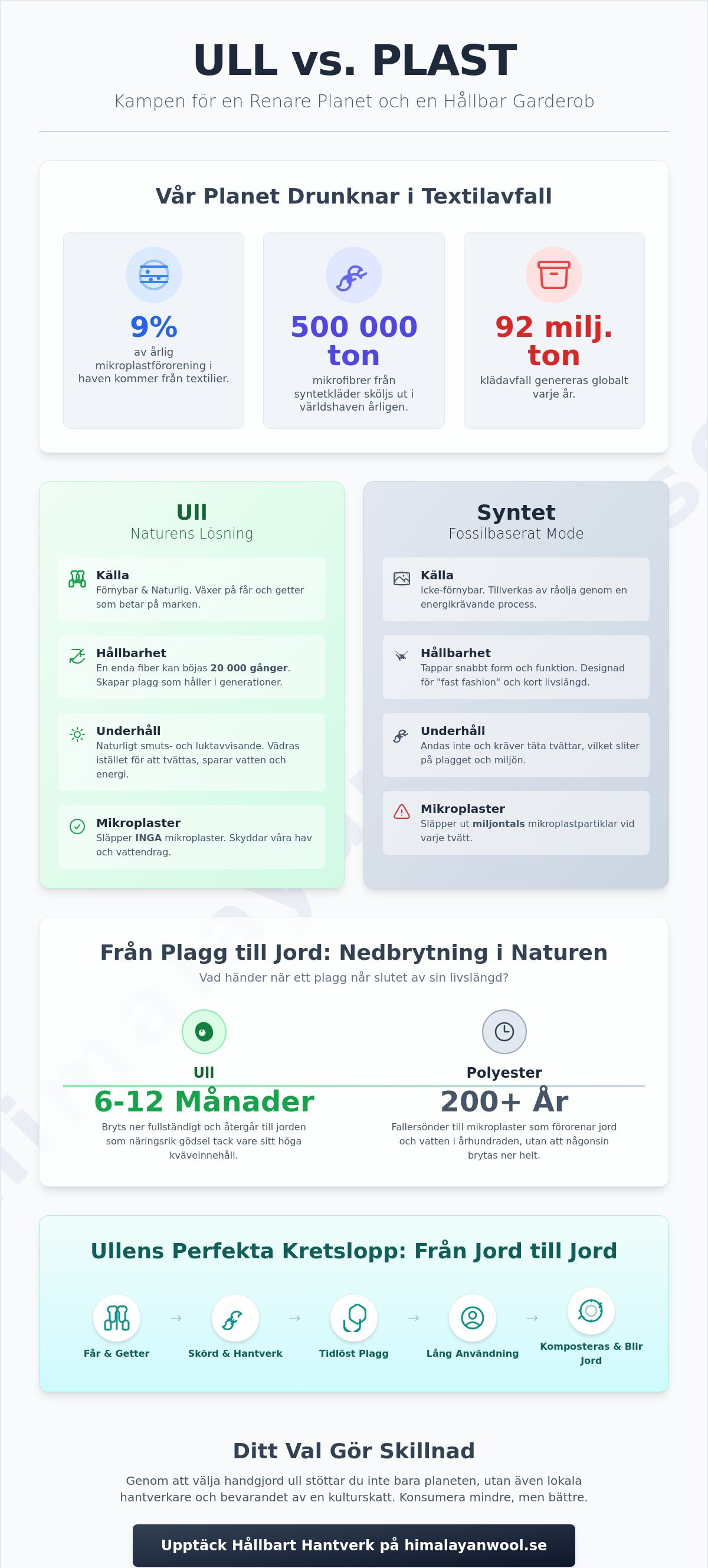
Textile and fashion waste is responsible for a full 9 percent of the annual microplastic pollution in our oceans, according to reports from January 2026. This is a truth that stings, especially when we know that up to 500,000 tons of microfibers from synthetic clothes are flushed into the world's oceans every year. Many of us feel a pang of guilt over garments that lose their shape after a short season or conceal plastic in their fibers. But amidst this challenge lies an ancient solution that breathes in rhythm with the earth. By understanding the environmental benefits of wool, you can transform your wardrobe from a burden into part of nature's own living cycle.
We know how difficult it can be to determine what is truly sustainable when the messages are many and complex. Here, you will discover how wool acts as a biological protector for our planet and why it is the ultimate choice for those who want to feel proud of their clothing choices. We provide an overview of the new EU regulations for 2026, such as the ban on destroying unsold goods on July 19, and show you how to consume less but better. Join us on a journey from the majestic mountain peaks of the Himalayas to your own wardrobe, where quality and ethics are woven together in every thread.
Key Takeaways
- Learn how wool's natural cycle allows fibers to return to the earth in less than a year, far from the eternal pollution of synthetic materials.
- Discover how wool's environmental benefits protect our oceans from the millions of microplastic particles that otherwise spread with every wash of plastic-based clothes.
- Understand why wool is an investment in timeless quality and how the fibers' ability to bend 20,000 times creates garments that never go out of style.
- See how choosing handmade wool supports local artisans in Nepal and preserves a cultural treasure that lives in harmony with nature's own conditions.
Why wool is nature's most sustainable answer to fast fashion
In an era where the global fashion industry generates up to 92 million tons of textile waste annually, wool stands as a timeless contrast to the fast-consumption, throwaway culture. While the modern wardrobe is often filled with garments that lose their shape after a few washes, wool offers something entirely different. It is a fiber that not only warms the body but also carries a soul and a history. Wool's environmental benefits begin on the vast pastures. As long as the sun shines and fresh grass grows in the valleys of the Himalayas, sheep and goats will produce new wool. This makes the material a completely renewable resource, harvested gently year after year without depleting the earth's finite resources.
The contrast to fossil-based materials is absolute. Synthetic fabrics like polyester and acrylic are, in reality, disguised crude oil, a raw material that can never be part of sustainable fashion. Choosing a hand-knitted sweater over a mass-produced synthetic hoodie is an active statement for the planet. It's slow fashion in its truest sense. Instead of viewing clothes as a consumable item, we see them as faithful companions that should age with dignity and pass down through generations. Every fiber in our garments is proof that quality and respect for nature can go hand in hand.
The biological cycle: From earth to earth
Wool is nature's own miracle material, composed of keratin. This is the exact same protein found in our own hair and nails, making the fiber completely natural and familiar to the ecosystem. For those seeking general information about wool and its biological structure, it becomes clear how ingenious the material is in its simplicity. When a wool garment finally serves its purpose after decades of use, it returns to the earth. Instead of lying in a landfill for centuries, wool naturally decomposes and becomes nourishment for microorganisms. It's a perfect circular process where the end of a garment becomes the beginning of new life in the soil.
Why we must leave the plastic wardrobe behind
The hidden environmental costs of the plastic-based wardrobe are enormous, from the energy-intensive extraction of oil to the toxic chemicals required for manufacturing. Synthetic materials do not breathe and necessitate more frequent washes, which in turn wears out both the garment and the environment. By instead prioritizing wool's properties, you create a non-toxic everyday life for yourself. Wool's environmental benefits extend into your own home; the material is naturally dirt-repellent and rarely needs washing, which saves vast amounts of water and energy throughout the garment's entire lifespan. It's time for us to stop wearing plastic and start dressing in materials that nature itself has designed to protect us.
Biodegradability: When clothes turn into soil
Imagine a sweater that leaves no trace when its life comes to an end. This is one of the most powerful aspects of wool's environmental benefits. Nature has a unique ability to recognize its own materials. When a fiber of pure wool lands in the soil, microorganisms immediately begin their work. They don't see a waste problem; they see a meal rich in proteins and nutrients. In just 6 to 12 months, a garment can be completely broken down and become part of the underlying ecosystem. It is a quiet and beautiful process that occurs entirely without human intervention.
The comparison with the modern plastic wardrobe is frightening. A polyester sweater can remain in nature for over 200 years, slowly breaking down into invisible microplastics that poison our earth. Wool does the opposite. Because it is rich in nitrogen, it acts as a natural fertilizer. Old, worn wool fibers can actually enrich your garden bed and provide strength for next season's crops. This is how we truly close the loop. In a sustainable society, wool never ends up in a landfill; it returns home to the earth it once came from.
Wool's role in the carbon cycle
There's a deeper science behind the grazing of sheep in the valleys of the Himalayas that is often overlooked in the environmental debate. Through regenerative grazing, animals help bind carbon in the soil, making them active participants in the fight against climate change. The composition of wool is fascinating; almost 50 percent of its weight consists of biogenic carbon absorbed from the atmosphere via the plants the animals eat. When you choose wool clothing from the Himalayas, you support a natural cycle where every thread has been part of a living organism and a clean environment.
Compost your sweater? A vision for the future
The idea of composting an old favorite might feel strange, but it's the ultimate form of recycling. For a garment to be fully compostable, every detail needs to be carefully considered. Unfortunately, many mass-produced garments use synthetic sewing thread which remains as small plastic strings in the soil even if the fabric itself is natural. We believe in a different path. By using traditional methods and natural materials even for buttons and seams, we ensure that nothing harmful is left behind. This is one of the most important aspects of wool's environmental benefits; that the whole is as clean as its origin.
Before you start composting on your own, it's wise to review the garment's details. Buttons made of horn, bone, or wood are crucial for the cycle to remain closed. It's about understanding that we are only borrowing materials from the earth for a time. If you want to experience the difference that genuine craftsmanship makes, you can explore our collections which are created with reverence for this cycle. It's slow fashion that not only feels good against the skin, but also nourishes the future.
Microplastics and the oceans: Wool's purifying power
Every time we start a washing machine filled with synthetic clothes, we release thousands of invisible plastic particles into our waterways. This is a silent pollution that, according to reports from February 2026, accounts for a full 35 percent of all microplastics in the oceans. Synthetic fleece is one of the biggest culprits; it releases millions of fragments that never disappear but instead find their way into the food chain. But here, wool steps in as a silent hero. One of the most significant aspects of wool's environmental benefits is its ability to exist in harmony with aquatic environments without leaving harmful traces.
Wool's "microfibers" are fundamentally different from plastic's by nature. If a wool fiber detaches during washing or use and ends up in the ocean, a natural degradation process begins even in the marine environment. This is due to the material's biocompatibility, meaning that wool's protein-based structure is fully compatible with living tissue and natural ecosystems. While acrylic and polyester accumulate in the oceans, threatening biodiversity, wool breaks down into harmless substances that do not harm the organisms living beneath the surface.
Wash less, love more
Wool possesses an almost magical ability to stay clean thanks to lanolin, nature's own protection against dirt and unwelcome odors. This natural wool grease makes the fibers repel moisture and prevents bacteria from taking hold. This means we can drastically reduce the number of washes, saving thousands of liters of water per year and decreasing energy consumption in our homes. By simply hanging your garment out in the fresh air on a damp morning, wool's self-cleaning powers are activated, and the garment regains its freshness. If you want to learn more about how to best care for your heavier outerwear, you can delve into our guide on women's wool jackets, where we share the secrets behind airing and how to preserve the quality of craftsmanship over time.
The silent heroes of the oceans
Studies show that wool fibers do not accumulate in the oceans in the same way synthetic fibers do. This is a crucial argument for anyone who cares about our waters and biodiversity. By choosing natural materials instead of plastic-based alternatives, you take active responsibility for the planet's future. Wool's environmental benefits are not just about what the material gives us in terms of warmth, but equally about what it doesn't give nature: eternal pollution. Dressing in wool is choosing a path where every choice we make supports the health of the ocean rather than burdening it. This is true slow fashion, where respect for the magnificent ecosystem guides our consumption.
Long-lasting fashion: Why sustainability is about time
Sustainability is measured not just by how a garment is made, but by how many years it gets to live and be loved. One of the most impressive aspects of wool's environmental benefits is the physical strength and resilience of its fibers. Nature has designed the wool fiber to withstand extreme conditions; it can be bent over 20,000 times without breaking. In comparison, cotton fibers typically give way after approximately 3,000 bends. This natural elasticity ensures that a high-quality wool sweater retains its shape and resilience year after year, drastically reducing the need to buy new items and burden the planet's resources.
When we talk about investment versus consumption, it's about looking beyond the price tag at the time of purchase and instead focusing on the cost per use. A handmade wool garment carries a value that grows over time. Wool's unique structure also makes it easy to repair and care for. Instead of discarding a garment when a small flaw appears, wool encourages mending. It's a silent protest against a fashion industry built on trends that die after just three months. By choosing timeless design, we create a wardrobe that stands firm when fleeting fancies blow by.
Heirlooms in wool
Stories of sweaters passed down from grandfather's shoulders to grandchildren's play are not uncommon in the world of wool. Within the slow fashion Sweden movement, this has become a central idea: to own fewer but better things that carry a history. Wool's environmental benefits are most apparent when a garment never ends up in the trash, but instead becomes part of the family's shared memories. Quality craftsmanship is the key to this longevity, where every stitch is laid with care and knowledge passed down through generations.
Care as an environmental act
Darning a sock or mending a small hole in a vest is more than just practical maintenance; it's an active step against overconsumption. The scaly surface of wool allows repairs to blend in beautifully, adding character to the garment. Through simple steps, such as storing your garments in an airy place and using cedar wood to protect against moths, you can extend the life of the material by decades. Giving an old favorite new life is a way of showing respect for both nature and the hands that created the garment.
Do you want to find garments that are designed to last a lifetime and age with dignity? See our handmade collections here.
Himalayan Wool: Ethical craftsmanship protecting the mountains
When we talk about wool's environmental benefits, we often look at the fiber's biological properties, but the real magic begins long before the garment reaches your wardrobe. The journey starts on the slopes of the Himalayas, where the air is so clear it almost shimmers, and the silence is broken only by the bells of animals. Here, sheep and goats live in a symbiosis with nature that has been lovingly nurtured for generations. It is an animal husbandry that knows nothing of factory stress or industrial efficiency. Instead, we see experienced herders who follow their family traditions and allow the animals to live in harmony with the majestic mountain peaks.
Social sustainability is the backbone of every thread we convey. By choosing handmade clothes, you not only support the planet but also the local artisans in Nepal who receive fair wages for their profound craftsmanship. There are no chimneys spewing smoke in our manufacturing; the power comes from human hands and traditional methods that do not burden the atmosphere with carbon emissions. Every garment is living proof that we can create timeless beauty without leaving scars on nature. It is the journey from Nepal's soul to your wardrobe, a journey that carries respect for both people and the environment.
Herders' heritage and the ecosystem
Small-scale grazing in the Himalayas plays a crucial role in preserving the region's biodiversity. By grazing at high altitudes, animals prevent the overgrowth of sensitive mountain meadows, allowing rare plants and insects to thrive. Wool from these altitudes has unique properties; the extreme cold makes the fibers unusually durable and insulating, a quality that industrially produced wool rarely can match. Respect for animals is deeply rooted in Nepalese culture, where the herder views their animals as companions rather than merely a resource.
The master's hands in every thread
The process of spinning and knitting by hand is a meditative art form that is entirely free from electricity-dependent machines. When a master craftswoman in Nepal creates a garment, she imbues a part of her own story into each stitch. The human value in knowing that your sweater or socks have been created by a person with a name and a face provides a sense of security that mass production can never offer. Wool's environmental benefits are enhanced here by the complete absence of industrial chemicals and machine noise. If you want to experience the feel of genuine, sustainable craftsmanship, you can explore our range of winter wool accessories, where every detail is created with love and respect for the mountains' heritage.
Choose a future woven in harmony with nature
Choosing wool is choosing a path away from the 500,000 tons of microfibers that, according to data from January 2026, pollute our oceans every year. We have seen how this fantastic material functions as a living cycle, from the grazing animals on the slopes of the Himalayas to the day the garment returns to the earth as nourishment in just 6 to 12 months. By embracing wool's environmental benefits, we break the pattern of rapid consumption and instead invest in garments that carry a history and a soul. It is a journey that is about more than just fashion; it is a stand for the survival of craftsmanship and the health of the planet.
Every stitch in our collections is created with reverence for both tradition and the future. With 100% genuine Himalayan wool and the hands of masters who have nurtured the craft for generations, we offer true slow fashion. It's time to let your wardrobe reflect the values we want to see in the world. We invite you to wear a piece of Nepal's soul and feel the difference that genuine quality makes for both you and nature. Let your next investment be part of nature's own answer to sustainability.
See our handmade and sustainable wool clothing from Nepal and become part of an endless cycle.
Common questions about wool and the environment
Is wool really good for the environment?
Yes, wool is one of nature's most resource-efficient materials because it is completely renewable and stores biogenic carbon throughout its life. Almost 50 percent of wool's weight consists of carbon absorbed from the atmosphere via the plants the animals graze on. By understanding wool's environmental benefits, we see how the material acts as an active part of balancing our ecosystem instead of burdening it with fossil raw materials like oil.
Does wool release microplastics when washed?
No, wool does not release microplastics because it is a natural protein fiber that is completely free of plastic. While washing synthetic materials accounts for 35 percent of microplastics in our oceans, wool fibers biodegrade if they detach in the machine. This makes wool a safe choice for those who want to protect our waters and preserve biodiversity in marine environments.
How long does it take for wool to break down in nature?
It usually takes between 6 and 12 months for pure wool to fully break down and return to the earth. This short time stands in stark contrast to polyester and other synthetic fibers, which can remain in nature for over 200 years. When wool decomposes, it also acts as a natural, nitrogen-rich fertilizer that nourishes the soil and promotes new vegetation.
Why is wool considered a circular material?
Wool is considered circular because it is born from the earth, grows on living animals, and ultimately returns to the earth without leaving harmful traces. The new "Materials Matter Standard," which comes into effect on December 31, 2026, emphasizes the importance of precisely this type of circular material flow. It is a fiber that does not require the extraction of new finite resources to be created anew season after season.
Is the production of wool ethical for animals?
Within traditional craftsmanship in Nepal, production takes place with a deep respect for animals as a central part of herders' family traditions. The animals live freely on majestic mountain slopes and are lovingly cared for by herders who have followed the same methods for generations. This small-scale system prioritizes animal welfare and differs fundamentally from the impersonal methods of industrial mass production.
How can I make my wool wardrobe more sustainable?
You make your wool wardrobe more sustainable by washing your garments less often and instead utilizing wool's self-cleaning lanolin by airing them out. Mending a small hole is also a powerful environmental action that counteracts overconsumption and extends the garment's lifespan by decades. With the EU's new rules from July 2026, which prohibit the destruction of unsold clothes, focusing on caring for what we already own becomes an important part of future fashion.
What is the difference between organic wool and conventional wool?
The difference lies primarily in strict requirements for land management and that no synthetic pesticides or chemicals are used during production. According to the EU's "Green Claims" directive, which becomes binding on September 27, 2026, all such environmental claims must now be supported by concrete evidence. Organic wool guarantees that animals have grazed on land managed with consideration for biodiversity and ecosystem health.
Why are handmade wool clothes better for the planet than machine-made ones?
Handmade clothes eliminate the need for large-scale factories and energy-intensive machines that contribute to global carbon emissions. By using human power and traditional methods, garments are created with minimal environmental impact while providing fair wages to local artisans. This is true slow fashion, where every thread in a sweater or hoodie carries a story of respect for both people and nature.