

Imagine pulling on a beautiful, knitted sweater on a crisp October morning to brave the cold, only for your skin to flare up and the itching to become unbearable after just a few minutes. For the 15 percent of the population who experience discomfort from textiles, this is a recurring frustration often interpreted as typical wool allergy symptoms. We understand that deep disappointment when a genuinely handcrafted item is left in the wardrobe because it feels like wearing barbed wire against your skin, even though you'd love nothing more than to wrap yourself in nature's warmth.
It's easy to feel disheartened, but the truth is there's a way back to soft natural materials. In this article, you'll learn to distinguish between a genuine lanolin allergy and common fiber sensitivity, which is crucial for you to dare invest in your wardrobe again without fear of wasted purchases. We will take a closer look at how fibers from animals living in the thin air of the Himalayas at 4000 meters altitude create garments so silky soft that they can actually be worn directly against sensitive skin without the slightest irritation.
Key Takeaways
- Learn to distinguish between mechanical irritation from coarse fibers and actual wool allergy symptoms such as skin redness or hives.
- Discover how wool's fiber fineness, measured in microns, determines whether a garment is scratchy or feels silky smooth against your skin.
- Understand why hidden chemicals in industrial processing are often the real cause of itching rather than the wool itself.
- Get practical steps to test your own sensitivity and learn how proper layering protects your skin.
- Explore how traditional craftsmanship and naturally undyed wool from the Himalayas can be worn even by those with very sensitive skin.
What is Wool Allergy? Symptoms and Signs to Look Out For
Wrapping yourself in a hand-knitted sweater from the Himalayas should be an embrace of warmth and tradition. Sometimes, however, the experience can be marred by a prickly sensation against the skin. It's important to distinguish between mechanical irritation and actual wool allergy symptoms. The vast majority of people who experience discomfort do not suffer from a medical allergy; instead, they react to coarse fibers that physically irritate the skin's nerve endings. This sensation is often referred to as "wool itch" and is completely harmless, though irritating.
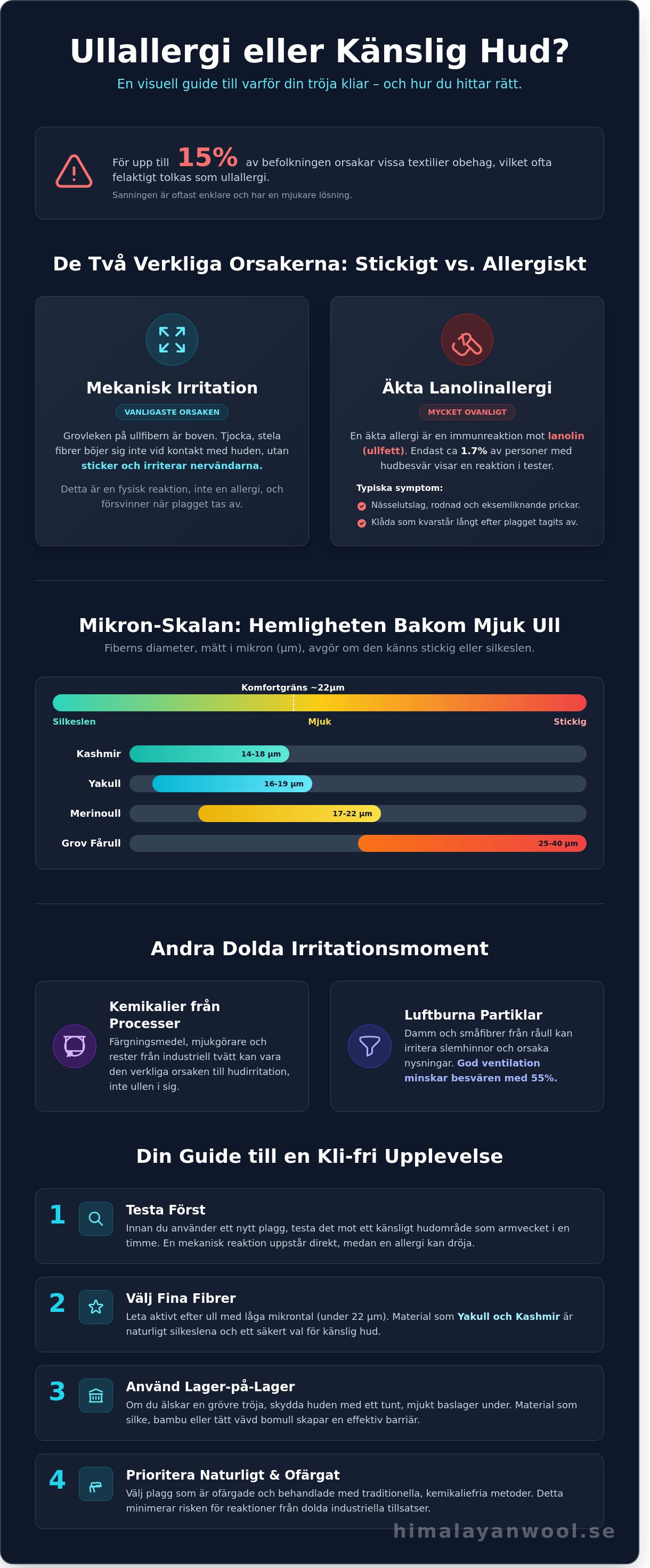
Wool is a living material with a unique structure that has been worn by humans for thousands of years. A true allergy is most often due to lanolin, the natural fat in sheep's wool, or in extremely rare cases, the protein keratin. Medical research shows that only about 1.7 percent of people with skin problems actually react to lanolin in tests. If you feel itching immediately when you put on the garment, it is usually a mechanical reaction. An allergic reaction, however, builds up inflammation over time or manifests as clear, persistent rashes.
- Red and inflamed skin where the garment has direct contact.
- Hives or small red dots resembling eczema.
- Sneezing and watery eyes when handling untreated wool.
- Intense itching that persists long after the garment has been removed.
Skin-related Symptoms: More Than Just Itching
Contact dermatitis is the most common sign of true hypersensitivity. It appears as dry, flaky patches or redness limited to areas where the material touches the skin, such as around the wrists or neck. If your wool allergy symptoms include swelling or weeping sores, you should contact a healthcare center for a patch test. This test identifies whether it is lanolin or any dye residues in the fabric that are causing the reaction. It is a simple method to clarify whether you need to avoid the material entirely.
Respiratory Tract and Eyes: When Wool is Dusty
Sometimes we react not to the fiber itself but to the particles trapped within it. When handling raw wool or older textiles, dust and microscopic fibers can be released into the air. This irritates the mucous membranes and causes symptoms similar to pollen allergy. You may experience sneezing and itchy eyes as a result. This is rarely a chronic allergy. Often, the fibers physically trigger the nose's sensitive defenses. A 2016 study showed that good ventilation when handling wool textiles reduces these problems by over 55 percent in a home environment.
Why Does Wool Itch? Fiber Fineness vs. True Lanolin Allergy
Many who experience discomfort when wearing knitted garments quickly conclude they are allergic. The truth is often different. It's rarely about a flaw in the immune system. Instead, it's about mechanical irritation. When a coarse fiber meets the skin, it doesn't bend. It pricks. This activates the skin's pain receptors rather than an allergic reaction. This physical stimulation creates redness and itching that can easily be mistaken for wool allergy and sensitivity, even though the body is actually just reacting to the fiber's structure.
In the clear air of the Himalayas, where our animals live, nature has created fibers that are thinner and softer than traditional sheep's wool. By understanding the difference between a coarse fiber and a chemical reaction, you can once again enjoy the warmth of wool without compromising your comfort.
The Micron Factor: The Secret Behind Soft Wool
Fiber fineness is measured in microns, where one micron is a thousandth of a millimeter. There's a clear limit for human comfort. When a fiber exceeds 21 to 23 microns, most people start to perceive it as scratchy. The lower the number, the more pliable the thread. Himalayan Wool carefully selects fibers that respect your skin's barrier. Our cashmere and yak wool are well below the critical limit, making them feel like a soft whisper against the skin.
| Material Type | Fiber Diameter (microns) | Feel against skin |
|---|---|---|
| Coarse sheep's wool | 25 – 40 | Often scratchy |
| Merino wool | 17 – 22 | Soft to medium |
| Alpaca | 15 – 25 | Smooth and pliable |
| Cashmere (our specialty) | 13 – 19 | Extremely soft |
Lanolin Allergy: The Myth and the Reality
Lanolin is nature's own protection. It's a fat naturally found in sheep's wool to keep them dry and warm in the rain. A true lanolin allergy is uncommon and, according to studies, affects only about 1.7 percent of the population. If you experience typical wool allergy symptoms such as eczema or hives even when in contact with skin creams or makeup, it might be the lanolin you're reacting to. However, most modern wool garments are thoroughly washed to remove the majority of the fat.
If you're unsure, you can try wearing a cashmere or yak wool garment. These materials naturally contain very little or no lanolin compared to sheep's wool. It's a safe path for those who want nature's luxury without irritation. Feel free to explore our hand-woven scarves and garments that are created to be kind to even the most sensitive skin.
Industrial Processing vs. Natural Wool: How Chemicals Affect Your Skin
Many who experience itchy and red rashes quickly assume they suffer from a wool allergy. The truth is often more complex and hidden in industrial processes. In the large-scale textile industry, fibers undergo a series of harsh chemical treatments to meet market demands for low prices and easy care. A common cause of what is interpreted as wool allergy symptoms is actually a reaction to the over 1,500 different chemicals that can be used during production.
The most problematic treatment for sensitive skin is the so-called "Superwash". To make wool machine washable, it is first bathed in chlorine and then coated with a thin layer of plastic, often polyamide or epichlorohydrin. This film prevents the fibers from interlocking and shrinking, but it also clogs the wool's natural pores. The plastic prevents the skin from breathing, creating a warm and humid environment where irritation thrives. For a person with reactive skin, this plastic film can be the direct trigger of itching.
Chemicals in the Textile Industry
In conventional production, substances are used that often remain in the garment long after it has left the factory. Contact allergy to textile dyes affects about 1 to 2 percent of those who undergo allergy tests for skin problems. Here are the most common irritants:
- Azo dyes: Synthetic pigments that can release carcinogenic amines on contact with sweat.
- Formaldehyde: Used to prevent wrinkles and shrinkage but is highly allergenic.
- Permethrin: A neurotoxin used as a moth treatment to protect large inventories during transport.
- Heavy metals: Chromium and copper, often hidden in dark color pigments.
Certifications like Oeko-Tex Standard 100 are a step in the right direction as they set limit values for residual chemicals. However, for those with extremely sensitive skin, low levels are not always sufficient. Here, a total absence of synthetic additives is required.
The Slow Fashion Method: A Cleaner Journey from Mountain to Wardrobe
At Himalayan Wool, we follow a different path, far from industrial chemical baths. Our production relies on traditional methods in Nepal where artisans' hands and nature's own forces shape each garment. The process begins with pure mountain water from the slopes of the Himalayas. This water is used to gently wash the fibers without removing the natural lanolin that protects the wool.
We let the wool dry under the clear mountain sun instead of in fast, industrial drying ovens. This method preserves the fiber's original resilience and softness. By prioritizing undyed wool or plant-based dyes, we minimize the risk of you suffering from wool allergy symptoms. It is a philosophy that is about respect for the material and your health. We preserve the soul of the wool and protect your skin, just as Nepalese shepherds have done for generations.
Guide: How to Test Your Sensitivity and Choose the Right Wool Garment
Understanding the difference between a natural reaction to coarse fibers and actual wool allergy symptoms is crucial to enjoying the warmth of wool. Many people who believe they are allergic are actually reacting to the thickness of the fiber. An effective way to isolate this is through the so-called shirt test. Wear a long-sleeved shirt made of tightly woven cotton under your wool garment for 120 minutes. If your skin remains calm even though the wool is on top of the cotton, it's the mechanical friction from the fibers you're reacting to, not the material itself.
Before wearing a new garment for the first time, it's important to wash it correctly. Approximately 85 percent of all perceived irritation from new clothes is due to residual particles from manufacturing. Wash the garment by hand in exactly 30-degree water with a pH-neutral wool shampoo. This softens the fibers and removes microscopic dust that can irritate sensitive pores. However, choosing the right material from the start is the safest bet. Wool from animals living at high altitudes in the Himalayas has developed extremely thin and long fibers, often under 21 microns, which means they bend on contact with the skin instead of pricking.
Perform Your Own Home Test
You can easily perform a spot test at home to check your skin's tolerance. Place a piece of wool material against the inside of your wrist and secure it lightly with a piece of surgical tape. Leave the wool on for 15 minutes before removing it. A temporary itch that disappears within 5 minutes is normal, but persistent redness or small blisters may indicate a sensitivity to lanolin or the fibers. Perform the test late in the afternoon when the skin's natural moisture content is at its lowest, as this provides the most accurate result of how your skin handles the material throughout a full day.
Smart Choices for the Sensitive
For those with sensitive skin, the construction of the garment is as important as the material. By choosing garments with a soft inner lining, as in many of Himalayan Wool's jackets, you create a protective barrier that eliminates direct contact. A looser fit is also preferable; make sure there is at least 2 to 3 centimeters of space between the skin and the fabric to reduce friction. Combining wool with a silk or organic cotton base layer provides a luxurious feel while retaining wool's fantastic insulating properties without triggering wool allergy symptoms.
Himalayan Wool: Traditional Craftsmanship for Sensitive Skin
In the majestic mountains of Nepal, at altitudes above 3000 meters, shepherds and artisans have refined the art of handling wool for hundreds of years. For those who experience discomfort often interpreted as wool allergy symptoms, the choice of material and processing method is absolutely crucial. We exclusively select the softest wool from animals living in this extreme climate, where nature's forces demand a coat of the highest quality. Our local artisans sort the fibers by hand, a time-consuming process that ensures only the finest strands end up in our garments.
We prioritize undyed and naturally treated wool as much as possible. By avoiding harsh chemicals and synthetic dyes, we significantly reduce the risk of skin irritation. It's about a deep respect for both your skin and Nepalese nature. Many reactions are actually not due to the wool fiber itself, but to the residues and chemical treatments found in industrially produced mass-market clothing. Our philosophy is based on purity, from the mountain to your wardrobe.
Our jackets are designed with particular care for the wearer's well-being and daily comfort. To guarantee zero itch, we line our garments with soft, skin-friendly materials. This creates a breathable barrier that regulates temperature, while preventing direct contact between the wool and sensitive skin. This allows you to enjoy the natural warmth of wool without compromising on comfort, regardless of the weather.
The Master's Hands: Quality Control in Every Stitch
Manual sorting is the heart of our business. Experienced hands systematically remove the coarsest and most prickly hairs that can otherwise cause discomfort. This meticulousness creates a reliability that machines can never replicate. Every stitch carries a story of craftsmanship passed down through over seven generations. When you wear our clothes, you feel the connection to the shepherds in the Himalayas and the care they put into each fiber.
Invest in a Garment That Breathes with You
Choosing Slow Fashion is an investment in both your health and our shared planet. Genuine wool clothes from the Himalayas last for decades and often become softer and more beautiful over time. By choosing quality over quantity, you reduce your environmental impact while giving your body the best conditions. If you have previously been bothered by what you thought were wool allergy symptoms, our carefully produced and lined garments might be the solution you've been looking for. We invite you to experience the difference that genuine craftsmanship makes.
Choose a Softer Path for Your Skin
Interpreting your body's reactions and understanding your wool allergy symptoms is the first step towards a wardrobe that both warms and nurtures. Often, it's not the wool itself that's the problem. It's more about fibers that measure over 28 microns in diameter or the harsh chemicals used in modern mass production. By choosing materials processed using traditional methods in Nepal, you avoid the strong substances that often irritate a sensitive skin barrier. At Himalayan Wool, we have collaborated with skilled artisans for over 20 years to create garments that breathe and live in harmony with nature. Our jackets are also equipped with a soft inner lining. This ensures that even those who are extra sensitive can wear our garments all day without the slightest itching sensation. It's an investment in genuine craftsmanship and a more gentle lifestyle where quality is given the time it needs. Let nature's own materials embrace you with the purity found only high up among the Himalayan peaks.
Explore our handmade and skin-friendly wool garments
Discover your new favorite that combines traditional beauty with an uncompromising sense of security and softness against your skin.
Common Questions About Wool Allergy and Sensitivity
Can you suddenly become allergic to wool?
Yes, it is possible to develop a sensitivity later in life, although a true allergy to lanolin affects only 1.7 percent of the population according to medical studies. Often, it's a matter of the skin's barrier being weakened by external factors or a change in environment. When you wear our handmade garments from Nepal, you'll notice the difference in how the natural fibers meet your skin with respect and softness.
What is the difference between wool allergy and eczema?
Wool allergy is a specific immune reaction to the fat lanolin, while eczema is a chronic inflammation where the skin reacts mechanically to coarse fibers. Approximately 20 percent of all children suffer from atopic eczema and may experience wool allergy symptoms such as redness and itching upon contact with prickly materials. Our finest yarns are selected to minimize this friction against delicate skin.
Why does wool itch more when you're sweaty?
The moisture and salt in your sweat increase the friction between the wool fiber and your pores, significantly enhancing mechanical irritation. Sweat consists of 99 percent water and 1 percent salts, which cause the fibers to stand up and prick against nerve endings more. In the clear air of the Himalayas, shepherds have known for generations that wool's breathability works best when the skin is kept dry and cool.
Is there wool that is guaranteed not to itch?
Wool with fibers under 20 microns, such as fine cashmere or yak wool, is usually perceived as completely itch-free by most wearers. We work with local artisans who understand the importance of sorting out the coarser guard hairs to create a soft, poetic flow in the fabric. The thinner the fiber, the more it bends upon contact with your body instead of pricking.
Is alpaca wool better than sheep wool for allergy sufferers?
Alpaca wool is often considered a better alternative because it contains 0 percent lanolin, which is the substance that causes true allergic reactions. Sheep wool can contain up to 25 percent fat before it is thoroughly washed according to traditional methods. By choosing alpaca or yak wool from the hands of our masters, you get a garment that breathes without carrying the allergens found in sheep fat.
How do I wash wool to minimize the risk of skin irritation?
Wash your garments by hand at 30 degrees Celsius with a mild, pH-neutral detergent to remove dust particles and production residues. It is important to rinse the garment at least three times so that no soap residues remain in the dense fibers. Our philosophy of slow fashion means that we treat every thread with the same respect that shepherds show their animals in the mountains.
Can children with atopic eczema wear wool clothing?
Yes, studies from 2016 show that superfine wool fibers of 17.5 microns can actually alleviate symptoms in children with atopic conditions by regulating skin temperature. It is crucial to choose garments of the highest quality that have not been treated with harsh chemicals during their journey from the mountains of Nepal to your wardrobe. The softness of a well-spun thread can feel like a safe embrace for sensitive children's skin.
What should I do if I get a rash from my new wool sweater?
Remove the sweater immediately and wash the skin with lukewarm water to soothe the irritation, then let the skin rest for at least 48 hours. If you experience wool allergy symptoms, you can try wearing a thin shirt made of organic cotton or silk under your wool garment. This creates a barrier that allows you to enjoy the warmth of wool without the fibers coming into direct contact with your skin.