

Did you know that over 80 percent of a garment's total climate footprint is created during the production phase, long before it lands in your arms or is hung on a hanger? It's a staggering thought that highlights the most effective way to reduce your climate impact with clothes is to slow down, choose with your heart, and let each garment become a lifelong companion. We are living in a turning point in 2026 where the EU's ban on destroying unsold textiles has finally come into force, but the real change begins in the personal relationship to what we wear closest to our bodies.
You've probably felt the fatigue of fast trends and garments that lose their soul and shape after just one season. I promise there's another way, where your wardrobe consists of fewer but significantly better garments that carry the scent of nature and craftsmanship. In this article, you'll learn how conscious material choices, slow fashion, and proper care can significantly minimize your carbon footprint. We delve into how you can extend the life of your favorite wool garments and create a wardrobe that is not only sustainable but also fills you with pride in its origin and the hands that shaped the material.
Key Takeaways
- Learn how extending the life of your garments can halve your carbon footprint and create a more sustainable everyday life.
- Understand why natural materials like wool are a superior choice compared to synthetic fabrics, which are fundamentally made of fossil fuels.
- Discover concrete methods to reduce your climate impact with clothes by prioritizing quality and timeless design over fast trends.
- Get practical advice on how to care for your garments by airing more and washing less, saving both energy and the fibers of the material.
- See how an investment in genuine craftsmanship and fair conditions creates a wardrobe with a deeper history and soul.
The Climate Crisis in Your Wardrobe: Why Your Clothing Choices Matter in 2026
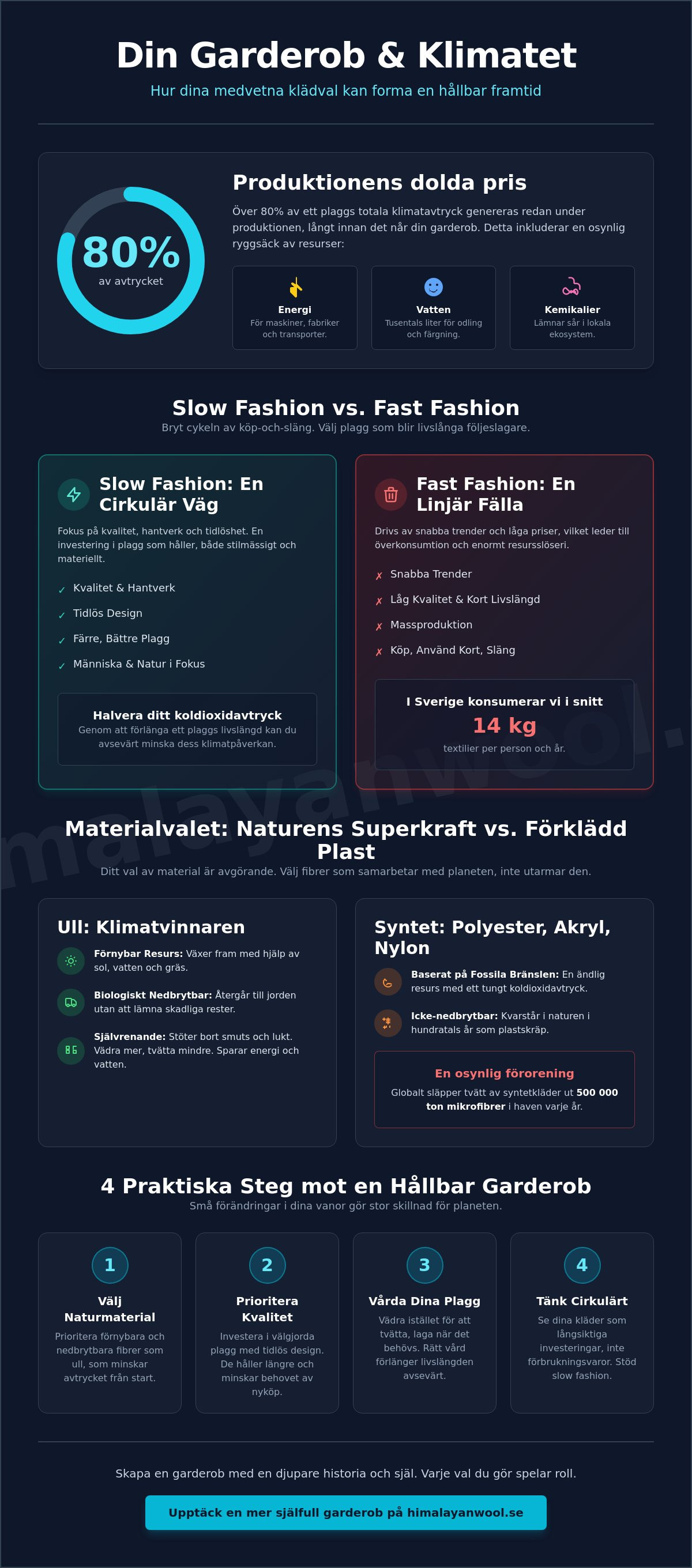
Our wardrobe is often a silent mirror of the planet's health. Every year, we in Sweden buy an average of 14 kilos of textiles per person, a figure that contains much more than just fabric and thread. It contains an invisible backpack of resources that stretches from the first fibers in the field to the day the garment becomes waste. Reducing your climate impact with clothes means understanding this backpack. Climate impact is defined here as the total amount of resources required during a garment's entire life cycle:
- Energy: The power required to run heavy machinery, factories, and global transport.
- Water: The thousands of liters consumed in cultivation and chemical dyeing baths.
- Chemicals: The substances used to prepare the fibers but often leave deep scars in local ecosystems.
2026 has become the year when we are seriously forced to shift focus from quantity to quality. We can no longer ignore that our choices in the store have direct consequences for global carbon emissions.
The Hidden Cost of Production
It's easy to think that the washing machine at home is the biggest environmental drain, but the truth is more complex. A full 80 percent of a garment's total climate footprint is generated before it even reaches your arms. Large-scale factory production functions as an anonymous machinery where speed is prioritized over sustainability. This extensive environmental impact of the fashion industry is the real price of mass-produced garments. Imagine a sweater created in a cold, noisy factory far away, where every stitch is the result of tight deadlines and cheap materials. This depletes the planet's resources in a way that small-scale craftsmanship, carried out with respect for both people and nature, never does.
From Linear to Circular Wardrobe
Moving from a linear to a circular wardrobe means we begin to view our clothes as long-term investments rather than consumables. We need to break the destructive cycle of buying, using briefly, and discarding. By choosing materials that age with beauty and carry a story, we can achieve climate goals together. The concept of slow fashion Sweden offers a solution where we slow down and value timelessness. When we choose garments with care, it becomes a natural part of everyday life to reduce our climate impact with clothes. A sweater made to last for decades becomes not just a garment, it becomes a loyal friend that carries memories and the soul of craftsmanship.
Material Choice: Nature's Superpowers vs. Synthetic Plastic
When we touch a fabric, we touch its origin. Many of the garments that fill today's store shelves are in fact disguised plastic. Polyester, acrylic, and nylon are born in refineries from fossil fuels, a process that requires enormous amounts of energy and leaves a heavy carbon footprint. Reducing your climate impact with clothes therefore begins with choosing materials that breathe in harmony with nature rather than burdening it with finite resources.
Wool stands in a class of its own as a true climate winner. It is a renewable fiber that grows through sunlight, water, and grass. Unlike synthetic fibers, wool is completely biodegradable. If a garment eventually reaches its end, it returns to the earth without leaving traces of eternal chemicals or microplastics. The climate impact of textile production is a complex equation, but by choosing natural materials, we lower the stakes right at the source. In addition, wool's unique ability to regulate temperature reduces the need to own a large number of niche garments for different weather conditions.
Wool vs. Synthetics: A Climate Comparison
Every time a synthetic sweater spins in the washing machine, thousands of invisible plastic fragments detach. Globally, washing synthetic clothes releases 500,000 tons of microfibers into the oceans each year. This is an invisible pollution that wool completely lacks. By delving into the properties of wool, you quickly understand that it is nature's most advanced functional material. Wool repels dirt and odor in a way that means it rarely needs washing. This saves both energy and water throughout the garment's lifespan and reduces wear and tear on the fibers.
Why Genuine Himalayan Wool Makes a Difference
High up among the peaks of the Himalayas live the animals that hold the key to a more soulful wardrobe. The goats and lambs graze freely in a landscape where humans and nature have lived in symbiosis for centuries. This natural grazing is not only ethical. It also helps to preserve biodiversity by keeping the landscape open and binding carbon in the soil. The material harvested here possesses a strength and resilience shaped by the harsh climate, a quality that cannot be rushed in a factory. When you choose to wear a wool sweater created under these conditions, you also carry a piece of the mountains' eternity and a craft that defies the passage of time.
Slow Fashion vs. Fast Fashion: Calculating the Lifespan of Clothes
Time is a strange force in the fashion world. Fast fashion thrives on restlessness and a constant whisper that what we own is no longer enough. It's an industry built on trends with expiration dates shorter than a season. Slow fashion is its exact opposite, an invitation to pause and breathe. When we choose to reduce our climate impact with clothes, we also choose to reject the stress that rapid cycles bring. Instead, we choose garments that age gracefully and become more beautiful with each passing year they are with us.
A central concept in this philosophy is "Cost per Wear." It's about looking beyond the price tag at the time of purchase and instead dividing the garment's price by the number of times it's actually worn. A sturdy wool sweater may at first glance seem like a larger investment, but its longevity makes it cheaper for both the wallet and the planet in the long run. According to current research, we can almost halve a garment's climate footprint by simply using it twice as long. It's a simple but powerful truth that shows sustainability begins with faithfulness to what we already own.
Timeless Design as a Climate Strategy
Choosing timelessness is an active environmental action. By avoiding trend traps and instead seeking classic cuts, we create a wardrobe that never feels dated. A well-cut women's wool jacket is an excellent example of this. It works just as well this year as it will in a decade, because its beauty lies in the proportions and the quality of the material rather than in a fleeting fashion term. When we choose colors drawn from nature's own palette, such as muted earth tones and soft grays, it becomes easier to combine garments across seasons. This reduces the need to constantly buy new items to feel appropriately dressed.
The Importance of Craftsmanship for Quality
There's a special magic in what's created by hand. In Nepal, where craft traditions have been passed down through generations, every garment is the result of human care and intuition. Hand-knitted garments often have stronger fibers than machine-made ones because the artisan can feel the resilience of the material and adapt each stitch to the unique character of the yarn. This human presence creates an emotional bond between the wearer and the garment. We care for what we love, and when we see the small irregularities in the yarn that bear witness to the artisan's skill, it becomes harder to see the garment as a disposable item. This is how we can reduce our climate impact with clothes, by choosing craftsmanship that carries a soul and a history worth preserving.
Practical Steps to Reduce Your Climate Impact with Clothes
Changing habits often requires looking at the familiar with fresh eyes. When we choose to reduce our climate impact with clothes, it's not just about the moment of purchase, but about the daily reverence for the garments we already own. It's in the small, practical actions that the real difference emerges. By caring instead of replacing, and by understanding the inherent logic of the material, we create a wardrobe that breathes in harmony with nature's own cycles.
The Art of Caring for Wool
Wool is a living material with a fantastic ability to self-clean thanks to the natural fat lanolin. Instead of letting your garments tumble around in a washing machine, which wears on both the fibers and the planet's energy, you should let them recover in the fresh air. Hang your sweater on a hanger on a humid morning or let it rest in the bathroom while you shower. The steam helps the wool fibers stand up and naturally transport away odors and dust. It's a simple ritual that means a wool sweater rarely, if ever, needs to be washed in water. This saves enormous amounts of water and energy over the garment's lifetime.
If a seam should give way or a small hole appear after years of use, see it as an opportunity to deepen your relationship with the garment. A simple repair with needle and thread is a silent declaration of love for craftsmanship and an effective way to counter the throwaway culture. When the season changes, you should store your wool clothes in airtight bags made of natural materials, preferably with a piece of cedarwood, to protect them from moths' curious appetites and preserve them for the future.
Build a Capsule Wardrobe with Natural Materials
A harmonious wardrobe is about fewer but better choices that can be combined endlessly. By building a capsule wardrobe with basic garments made of natural materials, you create a visual and practical order that reduces everyday stress. Focus on the layering principle to easily regulate warmth according to the whims of the weather. Here, the right winter accessories wool plays a crucial role. A warm hat or a pair of sturdy socks can allow you to get by with a thinner jacket further into the season, making your wardrobe more versatile.
When you organize your wardrobe and see the materials and colors you actually love, the need for impulse purchases that burden both conscience and the environment decreases. Reducing your climate impact with clothes then becomes not a limitation, but a liberation from the weight of excess. Explore our collection of timeless craftsmanship at himalayanwool.se and find the sustainable cornerstones your wardrobe deserves.
Himalayan Wool – A Journey Towards a More Soulful Wardrobe
Our journey begins where the clouds rest against the snow-capped peaks of the Himalayas. It is in this magnificent landscape, where the thin air demands both strength and softness, that the foundation of your wardrobe is born. For us, wool is not just a raw material; it is a bearer of stories, a link between pristine nature and your everyday life. By choosing craftsmanship over mass production, you also choose a path that genuinely allows you to reduce your climate impact with clothes. We believe in garments that not only warm the skin but also provide a sense of security and meaning.
Our philosophy is based on respect for slow processes. In a world that often spins too fast, we want to offer a counterpoint where every stitch is given the time it needs. When you wear one of our garments, you also wear the result of fair conditions and a deep reverence for the cultural heritage managed by generations of skilled artisans. It is a promise of quality that defies the passage of time and stands firm when trends blow by.
The Craftsmanship Behind Every Stitch
In the small workshops of Nepal, tradition and intuition meet in a quiet conversation. Here, artisans work whose hands possess knowledge that cannot be replicated by machines. It is the human presence, the slight variation in each stitch, that gives the garment its unique character and soul. A machine-knitted sweater often lacks the life and resilience that arises when a human guides the yarn with care. By exploring our range of Himalayan wool clothing, you get a glimpse into a world where every garment is a work of art in itself, created to accompany you through all of life's changes.
Your Contribution to a Better World
Every conscious choice you make in your wardrobe is a vote for the future you want to see. When you invest in a handmade jacket or a soft sweater from us, you directly support the local economy in Nepal and help preserve ancient craft traditions that otherwise risk fading away in the shadow of mass production. It is a way to actively reduce your climate impact with clothes by minimizing global waste and choosing products that are made to last for decades, not just weeks.
Your wardrobe doesn't have to be filled with excess to be rich. On the contrary, it becomes more valuable when every garment carries a story you are proud to tell. Let your clothes be an expression of your respect for the planet and the people who live on it. By choosing with your heart, you not only protect the climate, you also create a more soulful and sustainable existence for yourself and future generations.
A Future Woven with Care and Craftsmanship
The journey towards a sustainable wardrobe begins with a single conscious choice and a desire to live in harmony with nature's own cycles. We have explored how prioritizing natural materials like wool, embracing slow fashion, and learning the art of caring for your garments can make a real difference for the planet. To reduce your climate impact with clothes is not a sacrifice; it is an invitation to own fewer but more meaningful items that carry a story and a soul.
By choosing craftsmanship from the heart of the Himalayas, you support a circular future where quality and ethics go hand in hand. Our garments are handmade in Nepal under fair conditions, created from natural wool that breathes and is meant to be passed down through generations. These are clothes that are as kind to your conscience as they are to your skin. When you invest in craftsmanship that lasts, you also invest in a more beautiful world where every stitch counts.
Discover our handmade and sustainable wool clothing from the Himalayas and enjoy free shipping on orders over SEK 1000. Let your wardrobe become a living story of respect, tradition, and hope for the future.
Frequently asked questions about sustainable clothing and climate impact
How much does my climate impact decrease if I buy wool instead of polyester?
Choosing wool over polyester significantly reduces your climate impact because wool is a renewable material that does not require fossil fuels in its basic production. While polyester releases plastic microfibers with each wash, wool is biodegradable and ages with a strength that often makes the garment last three to four times longer than a synthetic alternative. By extending the garment's lifespan, you halve its carbon footprint per wear.
Why is slow fashion considered better for the environment than organic cotton?
Slow fashion is a philosophy that addresses the fundamental problem of overconsumption, rather than just replacing one fiber with another. Even organic cotton requires large amounts of water and energy for production and dyeing. By choosing timeless garments that are made to last for decades, we reduce the overall need for new production. The slow cycle is the key to truly reducing your climate impact with clothes over time.
How often do you really need to wash a wool sweater to be environmentally friendly?
A wool sweater rarely needs to see the inside of a washing machine; airing it in fresh air is usually enough. Wool's natural lanolin makes it dirt-repellent and antibacterial, meaning it cleans itself when allowed to rest outdoors or in a damp bathroom. By washing less often, you not only save water and energy, but you also protect the fibers so that the garment maintains its shape and integrity for many years to come.
Are handmade clothes from Nepal really sustainable considering transportation?
Yes, because production accounts for approximately 80 percent of a garment's total climate impact, while transportation constitutes a surprisingly small part of the overall picture. A handmade garment from Nepal, created under fair conditions and with minimal machine energy, has a significantly lower footprint than a mass-produced garment from a large factory. The quality and long lifespan of the craftsmanship more than compensate for the journey the garment makes to your door.
What should I do with my old synthetic clothes to reduce environmental impact?
Never throw textiles in regular household waste; instead, take them to your municipality's separate textile collection, which has been mandatory since 2025. If the garments are still intact, they can be resold or donated to extend their life cycle with a new owner. To reduce the spread of microplastics in our waters, you can also use a special laundry bag when washing your existing synthetic garments until they are completely worn out.
Can I really reduce my carbon footprint by just changing clothing material?
The choice of material is an important piece of the puzzle, but the biggest gain lies in how long you choose to wear the garment. By switching from synthetic materials to sustainable wool, you create the conditions for a wardrobe that requires fewer new purchases in the future. Reducing your climate impact with clothes is about the whole picture: choosing renewable fibers that do not deplete the planet's resources and that possess a quality that means they rarely need to be replaced.
What are the three most important things to look for when buying sustainable clothes?
First, focus on the authenticity of the material and look for natural fibers like wool, which are both renewable and biodegradable. Then, examine the craftsmanship; see if the garment is created with human care and under fair conditions that respect the people behind the stitches. Finally, you should choose a timeless design that you can see yourself wearing in ten years, so that the garment has the chance to age gracefully with you and your personal style.