

Did you know that today, the fashion industry accounts for a full ten percent of the world's annual carbon emissions, which is more than all international flights and shipping combined? This is a truth that grates on the heart, especially when we see our newly purchased garments lose their shape and soul after just a few washes. We live in a time when conscious consumption fashion has gone from being a whisper in the margins to a necessity for both the planet and our own peace of mind. It's not about ceasing to love beautiful things, but about reconnecting with craftsmanship, the earth, and the human hands that carefully shaped the fibers into something lasting.
You're probably familiar with the nagging feeling of standing in front of an overflowing wardrobe yet having nothing that feels right, or the frustration of greenwashing that hides cheap mass production behind pretty words. This guide will teach you how to make wise choices in the fashion world with heart and thoughtfulness, so you can discover the power of choosing quality over quantity. We will explore the path to a wardrobe with fewer but better garments, deepen your knowledge of material origins, and give you the tools to feel deep pride in your choices. Join us on a story that begins with nature's raw materials and ends in a timeless wardrobe that carries a history worth preserving and wearing close to the skin.
Key Takeaways
- Learn how to shift focus from volume to value by embracing the role of a "circulator" rather than a passive consumer.
- Understand why the origin of natural materials is crucial for a garment's lifespan and how conscious consumption fashion begins with the choice of genuine, sustainable fibers.
- Discover how the concept of "cost per wear" makes slow fashion a smarter investment for both your wallet and the planet's future.
- Get concrete tools to inventory your current wardrobe and build a personal style that stands firm when fleeting trends blow by.
- Explore how the journey from the artisan's hands in Nepal to your finished wool sweater or coat creates a garment with a soul and a history that withstands the test of time.
What does conscious consumption in fashion actually mean?
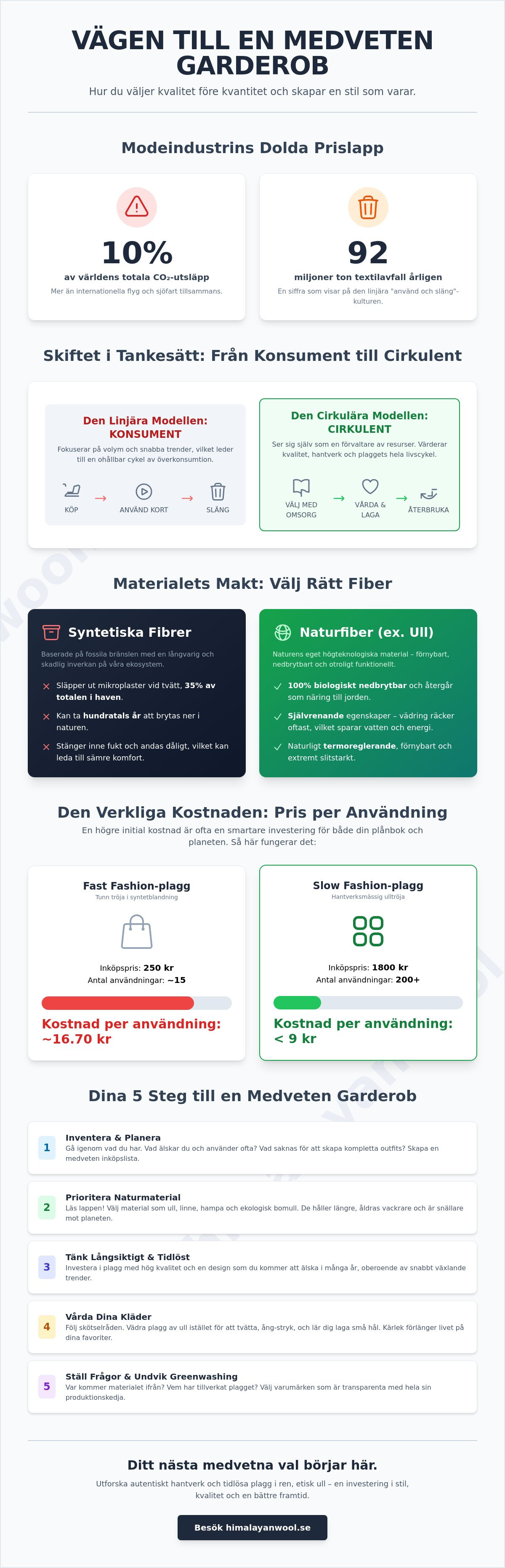
Choosing a garment with care is like inviting a new story into your life. It's not about accumulating, but about connecting with the craftsmanship, the earth, and the hands that carefully shaped each fiber. Conscious consumption fashion is, at its core, an active stance where we prioritize value over volume. It is a silent rebellion against the fast industry that pumps out 92 million tons of textile waste every year; a figure that forces us to pause and breathe. When we choose quality over quantity, we also choose to respect the resources that nature so generously lends to us.
Today, we increasingly talk about being a circulator rather than a consumer. A consumer consumes and discards, while a circulator sees themselves as a steward of resources. As a circulator, you take responsibility for the garment's entire journey, from the moment it lands in your arms to the day it returns to the cycle. The psychology behind impulse purchases is often based on a chase for quick dopamine, but by slowing down and feeling the material, we can break the pattern. We learn to appreciate the weight of a well-knitted wool sweater or the soft texture of a wool coat, garments that are made to age with dignity alongside us.
From linear to circular fashion philosophy
The old linear model, where clothes are produced, used briefly, and then thrown away, is crumbling. Since January 2025, it is mandatory for everyone in Sweden to sort their textile waste separately, marking a new era for how we view our wardrobes. To truly understand the depth of this transition, one might ask: What is sustainable fashion? It's about choosing materials that not only last for decades but can also be repaired when a seam gives way or composted when they finally wear out. Within the slow fashion Sweden movement, we see how the focus shifts from trends to timelessness, where a warm wool vest or a sturdy poncho becomes a trusty companion that never goes out of style.
Seeing through greenwashing
In a world where pretty words often cost less than the actual production, greenwashing has become a smokescreen that makes it difficult for us to choose correctly. Many large chains tempt with sustainability collections, but without transparency throughout the entire production chain, the promises remain empty. Conscious consumption fashion requires us to dare to ask questions. Where does the wool come from? Who knitted the sweater? True sustainability is found where companies dare to showcase their artisans and their small-scale processes. It is in the personal connection and the honest accounting of the material's origin that true security lies.
Material choice: The cornerstone of a conscious fashion choice
Every garment in your wardrobe begins with a fiber, a small thread that carries an entire world's environmental footprint. Practicing conscious consumption fashion means looking beyond the color and cut, right down to the roots of the material. While synthetic materials are often described as sustainable as long as they are recycled, they carry a hidden and long-term cost. A full 35 percent of the microplastics polluting our oceans originate from washing synthetic textiles, according to current environmental reports. By instead choosing natural materials like wool, we choose a path that is gentle on both the wearer and the ecosystems we all depend on.
Natural materials have an inherent logic that mass-produced plastics lack. In cold climates, wool is not just a fashion choice but a vital protection that has been shaped over thousands of years. Animals living in extreme conditions have developed fibers with a complexity that no laboratory can fully replicate. When we choose these materials, we invest in a circular future. Wool is naturally biodegradable and returns to the earth as nutrients when its long life cycle finally ends, unlike synthetic garments that can persist in nature for hundreds of years.
Wool's magical properties for the environment
Wool is nature's own answer to high technology. It is a renewable material that grows back every year, and its primary sustainability benefit lies in how we care for it. Thanks to wool's thermoregulation and its natural fats, the fibers are self-cleaning. This means you rarely need to use the washing machine; often, a night in the fresh air is enough for the garment to feel new again. This saves enormous amounts of water and energy during the garment's lifetime. If you want to know more about this fascinating material, you can read our deep dive into wool's properties.
Himalayan craftsmanship and raw materials
High up among the snow-capped peaks of the Himalayas live the sheep and goats whose fleece becomes warming garments. Here, among nomadic peoples like the Gaddi tribe, wool is part of an ancient cultural heritage. The difference between industrial wool and the wool we source from Nepal lies in the respect for the fiber. Manual carding and hand spinning preserve the natural strength and elasticity of the fibers, instead of them being torn apart by large factory machines. The result is a wool sweater or coat with a completely different luster and durability. If you are looking for a garment that combines this tradition with modern ethics, you can view our handcrafted wool sweaters and coats that are made to be worn for generations.
Slow Fashion vs. Fast Fashion: A practical comparison
In a world that is constantly speeding up, the fashion industry has become one of the fastest ticking clocks. Fast fashion is built on an illusion of infinite supply, where trends are born and die within weeks. This mass production often eradicates cultural identity; when everything looks the same, the local distinctiveness and the soul that exists in a craft disappear. By choosing conscious consumption fashion instead, we step out of the hectic hamster wheel. We choose to see time as a friend and a quality factor, rather than an enemy to be defeated with lower prices and poorer seams.
The true measure of economy in the wardrobe is not the number on the price tag, but the concept of Cost Per Wear. A cheap, mass-produced sweater that loses its shape after three washes ultimately becomes an expensive affair for both your wallet and the environment. A solid investment in a wool sweater or a coat that lasts for ten years or more, on the other hand, becomes an economic and ethical win. By supporting small-scale producers, we also contribute to a vibrant countryside, whether in the Swedish forests or in the mountains of Nepal, where traditional knowledge can continue to thrive through fair conditions.
The value of craftsmanship in a digital world
There is an almost spiritual energy in a hand-knitted stitch that a machine can never recreate. Every imperfection carries a trace of a human, a thought, and professional pride. In our production in Nepal, human rights and fair wages are a matter of course; it is the basis for artisans to preserve their traditions. When you wear such a garment, you are not just wearing textiles, but a work of art. It is a silent communication between the artisan in the Himalayas and your everyday life, a connection that makes us look at our clothes with greater reverence and love.
Quality that lasts for generations
Building a wardrobe that stands the test of time requires a trained eye. You recognize a durable seam by its evenness and strength, and a high fiber density gives the material a weight that both warms and protects. A high-quality wool sweater is not just a garment for the moment; it is a faithful companion that can be inherited for generations. Aesthetic durability is just as important as physical durability. By choosing classic cuts and natural color palettes, you create a style that stands firm when fleeting trends blow by, which is the very essence of a conscious and timeless life.
Practical steps to build a conscious wardrobe
The journey towards a more thoughtful wardrobe begins not in the store, but in front of your own mirror. Before inviting a new garment into your life, it is wise to carefully inventory what you already own; to rediscover the stories that already hang on your hangers. Conscious consumption fashion is about understanding that every purchasing decision is a vote for the future we want to see. By choosing versatile garments that work in multiple contexts, we reduce the need for constant new purchases. It's about finding a personal style that doesn't falter when fleeting trends blow by; a style built on security and self-knowledge rather than impulses.
Building a sustainable wardrobe requires us to slow down and ask ourselves if the garment will truly become a faithful companion over time. It is a process that requires patience. We need to learn to appreciate the tactile properties of materials and the finesse of craftsmanship. When we choose to invest in quality, we also choose to break the pattern of mass production and instead make room for garments that carry a soul. Every conscious choice is a step away from the throwaway culture and a step closer to a wardrobe that we can wear with pride and joy for many years to come.
The capsule wardrobe – Fewer garments, more possibilities
The capsule wardrobe is a tribute to simplicity and thoughtful choices. The foundation is laid by choosing high-quality basics that can be easily combined with each other. A well-cut women's wool jacket is an excellent example of such a key garment; it can be transformed from an elegant outer garment for festive occasions to a warming embrace during a crisp autumn walk. By sticking to a color palette that harmonizes across seasons, you create endless possibilities with a few garments, which provides a sense of calm and order in your everyday life.
Care and love prolong life
Once we have chosen a garment made of genuine natural materials, a new phase of care begins. For wool clothes, water is often an unnecessary strain; the fibers thrive best when allowed to breathe in the fresh night air. Airing is almost always better than washing to preserve the material's natural fats and luster. If a small hole should appear, we can choose to repair it with pride. "Visible mending," where the repair is allowed to show as beautiful embroidery, makes the garment even more personal and unique. It is a way to show reverence for the work put into the threads. Find your next faithful companions among our ethically produced wool clothes from the Himalayas.
Himalayan Wool – A bridge between the Himalayas and your everyday life
Our journey begins where the clouds rest against the sharp ridges of the Himalayas. It is here, in the thin air, that the raw material for our garments is born. We see ourselves not just as a clothing brand, but as a living bridge between these ancient landscapes and your modern everyday life. Promoting conscious consumption fashion means to us showing deep respect for the entire chain; from the sheep grazing at high altitudes to the skilled artisan in Nepal who hand-spins the thread. By working directly with local collectives, we ensure that every fiber carries a promise of authenticity and traceability.
Every garment we create is a carrier of a story that extends far beyond fleeting trends. It is the story of patience, of human hands shaped by tradition, and of a material that challenges the logic of fast consumption. We are proud of our small scale. It allows us to maintain a personal relationship with those who do the work and guarantee fair conditions. For us, transparency is not a marketing trick but a moral compass. When you choose a sweater, a vest, or a coat from us, you also choose to become part of a narrative where humans and nature walk side by side.
An investment in people and nature
When you wear our clothes, you actively contribute to preserving craft traditions that might otherwise fade in the shadow of industrial factories. Our focus on small-scale production minimizes the environmental footprint and allows us to cherish details in a way that mass production can never achieve. It is a circular thought where every choice counts for the future. You can deepen your understanding of this philosophy by reading more about our wool clothes from the Himalayas and how they combine timeless warmth with modern ethics.
Find your next life companion in wool
In our assortment, you will find everything from sturdy jackets and soft sweaters to warming winter accessories like wool hats, socks, and mittens. When you unpack a package from us, you are not met with an anonymous product, but with the scent of genuine natural materials and the feeling of authentic, human craftsmanship. These are garments meant to become your life companions; faithful pieces that age with dignity and grow with you over the years. We invite you to become part of our journey towards a more conscious consumption fashion. Together, we can choose quality, pride, and a sustainable future for both people and the planet.
Your journey to a timeless and living wardrobe begins here
By choosing materials that have emerged under the Himalayan starry sky and been refined by skilled human hands, you take a clear step away from the anonymous flow of mass production. We have explored how the choice of genuine natural materials radically reduces the environmental footprint and how a well-thought-out capsule wardrobe provides a security that fleeting trends can never offer. Ultimately, conscious consumption fashion is about seeing each garment as an extension of your own values and a deep respect for the earth that lends us its resources.
Every sweater, coat, and accessory in our range carries a promise of authenticity and longevity. Our collections are handmade in Nepal by local artisans, created from 100% natural materials and designed with a timeless aesthetic meant to last for decades. It's time to let your wardrobe tell a story that you can wear with pride and warmth for many years to come.
Explore our handmade wool clothing and choose with your heart. Your wardrobe is not just a collection of textiles; it's a powerful choice for a more beautiful and sustainable world where craftsmanship once again takes center stage.
Frequently Asked Questions about Conscious Consumption and Sustainable Fashion
What is the most important thing to look for to consume fashion more consciously?
The most important thing is to critically examine the choice of materials and the transparency of the production chain. Conscious fashion consumption begins with choosing natural fibers like wool, which have a significantly lower environmental impact than synthetic alternatives. Look beyond the price tag and ask yourself who made the garment and under what conditions. By prioritizing quality and timeless design over fast trends, you create a wardrobe that lasts over time and reduces the need for constant new purchases.
Are expensive clothes always more sustainable than cheap ones?
Price is not an automatic guarantee of sustainability, but genuine quality and ethical production come at a natural cost. Cheap mass-produced garments often hide hidden costs for the environment and workers. At the same time, luxury brands can use synthetic materials without taking social responsibility. The true measure of sustainability lies in the inherent strength of the material and the precision of the craftsmanship. A well-knitted wool sweater that costs more initially becomes cheaper per wear because it remains in your wardrobe for decades.
How do I know if a clothing brand is truly ethical?
A genuinely ethical brand is characterized by deep transparency and a willingness to tell the story behind every stitch. Look for companies that name their artisans or showcase their small-scale production units rather than just using vague sustainability buzzwords. Transparency means that the brand can account for the entire journey, from the raw material's source in nature to the finished product. If a company is open about its challenges and processes, it builds trust that empty marketing promises can never replace.
Why is wool considered one of the most sustainable materials for fashion?
Wool is considered a cornerstone of conscious fashion consumption because it is a renewable and naturally biodegradable resource. The fibers have unique, self-cleaning properties that mean garments rarely need machine washing, saving large amounts of water and energy over the years. In addition, wool is incredibly durable and retains its shape year after year. When the garment is finally worn out, it can return to the earth as nutrients instead of contributing to microplastic pollution in our oceans.
How many garments do you really need in a sustainable wardrobe?
The number of garments is less important than how well they serve your needs and how long they actually last. A sustainable wardrobe is often based on a smaller number of high-quality key pieces that can be combined in several ways. Focus on owning garments that you truly love and that carry a story, rather than striving for a specific number. By choosing versatile wool sweaters and timeless coats, you create a base that feels complete without your wardrobe ever feeling overflowing.
What can I do with clothes I no longer use?
Since January 2025, there is a legal requirement in Sweden to sort textile waste separately, which facilitates a circular management of our resources. Garments that are still in good condition should be resold or donated to extend their lifecycle with a new owner. If a garment is broken, you can explore the craft of mending to give it new life. For natural materials like pure wool, there is also the possibility of industrial recycling where the fibers can be re-spun into new, beautiful stories.
How does my consumption affect artisans in countries like Nepal?
Your choices have a direct impact on artisans' ability to preserve their ancient traditions and support their families under fair conditions. By choosing small-scale production from Nepal, you support local collectives where manual carding and spinning are still valued. This creates pride in the artisan and ensures that their unique knowledge is not erased by mass production. Every purchase becomes a voice for preserving a living cultural heritage and strengthening the local economy in the remote mountain regions.