

Have you ever wondered if the garments in your wardrobe carry a story that extends beyond the next seasonal sale? What if your favorite knitted sweater wasn't just a purchase, but a faithful companion that ages with the same dignity as an ancient oak in the forest? Many ask the question how long does a wool sweater last, and the truth is that a garment created with respect for nature's raw materials can journey through life with you for decades.
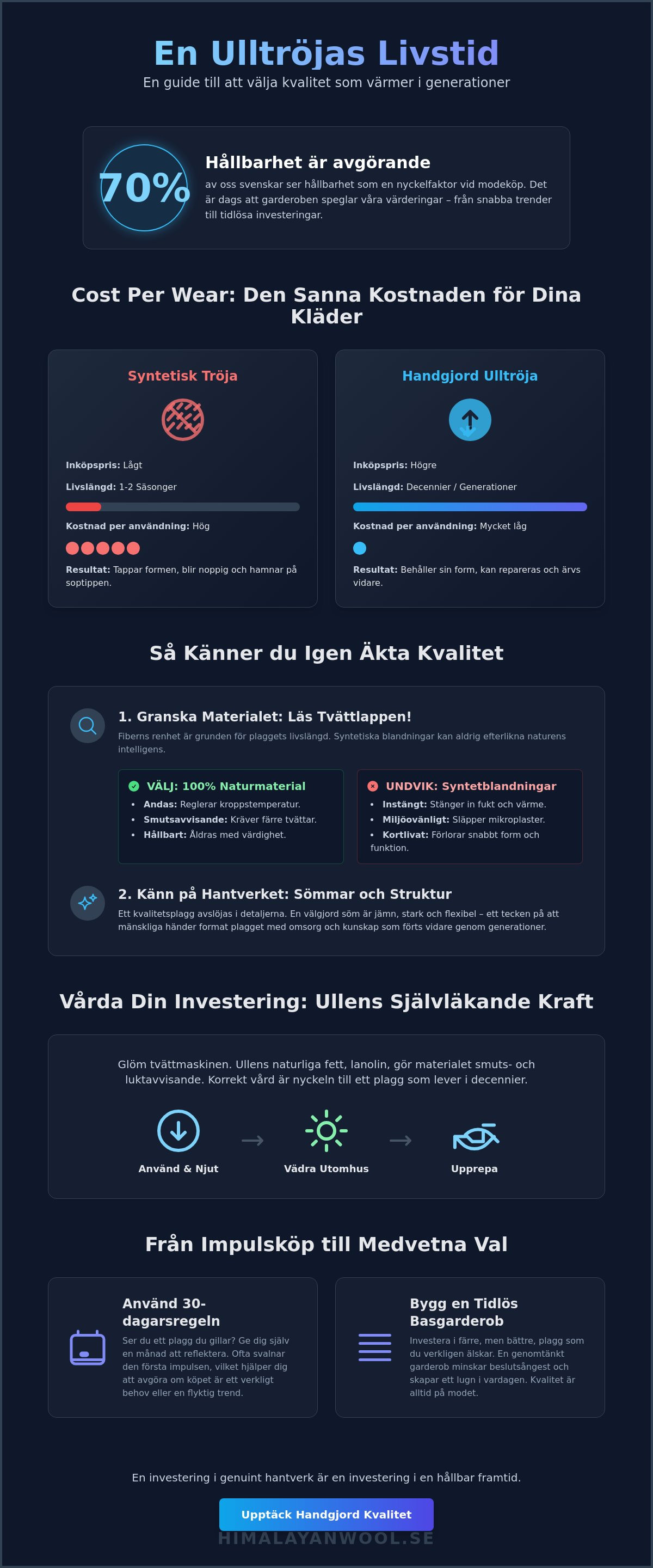
We all recognize the frustration of garments that lose their shape after only two washes or the dull conscience that gnaws when the wardrobe is overflowing with fast trends that never feel quite right. You are not alone in wanting to step off the hamster wheel; a full 70 percent of Swedes today see sustainability as a decisive factor in fashion purchases. In this guide, you will learn the art of choosing quality over quantity to build a wardrobe that warms both body and soul for generations. We explore how to identify genuine materials, understand the new EU rules for transparency, and find those few but perfect wool garments that truly matter.
Key Takeaways
- Learn why fewer garments with high utility value reduce everyday decision-making anxiety and create a more harmonious, timeless wardrobe.
- Discover the secret behind identifying genuine quality by examining seams and understanding why pure natural materials always outperform synthetic blends.
- Get answers to the question how long does a wool sweater last and how, with proper care, you can allow your favorite garments to warm both body and soul for decades.
- Explore how to care for your investments by utilizing wool's natural fat, lanolin, which allows you to air the garments instead of washing them.
- Understand the deep value of genuine craftsmanship where every stitch carries a story from the heights of the Himalayas to your own everyday life.
Why 'buy fewer but better garments' is the key to a sustainable style
Choosing quality over quantity is not just a modern consumption strategy; it is a return to a time when every item in the home was chosen with care and respect for craftsmanship. When we talk about buying fewer but better garments, we mean investing in items with high utility value. These are garments that not only cover the body but serve us faithfully through the years, whether it's a biting winter morning or a cool summer evening. Psychologically, an overflowing wardrobe is often a source of quiet stress. By curating a collection of garments that we actually love, we reduce daily decision-making anxiety and create much-needed calm in the morning routine. Environmentally, this is the most powerful stance we can take. After all, the most sustainable product is the one that never needs replacing.
Cost Per Wear - how to calculate your investment
Many ask the question how long does a wool sweater last when they see the price tag of a genuine artisan garment compared to a mass-produced version. Here, the concept of Cost Per Wear (CPW) becomes an invaluable tool for the conscious consumer. Imagine a cheap acrylic or synthetic blend sweater. It might seem like a bargain at checkout, but after just one season, it has often lost its shape, pilled, and lost its ability to warm. It ends up in the trash, and the cost per wear ultimately becomes high.
A handmade sweater in natural material, on the other hand, possesses a completely different vitality. Thanks to the unique properties of wool fiber, the garment can breathe, repel dirt, and maintain its structure year after year. The purchase price is spread over hundreds, perhaps thousands, of uses. Moreover, these garments possess a value that extends beyond the monetary; they can be repaired with simple means and eventually inherited as a cherished memory by the next generation.
From impulse buys to conscious choices
The path to a sustainable wardrobe begins with silencing the noise of fast trends and instead listening to our true needs. It's about building a style identity based on timelessness rather than the whims of the season. An effective method for breaking the pattern of impulse purchases is to apply the 30-day rule. If you see a garment that tempts you, give yourself a month to reflect. Often, you'll notice that the need cools when the initial emotional impulse has subsided.
By waiting, you can more clearly see if the garment actually complements your existing collection and if it meets your requirements for material and ethics. Building a wardrobe this way is a slow process, but the result is a collection of garments that whisper of quality and that you wear with pride. It's a journey from simply owning clothes to cherishing a story.
How to recognize genuine quality: From fiber to seam
Recognizing quality is about more than just looking at a price tag; it's a sensory experience where your fingertips tell the story of the garment's origin. When we ask ourselves how long does a wool sweater last, the answer is deeply rooted in the purity of the fiber and the patience of the artisan. Natural materials possess an inherent intelligence that synthetic blends completely lack. While plastics like polyester and acrylic trap body heat and create a stuffy feeling, natural fibers work in symbiosis with your skin. They breathe when you are warm and insulate when the cold bites, making the garment feel like a natural extension of yourself rather than a foreign shell.
The visible traces of craftsmanship are what distinguish mass production from soulful manufacturing. In a world of fast machines, it's the small details that reveal the truth. A well-executed seam should be even, strong, and at the same time flexible enough to follow the body's movements without breaking. When you choose wool sweaters from small-scale production, you often notice that each stitch has a unique character, proof that human hands have shaped the material with care and respect for tradition.
Material School: Why you should avoid plastic in your clothes
Plastic fibers like polyester and acrylic are cheap to produce but carry a heavy environmental cost, both during production and through the microplastics they release with every wash. To make conscious choices, you need to learn to read the care label like an expert. Look for 100 percent natural materials and be wary of "wool blends" where the natural fiber often makes up only a fraction of the content. Natural fibers have a unique ability to age with character and dignity; they often become more beautiful and softer the more they are used, unlike synthetic garments that quickly lose their luster. By understanding material care, you can also Build a timeless capsule wardrobe that actually delivers on its promises over time.
The art of scrutinizing craftsmanship
To truly assess a garment's lifespan, you should examine its finishes. Look closely at buttons and buttonholes; are they reinforced or are the threads loose? Feel the cuffs at the sleeves and the bottom hem. They should have a resilience that suggests they will retain their shape even after years of use. Hand-knitted details often provide superior strength because the artisan can adjust the tension in each stitch according to the material's needs. Another simple trick is the sniff test. Genuine wool has a faint natural and lanolin scent, while cheap substitutes often carry a chemical odor from the intense dyeing processes and treatments required to hide the material's flaws. A genuine wool sweater is an investment that speaks to all your senses.
Build a timeless capsule wardrobe with natural materials
Our Scandinavian climate places high demands on the garments we wear. Here, nature is both our greatest challenge and our primary source of inspiration. Building a wardrobe around the foundation of wool is not just a practical necessity; it's a way of living in harmony with the changing seasons. By embracing the layer-on-layer principle, a handful of well-chosen garments can create endless combinations that protect against everything from biting sea winds to damp autumn air. Instead of owning dozens of garments that only almost fit, natural materials allow you to own fewer items that truly work.
When you invest in so-called hero pieces, those central items that define your style, the choice of material and color becomes crucial. A color palette inspired by the muted green of the forest, the gray tones of the cliffs, and the warm brown hues of the earth ensures that your garments harmonize with each other for decades. It's a long-term aesthetic that rests securely in itself, independent of the fleeting whims of the fashion world. Choosing the right color is as important for durability as choosing the right seam; a shade you never tire of is a shade that will remain in your wardrobe for life.
The wool sweater - the ultimate 'better' garment
Many pause and wonder: how long does a wool sweater last, really? The answer lies in the quality of the craftsmanship and the inherent strength of the fiber. A genuine wool sweater is often the most profitable investment you can make for your personal style. Unlike short-lived trends in synthetic materials, a sweater made of genuine wool effectively replaces three or four alternatives in acrylic. The difference between various types of wool, from robust lamb's wool to exclusive cashmere, is about more than just feel; it's about how the fiber retains warmth and how it recovers after use. A high-quality sweater becomes a faithful friend that only gets softer and more pliable with age.
Outerwear that lasts a lifetime
For the colder months, outerwear is your primary shield against the elements. Choosing a women's wool jacket with a timeless silhouette means you avoid buying a new jacket every season. Wool's natural ability to repel water, thanks to the natural fat in its fibers, makes it perfect for the changing weather in the north. It's fascinating how nature itself has created the perfect technical fiber. Don't forget the details that complete your armor against the cold. The right winter wool accessories, like a tightly knitted beanie or a sturdy pair of mittens, not only elevate your outfit but guarantee that you stay warm all the way to your soul. When you choose these garments with care, you build a wardrobe that defies the test of time.
Care for your investment - how to make your garments last for decades
Caring for a garment is an extension of respect for the living creature that once bore the wool and the artisan who shaped it. This is where we find the true answer to the question how long does a wool sweater last; its longevity lies in your hands. Unlike synthetic materials, which gradually degrade with each use, wool possesses an almost magical ability to recover. The secret lies in lanolin, the natural fat that envelops each fiber and acts as a protective sheath against dirt and odor. By understanding this, we can stop viewing clothing care as a necessary evil and instead see it as a moment of reflection.
Instead of automatically tossing the sweater into the washing machine, we should let it rest. A night in fresh, preferably humid outdoor air does more for a wool fiber than any chemical detergent ever could. If an accident still happens and a seam comes undone, don't see it as the end. A visible repair, carried out with care and matching thread, is a mark of distinction that testifies to a beloved garment. It tells a story of durability that extends far beyond the horizon of fast consumption.
Wool's magical care instructions
Damp night air is like a spa for your wool garments. The fibers swell slightly and straighten out, causing the sweater to regain its shape and freshness without mechanical wear. It's also completely natural for wool to shed small excess fibers in the form of pilling during the initial period. By gently removing these with a wool comb or by hand, you preserve the soft structure of the surface without damaging the core of the material. To truly understand why these simple methods work so well, you can delve into wool's properties, where nature's own technology is explained in detail.
Long-term storage
When summer heat arrives and the wool goes into hibernation, storage is crucial for the joy of the next season. Gravity is the hidden enemy of knitted garments; hanging a heavy sweater on a hanger inevitably stretches the fibers and ruins the fit over time. Instead, let them rest flat in a drawer or on a shelf. Use cedar wood and lavender as natural protection. These gifts from the plant kingdom not only spread a lovely scent in the wardrobe but also keep moths and other unwelcome guests safely at bay. When the autumn leaves begin to fall, you revive your garments with a simple airing, ready for another winter.
Do you want to start your journey towards a wardrobe that lasts a lifetime? Explore our curated selection of timeless wool sweaters and accessories that are created to age gracefully with you.
Himalayan Wool: Handmade craftsmanship that defies the test of time
The journey of a garment from Himalayan Wool begins high above the clouds, where the air is thin and the silence is only broken by the whisper of the wind against the mountain walls. Here, on the rugged slopes of the Himalayas, live the creatures that provide us with their protective layer. It is a place where the forces of nature dictate the conditions, and it is precisely these extreme conditions that give the wool its unique strength and softness. When we talk about how long does a wool sweater last, the answer begins in these heights. A fiber created to protect against the harshest cold possesses a natural resilience that no factory in the world can replicate.
From the wild grazing of goats to the nimble fingers of artisans in Nepal, every step of the process is imbued with patience. Unlike mass-produced garments, which often lack a deeper connection to their origin, our handmade garments carry a soul. Each stitch is the result of human skill and an ancient tradition passed down through generations. These are clothes that are not just meant to be worn, but to be your faithful companions through all the changes of life. We see our garments as bearers of a story that begins in the mountains and continues in your everyday life.
Slow Fashion in practice
Working with slow fashion Sweden means for us daring to pause and value the process as much as the end product. We believe in fair conditions and the importance of preserving the craft techniques that risk being lost in an increasingly fast-paced world. Every garment we create is a protest against the throwaway culture. By choosing wool clothes from the Himalayas, you become part of a circle of respect; respect for the animals, for the artisans, and for the planet we all share. Every stitch tells a story of patience and human skill that machines can never replace.
Your journey to a better wardrobe starts here
Your wardrobe should be a reflection of your values, a collection of garments that mean something to you personally. When you put on a sweater of genuine, unadulterated wool, you immediately feel the difference against your skin. It is a warmth that is not just physical, but also a feeling of security and quality. We invite you to become part of a movement that chooses quality over quantity. By investing in a garment created with love, you contribute to a future where craftsmanship and sustainability go hand in hand. This is where your journey to a timeless and meaningful wardrobe begins, with garments that warm both body and soul.
Let your wardrobe tell a story that lasts
Choosing quality over quantity is a beautiful journey back to what is genuine and meaningful. By understanding the inherent power of the material and the soul of craftsmanship, you can create a collection of garments that are not only ecologically sustainable but also deeply personal and reliable. We have explored how proper care and conscious choices allow your garments to age gracefully with you through all of life's changes. The answer to the central question how long does a wool sweater last lies in the balance between nature's raw strength and your own loving care.
Our garments are handmade in Nepal by skilled local artisans who refine 100% natural wool from the pristine heights of the Himalayas. It is a timeless design created to last for decades; a faithful companion that stands firm as fleeting trends blow by. By choosing genuine craftsmanship over mass production, you take an active step towards a more responsible future where every stitch carries a living cultural heritage.
Discover our handmade wool garments and start building your dream wardrobe today. Let your clothes become part of your own story, shaped by patience, respect for nature, and a beauty that never fades.
Frequently Asked Questions about Sustainable Fashion
Is it really cheaper in the long run to buy expensive clothes?
Yes, it is often more economical to invest in quality over quantity. By calculating the cost per wear, you quickly see that a more expensive garment made of natural materials, which retains its shape and function year after year, becomes cheaper than constantly replacing inexpensive synthetic garments. It's about shifting focus from the purchase price to the long-term durability and the actual value the garment adds to your everyday life over many seasons.
What materials should I look for if I want to buy durable garments?
Look for pure natural materials such as 100 percent wool, cashmere, or linen. These fibers have a natural resilience and breathability that synthetic blends completely lack. Also, examine the wash label carefully; avoid materials like acrylic and polyester as they quickly lose their luster and contribute to the spread of microplastics in our oceans. A garment made of genuine wool ages with a dignity that plastic-based materials can never achieve.
How many garments do you actually need in a basic wardrobe?
A well-functioning basic wardrobe doesn't need to consist of more than 10 to 15 carefully selected garments. By choosing timeless cuts and a harmonious color palette, you can create endless combinations for all of life's occasions. Focus on versatile hero pieces, such as a sturdy wool sweater or a classic coat, that can be layered for much of the year without ever feeling outdated or worn out.
Why is wool better than synthetic materials for sustainability?
Wool is a renewable and biodegradable fiber that leaves no harmful traces in nature at the end of its life cycle. Thanks to the natural fat lanolin, wool is also self-cleaning, which means you need to wash the garment significantly less often than a synthetic alternative. This saves both water and energy while protecting the fibers from unnecessary wear, making wool the ultimate choice for a sustainable lifestyle.
How do I know if a garment is ethically made?
Ethical manufacturing is characterized by full transparency throughout the production chain. Ask about the artisans' working conditions, where the material comes from, and whether production takes place on a small scale with respect for local traditions. Companies that work ethically often share the stories behind the garments and have a personal connection to the people who shaped them with their own hands, rather than hiding behind anonymous and impersonal factory numbers.
Can you really have the same wool sweater for ten years?
Yes, a well-maintained, high-quality wool sweater can easily be a faithful companion for ten years or more. When considering how long a wool sweater lasts, the answer is that it can journey through life with you if you give it the right care. By airing the garment instead of washing it and mending small damages in time, you preserve the wool's natural strength and luster for several decades.
What is the first step to start with slow fashion?
The first step is to pause and inventory what you already own in your current wardrobe. Get to know your garments, understand what materials they are made of, and reflect on what you actually feel most comfortable in. Then, implement a 30-day rule for all new purchases; if you still feel a genuine need for the garment after a month, it is likely a worthwhile investment. Slow fashion is about building a conscious relationship with your clothes.