

Imagine a raw, chilly morning in November 2024, when the north wind bites through your thin synthetic jacket, leaving you shivering despite layers of clothing. This is exactly what craft enthusiast Sofia experienced before she found comfort in a genuinely crafted boiled wool jacket for women from our masters in Nepal. Here, where the air is clear and nature untouched, shepherds have cared for their animals for generations to provide us with material that actually delivers on its promises under extreme conditions.
We understand your frustration with garments that lose their shape or wool that feels itchy against the skin. You want to wear something that feels as soft as a warm embrace and is ethically justifiable all the way from the majestic mountain peaks to your wardrobe. In this complete buying guide for 2026, we promise to help you find the perfect jacket that combines the ancient craftsmanship of the Himalayas with a timeless and elegant style that never goes out of fashion.
We will explore how 100 percent natural fibers create unbeatable warmth and why "Slow fashion for real" is the only way forward for a sustainable future. You will also get concrete tips on how to care for your investment so that it remains a loyal companion in your wardrobe for many years to come.
Key Takeaways
- Learn why the unique boiling process makes wool naturally water-repellent and perfect for the changing Nordic climate.
- Discover how to choose a boiled wool jacket for women of the highest quality by examining the purity of the wool and the importance of the lining for your comfort.
- Understand the crucial differences in wind resistance and mobility that make boiled wool a superior choice compared to regular wool.
- Get practical tips on how to care for your garment through airing and gentle maintenance so that it can warm the next generation.
- Explore the genuine story behind the craftsmanship in Nepal and how every stitch carries a soul of sustainability and tradition.
What is a boiled wool jacket for women and why is it unique?
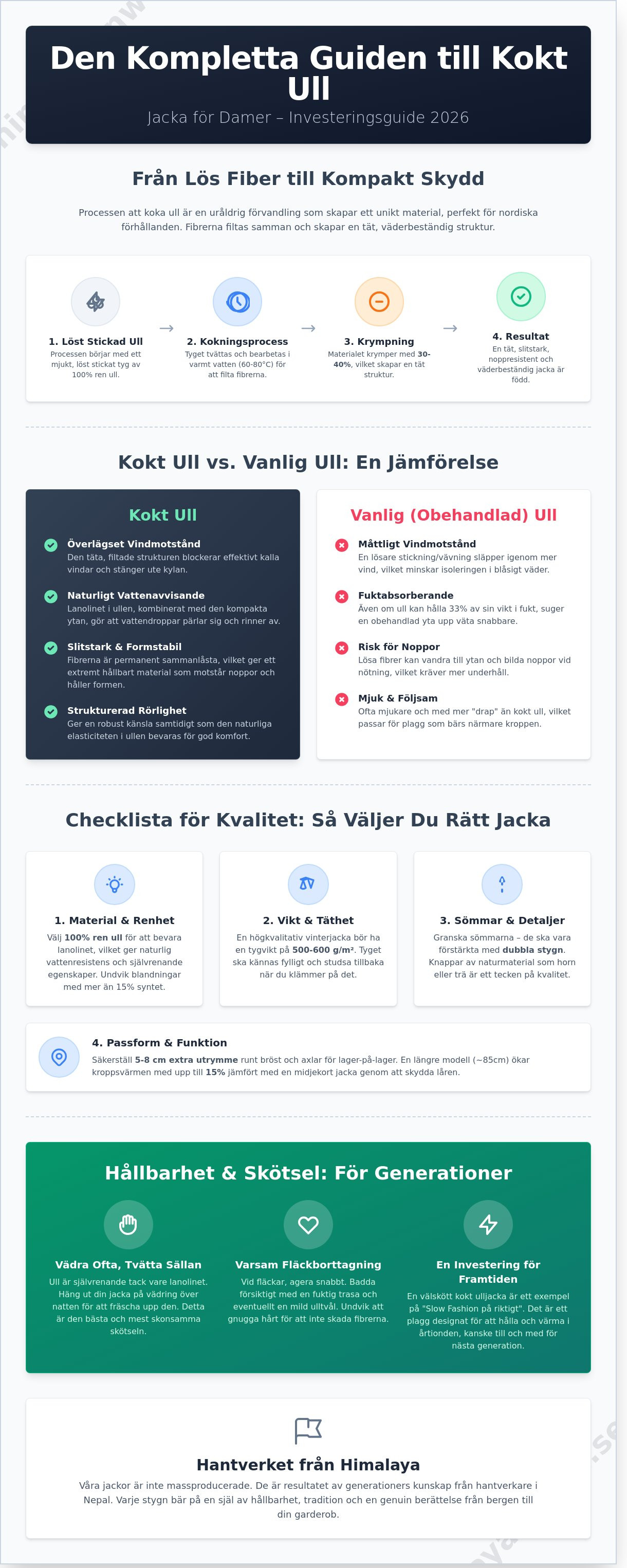
A boiled wool jacket for women is not just a garment; it is the result of an ancient transformation where nature's raw material meets craftsmanship. The process begins with knitting the wool into a loose fabric, which is then washed and processed in hot water, often between 60 and 80 degrees Celsius. During this treatment, the material shrinks by 30 to 40 percent of its original size. The result is a dense, felted structure that combines the softness of wool with a robustness similar to tightly woven fabrics. It is this density that makes the garment a loyal companion in the wardrobe, created to last for generations.
Unlike industrially produced felt, which is often pressed together from short fibers and synthetic binders, genuine boiled wool retains the natural elasticity of the fiber. The material is unique because it breathes actively. It releases excess heat when you move, but keeps out biting winds thanks to its compact surface structure. Wearing a boiled wool jacket for women is about choosing slow fashion for real, where every thread carries a story from the mountains to your everyday life.
The felting process: From loose wool to compact protection
When the wool is boiled, the surface of the fibers becomes ruffled so that the small microscopic scales interlock permanently. This natural locking mechanism makes the jacket significantly more durable than regular knitted sweaters. A major advantage is that the material becomes naturally resistant to pilling. Since the fibers are already intertwined in a fixed structure, they do not migrate to the surface to form small balls. This saves you hours of maintenance and keeps the jacket beautiful year after year.
Why boiled wool is the ultimate material for Nordic winters
The secret of wool lies in lanolin, the natural fat that acts as a protective shield against moisture. In light rain or snowfall, droplets bead on the surface instead of being absorbed directly. Should the weather change, the wool can absorb up to 33 percent of its own weight in moisture without feeling wet or losing its insulating ability. The millions of small air pockets in the felted structure act as a thermal barrier. This means that your boiled wool jacket for women provides warmth just as effectively during a crisp morning walk as when you are waiting for the bus in sleet.
How to choose the right boiled wool jacket: A quality checklist
Investing in a boiled wool jacket for women is choosing a lifelong companion for cold days. To find a garment that truly lasts for decades, an keen eye for detail is required. Always start by examining the purity of the material. A jacket made of 100% pure wool retains the natural lanolin of the fibers, which provides a water-repellent surface and a self-cleaning ability that disappears if the wool is mixed with more than 15 percent synthetic material. Look closely at the seams; in genuine craftsmanship, they are often reinforced with double stitches to withstand the stresses that arise from daily wear.
The details define the jacket's lifespan. Buttons made of natural materials like horn or wood are not only beautiful but also tend to stay on better than mass-produced plastic buttons. The placement of the pockets is also crucial for comfort. They should be at an angle that allows the hands to rest naturally without the fabric straining across the hips. When trying on your boiled wool jacket for women, make sure there is at least 5 to 8 centimeters of extra space around the chest and shoulders. This allows room for a substantial knitted sweater without the jacket losing its elegant silhouette.
Material weight and density
A high-quality winter jacket should have a fabric weight of about 500 to 600 grams per square meter. You can feel the difference by pressing the fabric between your thumb and forefinger; it should feel full and spring back rather than feeling thin or flimsy. Handmade garments from regions like Nepal often have a unique structure where every square centimeter bears traces of the artisan's hands, providing a density that machines struggle to replicate. This density is what stops the wind from penetrating the fibers on a chilly January morning in 2026.
Design and function for an active lifestyle
The choice between a short model and a longer coat depends on your everyday life. A model measuring 85 centimeters from the collar down protects the large muscle groups in the thighs, increasing body heat by up to 15 percent compared to a waist-length model. A high, sturdy collar eliminates the need for a scarf in milder weather and protects the neck from drafts. For those who move a lot in forests and fields, earthy tones such as olive green or deep gray are wise choices, as these shades hide dust and pollen significantly better than black or light fabrics. You can explore our curated selection of handmade wool clothing to find a faithful companion that combines tradition with modern function.
Boiled wool vs. regular wool jacket: Which material suits you best?
The choice between a classic wool coat and a boiled wool jacket is about more than just style; it's about how the garment breathes and moves with you. A regular wool jacket is often woven, which gives a smooth and formal surface but limited mobility. When wool is boiled, it undergoes a mechanical process where the fibers contract and the fabric shrinks by about 30 percent. This creates a material that is naturally elastic. A boiled wool jacket for women follows your movements during a brisk walk without straining across the shoulders, unlike the stiff resistance often felt in a traditional coat.
Wind resistance is another crucial factor in the Nordic climate. The dense felting of boiled wool acts as a natural barrier. While wind easily penetrates loosely woven fabrics, the boiled structure retains body heat even when gusts reach 10 meters per second. Aesthetically, boiled wool offers a rustic, lively texture that reflects the soul of craftsmanship, while the regular wool coat often strives for an industrial perfection that lacks the same depth and character.
When should you choose a boiled wool jacket?
This material performs best in temperatures between 0 and 15 degrees Celsius. It is the ultimate garment for an active city life or long forest hikes where you need to regulate heat without getting sweaty. A unique feature is how, after about 20 uses, the garment begins to conform to your specific body shape. It becomes like a second skin, a comforting embrace that only gets more comfortable with each passing season in the cold winds.
Lifespan and maintenance: A comparison
The durability of boiled wool surpasses most synthetic alternatives thanks to the natural elasticity of the fibers. The wool's own fat, lanolin, ensures that dirt stays on the surface instead of penetrating. Statistically, a boiled wool jacket for women only needs to be washed once a year, while a polyester jacket often requires washing every fortnight to stay fresh.
- Recovery: If the jacket is packed in a suitcase for 12 hours, it will regain its shape in just 30 minutes if hung in a humid bathroom.
- Investment: A quality jacket for 3,500 SEK worn 80 days a year for 10 years results in a cost of only 4.37 SEK per use.
- Durability: Boiled wool does not unravel or lose its shape, allowing it to be passed down through generations.
Sustainability and care: How to make your wool jacket last for generations
A boiled wool jacket for women is not just outerwear; it's an investment in the future that requires minimal but proper care. Wool fibers possess a natural intelligence that humans have relied on for thousands of years. Lanolin, the natural fat found deep within the wool, acts as a protective barrier that repels both dirt and unwanted odors. Instead of wearing out the material in a washing machine, which often shortens the garment's lifespan by several years, it's usually enough to let the jacket rest and breathe.
Nature's own cleaning: The power of airing
Oxygen is wool's best friend. By hanging your jacket on a sturdy hanger in fresh air, the fibers' ability to self-clean is activated. If your jacket feels wrinkled after prolonged storage, you can advantageously hang it in the bathroom while you take a warm shower. The humid air, which often reaches over 70% humidity, helps the fibers relax and smooth out wrinkles gently. It's a method that saves both the garment and our planet's resources.
To keep your jacket in pristine condition, follow these simple steps:
- Spot treat stains: If an accident occurs, use lukewarm water and a drop of mild wool soap. Gently press with a clean cloth instead of rubbing, as rubbing can damage the felted structure.
- Summer storage: When the spring sun takes over, your jacket should be stored clean and dry. Use red cedar wood scent blocks or small sachets of dried lavender to keep moths and other insects away.
- Rest the garment: Wool benefits from resting between uses. Let the jacket hang freely so that the fibers can regain their natural elasticity.
Ethical production and slow fashion
Choosing a handmade boiled wool jacket for women from Nepal means you're carrying a story that extends far beyond the fleeting trends of fashion shows. In the shadow of the Himalayas, these garments are created with a respect for animals and nature that has been passed down for generations. This is slow fashion for real. Each jacket bears the marks of the artisan's hands, giving the garment a unique soul that mass-produced alternatives completely lack. By investing in quality that is made to last for 20 years or more, you contribute to a more sustainable world where we value the timeless beauty of craftsmanship.
When you choose a garment created with love and tradition, you also choose to preserve a cultural treasure. It is a circular way of thinking where the material can one day return to the earth, but until then, it will keep you warm through all of life's changes.
Handmade wool jackets from the Himalayas: Why choose Himalayan Wool?
The story of your boiled wool jacket for women begins far from the hustle and bustle of the big city and fleeting trends. It takes shape in the hands of our skilled master craftswomen in Nepal, where craft traditions have been nurtured and passed down for generations. Here, at altitudes around 3000 meters above sea level, every seam is a testament to patience and profound craftsmanship. It's about more than just an outer garment. It's a piece of Nepal's soul transported from the majestic mountain peaks directly to your wardrobe.
Our quality guarantee rests on the pure mountain air and the freedom of the animals. We use 100% genuine wool from animals that graze freely on the slopes of the Himalayas, providing a fiber with natural elasticity and superior insulating properties. Each jacket is adorned with unique design details such as handmade edgings and natural material buttons. These details are created with a precision that industrial mass production can never achieve, making each garment a unique work of art.
The craftsmanship behind every thread
Finishing a single jacket by hand often requires between 14 and 21 days of focused work. This slow process creates a special density in the wool that gives the garment its characteristic wind resistance and durability. When you put on a boiled wool jacket for women from Himalayan Wool, you immediately feel the difference in the structure. It's a weight and softness that can only arise when human hands guide every step of the manufacturing, from carding to the final stitch.
Make a difference with your wardrobe
Your purchase creates a direct and significant link between your daily life in Sweden and the living conditions of artisans in Nepal. By choosing Himalayan Wool, you support over 50 local artisans and help preserve ancient techniques that otherwise risk being pushed aside by the fast fashion industry. We call it slow fashion for real. It's a conscious choice for 2026 and the future, where quality and ethical responsibility are allowed to go hand in hand.
Wear a story that warms through generations
Choosing a boiled wool jacket for women for 2026 is about more than just aesthetics; it's a conscious choice for a sustainable lifestyle that lasts longer. By combining 100% genuine wool from the rugged landscapes of the Himalayas with ancient techniques, a garment is created that truly defies the test of time. Each individual jacket requires up to 45 hours of dedicated craftsmanship by local master artisans in Nepal before it is ready for its long journey home to you. This is slow fashion for real, where the natural material resists both wet and cold in varying climates without losing its unique character or fit.
When you invest in quality designed to last for over 30 years, you directly contribute to preserving an invaluable cultural treasure and supporting local artisan communities. You get a garment that breathes, regulates warmth, and ages with a rare dignity alongside you. Let your next jacket be a timeless testament that genuine craftsmanship and personal style can walk hand in hand through all seasons of life.
Find your unique handmade wool jacket from Nepal here
Give yourself the gift of natural warmth and let the soul of Nepal move into your wardrobe today.
Frequently asked questions about boiled wool
Is a boiled wool jacket warm enough for Swedish winter?
Yes, a boiled wool jacket can handle temperatures down to -15 degrees if you use the layering principle with a substantial sweater underneath. The material's natural density creates an effective barrier against cold winds while retaining body heat in a way that synthetic materials rarely do. In 2026, more and more people are choosing this sustainable option for its ability to insulate even when humidity is high.
How do you best wash a boiled wool jacket for women?
You should primarily air your boiled wool jacket for women outdoors in humid air instead of washing it in a machine. The natural lanolin in the wool repels dirt and bad odors, meaning the garment stays fresh with just 2 to 3 hours of airing. If a stain occurs, you can spot treat the area with lukewarm water and a mild wool soap at a maximum of 30 degrees to preserve the fiber structure.
Is boiled wool itchy against the skin?
No, boiled wool is rarely perceived as itchy because the fibers contract and soften during the controlled boiling process. Our garments are made from 100 percent pure wool from Nepal that feels soft and comforting against the skin throughout the day. For people with very sensitive skin, we recommend wearing a long-sleeved base layer in silk or organic cotton under the jacket for maximum comfort.
What is the difference between boiled wool and felted wool?
The difference lies in the manufacturing method where a boiled wool jacket for women is first knitted and then shrunk in hot water with about 25 percent precision. Felted wool, on the other hand, consists of loose fibers that are pressed together through moisture and mechanical processing without first having been a knitted fabric. This gives boiled wool superior elasticity and freedom of movement compared to the stiffer felted material.
How do I know what size to choose for a handmade wool jacket?
You should measure a jacket you already own and compare these measurements to our size chart to find the perfect fit. Since each garment is handmade by artisans in Nepal, measurements may vary by 1 to 2 centimeters between different pieces. Choose a size that allows for an extra sweater underneath so you can regulate warmth depending on the weather.
Is boiled wool waterproof?
Boiled wool is naturally water-repellent but not completely waterproof in heavy or continuous rain. The material can absorb up to 30 percent of its own weight in moisture without feeling wet or losing its insulating ability against the cold. In light snowfall or drizzle, you often see water droplets bead on the surface thanks to the wool's natural oils.
Why do some wool jackets pill more than others?
Pilling occurs when short wool fibers migrate to the surface and intertwine due to friction, for example, on the arms and pockets. High-quality jackets use 100 percent long fibers that hold together better and pill significantly less than cheaper blended materials. You can easily restore the surface by using a wool comb once a season to gently remove loose fibers.
How do I best store my wool jacket when it's not in season?
Store your jacket freshly washed and completely dry in an airtight storage bag to protect the natural fibers from moths and moisture. Include two pieces of cedar wood or a small sachet of dried lavender as natural pest protection during the summer months. Avoid hanging the jacket on a hanger for an extended period, as the weight of the wool can cause the garment to lose its original shape.