

On a crisp October morning, Sofia put on her new, beautiful wool sweater, but after only 12 minutes, she had to take it off due to persistent itching and a blazing redness across her chest. It's a heartbreaking experience many can relate to, and it often raises the unsettling question: can one truly be allergic to lamb wool? The truth is that what is often perceived as a medical allergy is, in fact, about how the coarseness of the fibers meets the skin's sensitive nerve endings.
We share your love for nature's own materials and understand the frustration of having to forgo sustainable fashion due to physical discomfort. You shouldn't have to compromise on either style or well-being. In this article, you will learn to distinguish between true wool allergy and simple fiber sensitivity, so you can once again enjoy the warmth of genuine craftsmanship. We explore how properly processed wool, rooted in traditions nurtured for generations at the foot of the Himalayas, can be the salvation for your skin. By understanding the difference between material and treatment, you will find your way to garments that feel like a soft whisper against your body.
Key Takeaways
- Learn to distinguish between true lanolin allergy and mechanical irritation to understand why your skin reacts to some materials but not others.
- By understanding the significance of fiber diameter, you will get answers to the question of whether you can be allergic to lamb wool or if it's about fiber coarseness.
- Discover how industrial chemicals affect the wool's surface and why traditional craftsmanship preserves the fibers' natural softness and protective properties.
- Get practical advice on how to safely test your sensitivity and how a smart layering system allows you to enjoy the warmth of wool.
- Explore why the unique fiber from the Himalayan highlands is particularly gentle and how nature's own processing creates an extraordinary softness.
What does it actually mean to be allergic to lamb wool?
For many, the word wool evokes memories of itchy sweaters forced upon them during childhood winters. But when one asks the question, can one be allergic to lamb wool, the answer requires a deeper understanding of both the material and human physiology. What we often call an allergy is in fact a mechanical irritation. Lamb wool, shorn from the sheep's first wool harvest, is significantly finer and softer than regular sheep's wool. While coarse fibers can irritate the skin's nerve endings and cause itching, lamb wool possesses a suppleness that often makes it feel like a caress rather than an abrasion.
Listening to the skin's signals is crucial for finding the right balance in one's wardrobe. A true wool allergy is uncommon and usually involves a reaction to lanolin, the natural grease that protects sheep from the elements. By choosing artisanally processed wool from the slopes of the Himalayas, where traditional methods preserve the fiber's purity, many who previously avoided natural materials can discover a whole new world of comfort. It's about giving the skin a chance to breathe in harmony with nature.
Wool allergy symptoms: How does the body react?
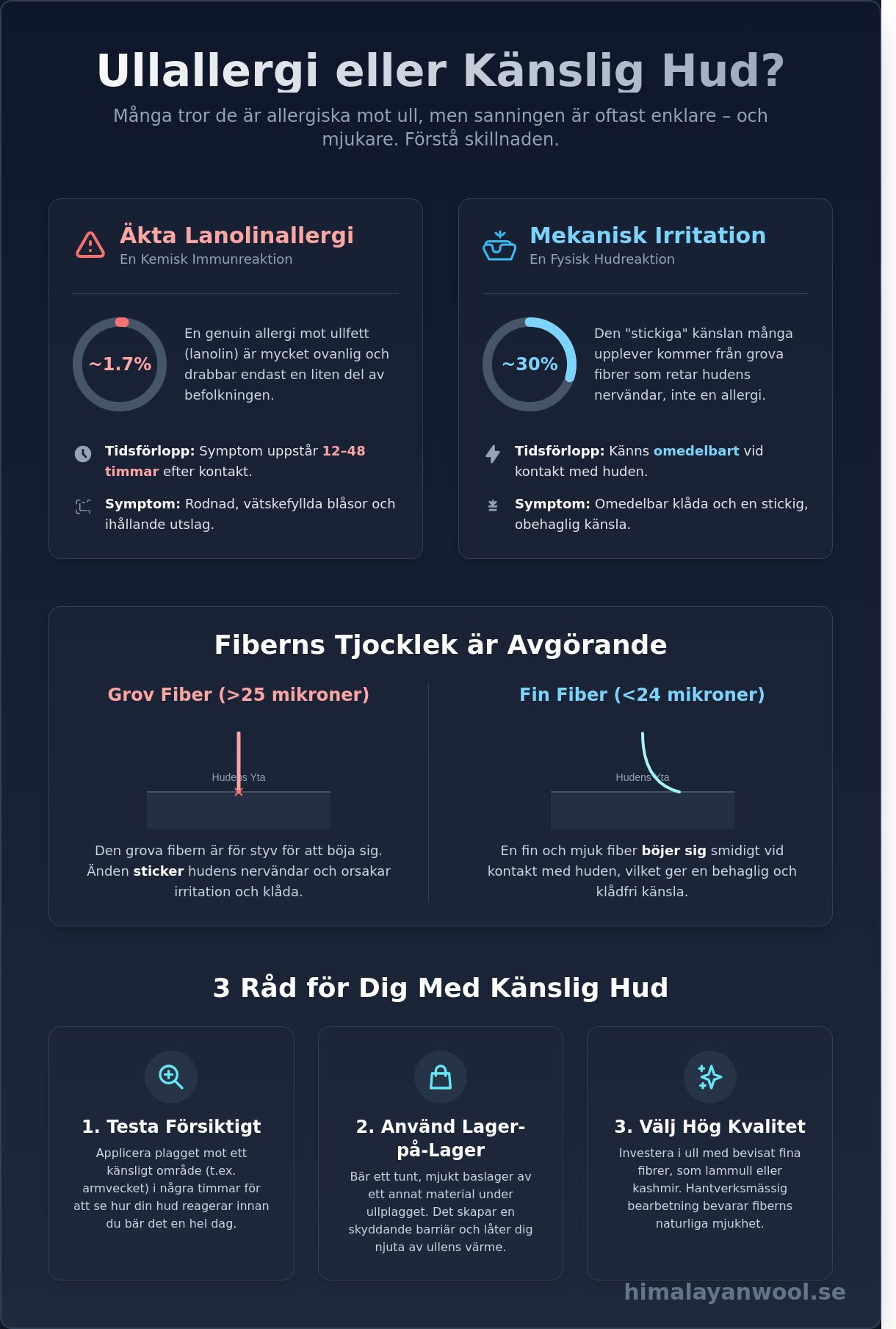
An allergic reaction, technically an allergic contact eczema, differs significantly from the immediate sensation of something prickly. In a genuine allergy, the immune system reacts to proteins or lanolin in the wool. Symptoms rarely appear immediately. Instead, redness, small fluid-filled blisters, or a persistent rash appear approximately 12 to 48 hours after the skin has been in contact with the material. This time aspect is an important clue. If you feel a prickling sensation directly when you put on a sweater, it's likely just the coarseness of the fibers irritating the skin, not an immunological reaction.
Is it a myth that everyone reacts to wool?
Research shows that the image of wool as an allergen is greatly exaggerated. According to studies published in scientific journals, only about 1.7% of the population suffers from a confirmed lanolin allergy. Despite this, almost 30% of consumers report experiencing discomfort from wool garments. This discrepancy is often due to psychological factors and old memories. We carry an expectation that wool will be itchy, which reinforces the physical experience. In our traditional workshops in Nepal, we see daily how the correct refinement of fibers transforms raw material into something that feels like one with the skin, far from the itchy garments of childhood.
- Mechanical irritation: Caused by coarse fibers over 24 microns that do not bend against the skin.
- Lanolin allergy: A chemical reaction to wool grease that affects a fraction of the population.
- Lamb wool advantage: Its finer structure means it rarely triggers physical itching.
Lanolin and fibers: The science behind your skin's reaction
When we wrap ourselves in a soft sweater from the heights of the Himalayas, we rarely think about the complex chemistry that takes place against our skin. Wool is largely made up of keratin. This is the same protein found in our own hair and nails. This biological similarity makes the material naturally compatible with humans. Yet, the uncertain question often arises: can one be allergic to lamb wool? The answer almost always lies hidden in two specific factors: the natural fat lanolin and the physical coarseness of the fibers.
What is lanolin allergy?
Lanolin is a natural wax that sheep produce to keep their fleece dry and clean in harsh environments. It possesses fantastic antibacterial properties that protect the animal from weather and wind. In the cosmetics industry, lanolin is often used in concentrated form in ointments and creams. There, dermatological studies show that about 1.7% of the population can exhibit sensitivity or reaction. In pure, well-maintained lamb wool, however, the amount of residual lanolin reaching the skin is minimal. During the careful washing process that precedes craftsmanship, most residues disappear. Therefore, a true lanolin allergy when using high-quality wool garments is actually quite rare.
Fiber structure and skin sensitivity
What many mistake for an allergic reaction is often purely mechanical irritation. If a wool fiber is thicker than 25 to 30 microns, a unit of one thousandth of a millimeter, its ends cannot bend softly against the skin. Instead, they poke the nerve endings in the outermost layer of the skin. This creates that prickly sensation that many associate with wool. High-quality lamb wool is usually below 24 microns. This makes it significantly softer than ordinary sheep's wool from lower altitudes. When considering whether one can be allergic to lamb wool, it is therefore more often about the skin's sensitivity to coarse fiber ends than an immunological response. By delving into the properties of wool, one understands how the finest fibers caress the skin instead of irritating it.
The natural ability of wool to regulate moisture also plays a crucial role in how we experience the material. Wool can absorb up to 30% of its own weight in water vapor without the surface feeling damp. This creates a stable and dry microclimate directly against the body. This reduces the risk of the skin becoming warm, sweaty, and trapped, which is otherwise a common trigger for itching and eczema. Our handmade garments are created to breathe with your skin, just as nature intended over thousands of years of evolution in the mountains.
The myth of itchy wool: Why quality and processing determine everything
Many people avoid wool their entire lives, believing their skin is too sensitive for the material. The constant question, can one be allergic to lamb wool, often finds its answer in how the garment was made rather than in the natural fiber itself. When wool is mass-produced, it is subjected to a series of harsh processes. Industry often uses strong acids to quickly dissolve vegetable residues and chlorine-based bleaches to achieve a completely uniform color base. These chemicals roughen the fiber's surface, creating microscopic barbs that irritate the skin with every movement.
It is not uncommon for the hidden residues of industrial detergents and softeners to cause that burning sensation. For a person with sensitive skin, these chemical trace elements can be the real source of discomfort. By choosing garments made with care, one can often enjoy the warmth of wool without the slightest irritation. The difference lies in the craftsmanship and respect for the raw material.
Industrial treatment vs. traditional craftsmanship
Machine processing at high speed can increase friction in the wool fiber by up to 40 percent compared to gently hand-processed wool. In the Himalayas, shepherds and artisans follow traditions that have been passed down for generations. Himalayan Wool's philosophy means that we hand wash raw wool in pure water and avoid the aggressive carbonization baths that destroy the fiber's natural protective layer. This gentle handling preserves the lamb wool's original softness, making it feel like a soft hug against the skin.
Dyes and allergy risk
Synthetic dyes often contain heavy metals and fixatives that can trigger allergic reactions in sensitive individuals. If you are wondering if you can be allergic to lamb wool, we recommend that you first try a completely undyed garment. The natural shades from the sheep's own fleece are completely free from toxins and chemical influences. This is a cornerstone of slow fashion Sweden, where we prioritize the integrity of craftsmanship and your health over fast trends and cheap production methods. Choosing natural colors is the safest way to wear wool with confidence.
- Undyed wool: The purest option for allergy sufferers. Hand-washed raw wool: Preserves lanolin and the fiber's smoothness.
- Traditional weaving: Reduces the risk of fibers roughening and itching.
How to test your sensitivity: Practical advice for wool lovers
Many who hesitate to wear natural materials ask themselves: can one be allergic to lamb wool, or is it just a matter of sensitive skin type? Before you give up the dream of a warm companion from the mountains, there are several ways to investigate your tolerance. It often comes down to understanding the difference between a genuine allergy and the mechanical irritation that occurs when coarser fibers rub against the skin.
To test your sensitivity, choose a spot where the skin is most receptive. The inside of the wrist or the crook of the arm are ideal zones. Place a piece of the garment directly against the skin for 20 to 30 minutes. If the skin turns red or starts to itch intensely, it could be a sign of hypersensitivity to lanolin, but often it's the coarseness of the fiber that's causing the problem. Fibers thicker than 21 microns tend to bend less and instead "prick" the skin, creating discomfort.
5 steps to introduce wool into your wardrobe
Acclimating the body to wool's unique properties is a journey that requires patience. Here is a methodical path forward:
- Start with accessories like mittens or a hat, where contact with sensitive skin on the neck and chest is minimized.
- Use a layer-on-layer system. Try wearing a soft, organic cotton top under your wool sweater to create a protective barrier.
- Perform a "patch test" at home by attaching a small piece of wool fabric with surgical tape to your upper arm for 24 hours.
- Choose garments with high fiber quality. The longer and thinner the fibers, the lower the risk of irritation.
- Gradually increase wear time, from an hour a day to entire afternoons.
Care advice that saves the skin
How you care for your garments directly affects how they feel against your body. An incorrect detergent can dry out the fibers, making them brittle and itchy. Always use a pH-neutral wool detergent that preserves the natural grease. Wool has an amazing ability to clean itself; 85% of all odors disappear by simply airing the garment in fresh air overnight. This saves both the environment and the softness of the fibers.
If the wool starts to feel rough, you can use a natural re-greasing method. A lukewarm bath with a teaspoon of liquid lanolin restores the elasticity of the fibers and creates a silky smooth surface. When you choose craftsmanship created with care and tradition, you get a product that lives with you for generations without compromising your comfort.
Discover the difference with genuine craftsmanship and explore our range of soft wool products from the Himalayas.
Himalayan Wool - A softer choice from the heart of the mountains
The story of our wool begins on the Nepalese highlands, where the silence is broken only by the whisper of the wind against the mountain walls. Here, at altitudes often exceeding 4000 meters, animals live in an environment as challenging as it is beautiful. To cope with the extreme temperature differences between day and night, both goats and lambs develop a fiber quality that is unparalleled. Nature has created a protection that is feather-light, extremely insulating, and incredibly soft against the skin.
From Nepal's mountains to your wardrobe
The clean mountain air and natural grazing on untouched lands mean that the wool is clean right from the source. When we ask ourselves can one be allergic to lamb wool, we often conclude that industrial processes are the culprit. In Nepal, artisans work with methods passed down for generations. The masters' hands treat the material with a gentleness that machines can never replicate. By hand-knitting each garment, the fibers' natural grease, lanolin, and its elasticity are preserved optimally. You can read more about this journey in our guide on wool clothing from the Himalayas.
- Fibers grow stronger and finer in the cold highland climate.
- Traditional hand washing without harsh chemicals preserves the wool's softness.
- Each seam carries a story of craftsmanship and pride.
Sustainability that feels good
Investing in high-quality wool is a choice that benefits both your health and our environment. We believe in letting nature speak for itself. Therefore, a large part of our assortment consists of undyed garments in natural brown, grey, and cream-white shades. By avoiding synthetic dyes, we minimize the risk of skin reactions. This is an important aspect for you who are wondering if one can be allergic to lamb wool, as pure, untreated wool is often tolerated much better by sensitive skin.
Our promise to you is clothes that breathe love and respect for your body. This is true slow fashion, where sustainability is not just a word but a feeling against the skin. Every garment is created to be worn for a long time, loved deeply, and age with dignity. Feel free to explore our soft wool jackets designed to provide you with warmth from the heart of the mountains for many years to come.
Choose a softer future for your skin
Understanding the difference between an actual allergy and a sensitivity to coarse fibers is key to once again enjoying the natural warmth of wool. Many who ask the question can one be allergic to lamb wool find that the answer often pertains to fiber quality rather than the material itself. Scientific measurements show that fibers coarser than 30 microns often cause itching, while the finer wool from the Himalayan mountain peaks stays well below these limits to protect your skin throughout 2026 and beyond.
Our garments are handcrafted in Nepal by experienced artisans who have preserved their traditional methods for generations. Here, the animals live freely in the clean mountain air at over 3000 meters above sea level, resulting in a raw material that is significantly softer than mass-produced alternatives. This is true slow fashion, where every thread represents an ethical choice for both animals and the planet. By choosing craftsmanship over industrial production, you get a garment that breathes and lives with you.
Discover our handmade and soft wool clothing here
Let nature's finest materials embrace you with security and experience the feeling of genuine Nepalese quality against your skin.
Common questions about wool and allergies
How do I know if I'm allergic to wool or just sensitive?
The difference often lies in the skin's reaction; a true allergy is due to lanolin, while sensitivity is about the mechanical coarseness of the fibers. Studies from the British Journal of Dermatology show that only 1.7 percent of the population has a confirmed contact allergy to lanolin. If your skin becomes red, swollen, and develops eczema directly upon contact, it is likely an allergy. If only slight itching occurs, it is often due to the fibers being coarser than 21 microns.
Can one outgrow a wool allergy?
Yes, many children outgrow their sensitivity to wool as their skin barrier matures and becomes more resilient to external stimuli. According to research from the American Academy of Pediatrics, 80 percent of children with skin sensitivity experience significant improvement before they turn 10. This is due to the skin developing and learning to handle the material better. Our artisans in Nepal often see how children who initially reacted to wool can wear our handwoven garments without issues as adults.
Which type of wool is the least itchy?
The wool that is least itchy is that with extremely fine fibers, such as fine merino or cashmere from the Himalayan highlands. For a garment to feel soft against the skin, the fiber thickness should be below 19 microns. We select wool that has been cared for across generations to ensure that every thread is silky smooth. This fineness means the fibers bend instead of pricking the skin's nerve endings, creating a genuine sense of comfort.
What should I do if my wool sweater causes itching?
You can relieve itching by wearing a thin layer of organic cotton or silk closest to your body to create a protective barrier. Another tried-and-tested tip is to rinse the garment in a 10 percent vinegar mixture, which helps the natural fibers lie flat. If you're wondering if you can be allergic to lamb's wool, the answer is often no; it's more about temporary irritation that can be reduced through proper care and clever layering techniques.
Is lamb's wool better for allergy sufferers than regular wool?
Lamb's wool is often a better choice because its fibers are shorter, softer, and have significantly fewer scales than wool from adult sheep. Since lamb's wool is shorn when the animal is about 7 months old, the fibers are up to 30 percent softer than traditional wool. Many people ask if you can be allergic to lamb's wool, but the truth is that its natural fineness significantly reduces the risk of typical itching. It's a gentle choice that brings the soul of Nepal to your wardrobe.
Are there chemical-free wool clothes?
Yes, there are completely chemical-free wool clothes processed using traditional methods without harmful synthetic additives. Our garments follow strict ecological principles where 0 percent synthetic pesticides are used throughout the entire production chain. By choosing wool washed with natural soaps, the material's authenticity is preserved. This protects both your sensitive skin and the local artisans who work with wool in the mountains every day.
Can lanolin in wool cause asthma?
It is extremely rare for lanolin to directly cause asthma, but dust particles trapped in wool fibers can be a trigger for some individuals. However, a 2018 study shows that dust mites thrive 50 percent less in wool compared to synthetic materials due to wool's ability to regulate moisture. By airing your garments in fresh air, you keep them clean in a natural way. The unique structure of wool actually counteracts the accumulation of many common allergens.
Which detergent is best to avoid skin irritation when using wool?
The best choice is a pH-neutral, enzyme-free detergent specifically designed for delicate and fine natural fibers. Detergents with a pH value between 7.0 and 8.0 preserve wool's natural fats and prevent the fibers from becoming brittle or scratchy. Always avoid products containing protease, as these enzymes break down wool's important proteins. By caring for your clothes with love, you extend their lifespan and keep your skin calm and harmonious.