

You stand there in the biting winter cold, wrapped in what looks like a soft and comforting embrace, yet the cold penetrates straight through the fibers while your skin feels trapped and damp. This is the bitter reality when cheap polyester masquerades as exclusive natural fiber, a trend that means up to 70% of the garments in stores today contain hidden plastic materials. The big question that arises with every purchasing decision is: how do you know if it's real wool, really? We know how frustrating it is to invest money in a garment that promises warmth but delivers plastic, especially when seeking that genuine sense of craftsmanship meant to last for generations.
We agree that you deserve honesty and the unique function that only nature's own fibers can provide. In this guide, you will learn to distinguish between nature's warming gifts and cheap plastic with the help of our proven expert tricks from the Himalayas. We will show you exactly how to use your senses to uncover synthetic materials in just 5 seconds. You will also learn how the classic flame test works, so you can feel completely secure the next time you choose a garment that will carry a story and truly warm your soul.
Key Takeaways
- Learn to use your senses to feel the difference between wool's natural elasticity and synthetics' dull surface through simple touch tests.
- Discover how the flame test serves as the most reliable tool to answer the question how to know if it's real wool without damaging your favorite garment.
- Understand why genuine natural fibers outperform acrylic in terms of both your body's thermoregulation and the planet's long-term well-being.
- Gain insight into why a "100% wool" label is just the beginning and how fiber length determines whether the garment will remain soft or pill.
- Explore the soul of craftsmanship from the Himalayas and learn to value the unique quality that only generations of traditional methods can produce.
Why it matters if your wool is real
Wrapping yourself in a soft sweater from the heights of the Himalayas is an experience for both body and soul. But in a world where fast trends dominate, plastic often hides beneath the surface. Real wool is not just a material; it is a living, protein-based fiber bestowed upon us by the animal kingdom. Whether it comes from sturdy sheep, soft alpacas, or the exclusive goats that give us cashmere, each fiber carries a unique history of survival and warmth. The question how to tell if it's real wool is therefore about much more than just the label on the neck. It's about understanding the difference between nature's genius and the factory's copies.
A pure wool sweater is an investment that can be passed down through generations. While synthetic garments often lose their luster after just ten washes, wool becomes more beautiful with time. It is naturally biodegradable and returns to the earth without a trace, unlike plastic fibers that linger for centuries. Choosing genuine goods is to honor traditional craftsmanship and the shepherds who for centuries have cared for their animals in the clear mountain air.
Wool vs. Synthetic: A Battle for Comfort
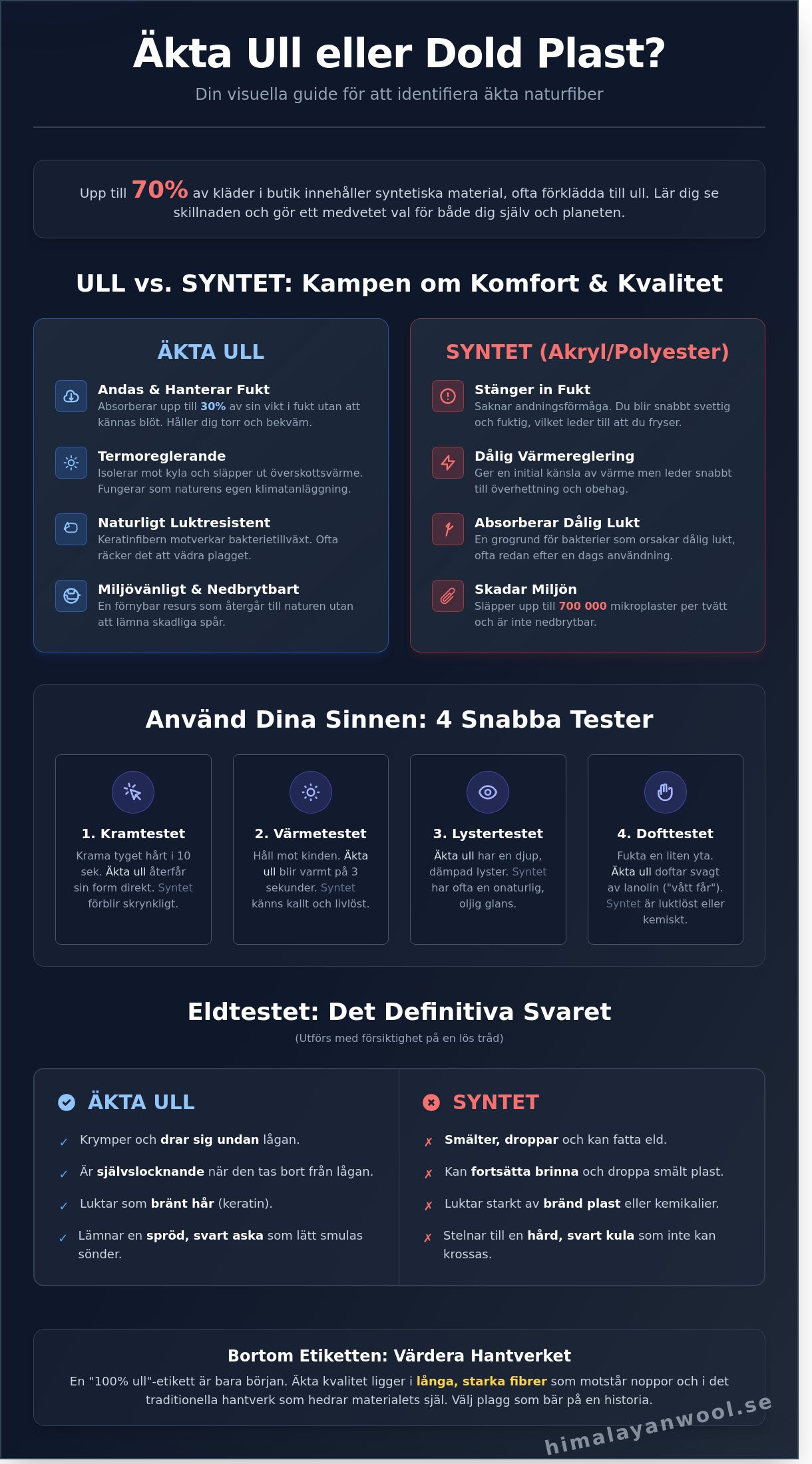
The difference is most noticeable when the temperature drops or when you are active. Acrylic and polyester are essentially oil-based plastics that trap the skin. In these materials, you quickly become sweaty because they lack breathability. Wool, on the other hand, has incredible thermoregulation. It can absorb up to 30 percent of its own weight in moisture without feeling wet. This means you stay dry and warm even if it's snowing. In addition, wool has a natural resistance to bacteria. Where a synthetic sweater starts to smell bad after a day of use, airing your wool sweater in the fresh air is usually enough to make it like new again.
The Price of a Copy
Many are tempted by cheap blended materials marketed with a "wool-look," but the truth is that the function can never be copied. When you choose a cheap copy, you pay a high price in other ways. A study from Plymouth University shows that a single wash of a synthetic sweater can release up to 700,000 microplastic particles that end up in our oceans. By learning how to know if it's real wool, you not only protect your own wardrobe, but also the planet. By supporting ethical craftsmanship over fast fashion, you ensure that the knowledge of local artisans in Nepal continues to thrive, while also getting a garment that exudes quality and soul.
The Sensory Tests: Use Your Senses
Understanding the difference between living natural materials and mass-produced plastic requires you to slow down and listen to what the material tells you. For thousands of years, nature has perfected the wool fiber to protect animals from the biting cold of the Himalayas, leaving traces that a factory can never imitate. When you stand with a garment in your hand and wonder how to know if it's real wool, your own senses are your most reliable tools.
Your Palm Knows Best
Wool has a unique mechanical resilience, a kind of inherent vitality. If you firmly squeeze the garment in your palm for exactly 10 seconds and then release, the fibers should expand and regain their shape almost immediately. Synthetic materials like acrylic often feel stiff or "dead" in comparison, and they often leave sharp creases that don't straighten out on their own.
- The Warmth Test: Hold the material against your cheek. Real wool should start reflecting your body heat within just 3 seconds, creating an immediate sense of comfort. Synthetics often feel cold and repellent upon first contact.
- The Luster: Examine the surface in natural daylight. Real wool has a deep, muted luster thanks to the scales on its fibers. Plastic-based materials often have a glossy, almost oily reflection that looks unnatural.
- The Dance of the Fibers: Look for small irregularities. In our handmade products, you'll see that each thread has a soul, with small variations that prove it's genuine craftsmanship rather than the result of a sterile machine process.
The Scent of Nature
One of the most revealing methods for answering the question how to know if it's real wool is the scent test. Real wool contains keratin, the same protein found in human hair and nails. It carries a subtle scent of earth and animal, especially if exposed to a little moisture. If you dampen a small area with a few drops of lukewarm water, a faint smell of lanolin or "wet animal" should emerge. It's the scent of a material that has breathed pure mountain air.
Synthetic materials are made from petroleum and chemicals. They are either completely odorless or emit a faint, pungent plastic smell when warm or damp. Wool can absorb up to 35 percent of its own weight in moisture without feeling wet, while water on a synthetic garment either runs off immediately or settles as a heavy, cold film. This ability to manage moisture is part of wool's magic, a tradition we have maintained for generations to provide you with clothes that breathe in harmony with your body.
The Flame Test: The Ultimate Way to Reveal Synthetics
When fingers aren't enough to determine quality and feel fails, we turn to the elements. Fire never lies. It's the most definitive answer to the question: how do you know if it's real wool? By observing how fibers react to heat, we immediately see the difference between nature's living materials and the factory's dead plastic. A single small thread holds the truth about whether the garment comes from animals grazing on vast plains or if it's a byproduct of the oil industry.
Wool is a protein-based material, just like our own hair. It has a natural resistance to fire and behaves gracefully when it encounters heat. Synthetic fibers like polyester and acrylic are, in practice, plastic. They react with panic upon contact with flames. The flame test is therefore the artisan's last and most reliable method to ensure that the tradition and quality of the material are intact.
Step by Step: How to Perform a Burn Test
Safety is crucial when performing this small experiment. You don't need to damage your garment to get answers. Find a loose thread in a hidden seam, preferably near the armpit or on the inside of a hem. Gently pull out a fiber that is at least 2 centimeters long. Hold the thread firmly with tweezers over a ceramic or metal dish. Then slowly bring a match or lighter to the very tip of the fiber and carefully observe what happens.
Analyze the Result
Real wool, like that which we carefully process from the high plateaus of the Himalayas, burns slowly. It often extinguishes itself when you remove the heat source. The smell is unmistakable; it smells of burnt hair or feathers. When the fire has done its work, it leaves behind a brittle, black ash. If you touch the ash, it immediately crumbles into a fine powder between your fingertips. This is the primary proof of a pure natural product.
Synthetic materials behave completely differently. They melt rather than burn and quickly pull away from the flame. The smell is pungent and chemical, like burnt plastic or rubber. Instead of ash, a hard, shiny black bead forms, stuck to the end of the thread. This bead cannot be crushed; it is solid and unyielding. If you test a blended material, you will notice that the thread both smells of burnt hair and leaves a hard residue. Often, as little as 15 to 20 percent synthetic material is enough for the hard plastic bead to be clearly noticeable during the test.
This melting and solidifying property is the basis of thermoplastics, and with the right equipment, it can be used to create extremely strong joints. Companies specializing in this, such as Sharkhead Nordic AB, use advanced methods to join plastic materials in a controlled manner.
- Real wool: Smells of burnt hair, leaves brittle ash, extinguishes easily.
- Synthetic: Smells chemical, melts into a hard bead, often burns quickly.
- Blend: Exhibits properties from both categories, often with a hard edge.
By understanding these simple physical laws, you can always feel confident in your choices. Knowing how to tell if it's real wool ultimately means cherishing genuine craftsmanship and choosing materials that breathe with nature.
Beyond the Label – How to Assess Wool Quality
The label is just the beginning, a whisper about what the garment truly contains. Understanding how to know if it's real wool of the highest class requires us to look beyond the printed words and instead listen to the material's own voice. A sweater labeled 100% wool can feel completely different depending on whether it was created in a bustling factory or in tranquil forms in a Nepalese mountain village. The difference often lies in the length of the fibers and how they were treated before ending up on the knitting needles.
In industrial production, wool fibers shorter than 5 centimeters are often used. These short fibers tend to creep out of the yarn and cause skin irritation. When artisans in the Himalayas select wool, they prioritize fibers measuring between 10 and 15 centimeters. Long fibers produce a yarn that is both softer and stronger, which is crucial for the garment to retain its shape for decades instead of just one season.
- Fiber length: Longer fibers mean fewer protruding ends, reducing the risk of itching.
- Knitting density: A quality garment often uses 30% more yarn than budget alternatives to create a stable and warm structure.
- Weight: A genuine wool sweater in men's size should weigh between 500 and 800 grams; if it's lighter, there's a high risk that the stitches are too loosely knitted.
Why do some wool sweaters pill more than others?
Pilling occurs when loose fiber ends twist together on the surface due to friction. It is a natural phenomenon for all natural materials, but the amount of pilling reveals the quality of the yarn. Handspun yarn from Nepal has a natural variation that binds the fibers more tightly than machine-spun yarn. If a sweater pills excessively after only two weeks of use, it indicates that the manufacturer used waste material or extremely short fibers. A high-quality wool sweater may get occasional pills at the beginning, but these decrease once the shortest fibers have shed.
Quality control in the store
To assess the quality on the spot, you can hold the garment up to a light source, such as a window or a strong lamp. The light should filter evenly through the stitches. If you see dark spots or large gaps, it indicates uneven fiber distribution. Also, examine the seams at the shoulders and cuffs. Handmade seams are often more flexible and pliant, allowing the garment to move with your body instead of restricting it. Knowing the origin is the best guarantee; wool grown in pure mountain air and hand-processed carries a completely different energy than mass-produced textiles.
When you seek answers to the question of how to tell if it's real wool and high quality, trust your fingertips. It should feel resilient and regain its shape immediately after you squeeze it.
Himalayan Wool: Authentic Craftsmanship from the Roof of the World
Our promise is unwavering: we offer only 100% genuine wool from goats and lambs living at over 3000 meters altitude in the Himalayas. Here, in the thin and pure mountain air, the animals develop an undercoat of exceptional quality to cope with extreme temperature fluctuations. Many customers ask us how to tell if it's real wool when the market is flooded with cheap blended materials, but for us, purity is a given. The natural lanolin remains in the fibers, providing a softness and a scent of nature that synthetic copies can never replicate.
Every stitch in our collections carries a unique story from Nepal. It is slow fashion in its purest form. Instead of plastic-based materials that contribute to microplastics in our oceans, we offer clothes that breathe, warm when it's cold, and cool when the sun peeks out. Our wool feels different against the skin; it is alive, pliable, and has a thermal capacity that technical materials can only dream of. It doesn't itch in the same way cheap wool often does, because the fibers are long and silky.
From Nepal's Mountains to Your Wardrobe
The journey begins with shepherds who have followed their family traditions for more than seven generations. By using traditional methods, where the wool is sorted and spun by hand, we preserve the natural properties that make the material so unique. We consciously choose to forgo machine mass production to ensure that each fiber retains its elasticity and strength. Once you have learned how to tell if it's real wool by feeling our garments, you will never want to go back to synthetic. We never compromise on origin; we know that true quality requires time and respect for nature's rhythm.
Choose with Your Heart
Shopping with us is more than just a purchase; it's an act that makes a difference. Your choice directly supports over 50 local families in Nepal and helps preserve a craft that risks disappearing in a world of fast fashion. By investing in a jacket or sweater that only becomes more beautiful and comfortable with each passing year, you break the consumption pattern and choose true sustainability.
Discover our collection of genuine wool jackets and sweaters here and become part of the story that stretches from the majestic peaks of the Himalayas all the way to your wardrobe.
Choose a Craft That Breathes Nature's Own Power
By using your senses and performing the crucial flame test, you can now confidently distinguish between plastic and nature. This is vital knowledge in an era where over 60 percent of the world's clothing now consists of synthetic materials. When you ask yourself how to know if it's real wool, it's about more than just material choice; it's about seeking the soul and warmth that only 100 percent natural fibers can provide. Our garments are lovingly handmade by 25 skilled artisans in Nepal who preserve techniques passed down for 4 generations. Here, at 3000 meters altitude, each thread becomes a tribute to slow fashion and ethical production that cares for both people and animals.
To wear real wool is to wear a piece of the living history of the Himalayas. Every stitch is made with such care that the garment is designed to give you warmth for at least 10 winters. We believe in a quality that feels directly against the skin and that makes a real difference to the families in the mountains who created it. Take the step towards a wardrobe that is both honest, sustainable, and timeless.
See our handmade and guaranteed genuine wool clothing from the Himalayas
Let nature's purest materials embrace you and give you the security that only genuine craftsmanship can offer.
Frequently Asked Questions About Real Wool
Can you trust the care label when it says 100% wool?
Unfortunately, you can't always blindly trust the care label; EU Regulation 1007/2011 actually allows for a tolerance margin of 3 percent for fiber content. This means that a sweater labeled 100 percent wool can contain small amounts of other fibers without it being declared on the label. To truly answer the question of how to tell if it's real wool, you should combine label reading with a simple flame test or feel the material's natural elasticity.
What does real wool smell like when it burns?
Real wool smells exactly like burnt hair or burnt feathers when it comes into contact with an open flame. Since wool is an animal-based protein fiber, similar to our own hair, combustion creates a distinct and pungent sulfuric odor. Synthetic materials, on the other hand, smell chemical or like burnt plastic, making the scent test one of the most reliable ways to identify natural materials and craftsmanship.
Why do some wool sweaters itch more than others?
It's the fiber diameter, measured in microns, that determines whether a wool sweater itches or feels soft against the skin. When fibers are coarser than 25 microns, they don't bend on contact with the skin but instead prick the nerve endings. Our wool from Nepal often has a lower micron level, creating that soft and supple feel that retains warmth without irritating the skin during cold winter days.
Is there vegan wool that feels like the real thing?
There are no vegan alternatives that can fully replicate wool's unique ability to absorb up to 30 percent of its own weight in moisture without feeling wet. Materials like acrylic or recycled polyester may look like wool at first glance, but they lack the natural air pockets that provide thermal regulation. For us, the genuine article from Himalayan herders is irreplaceable due to its longevity and biodegradability.
What is the easiest way to test wool without fire?
The easiest way to test wool without fire is to quickly rub the fabric between your hands for 10 seconds to feel for heat generation. Real wool fibers generate natural frictional heat and immediately feel warm, while synthetic materials often remain cool or almost sticky. It's a quick way to get an answer to the question of how to tell if it's real wool when you're in a store or at a market.
How can you tell if a sweater is a blend of wool and synthetic?
You can usually tell if a sweater is a blend by looking at how the fibers break down; a pure wool product leaves a brittle ash when burned, while a blend creates a hard, plasticky bead. If the garment has started to pill, you'll also see a difference. Synthetic pills are firmly attached with strong threads, while pills on 100 percent pure wool can easily be picked off with your fingers without damaging the weave.
Are cashmere and merino also real wool?
Yes, both cashmere and merino are types of real wool derived from specific animal breeds with unique properties. Cashmere comes from the undercoat of the cashmere goat and has fibers thinner than 19 microns, making it extremely soft and luxurious. Merino comes from the merino sheep and is known for its long, fine fibers. Both materials carry the same proud tradition of craftsmanship that we cherish in our products from Nepal.
Why do some wool clothes melt when ironed?
Wool clothes only melt if they contain synthetic fibers like polyester or acrylic, which have a melting point around 160 degrees Celsius. Pure wool never melts; it can withstand temperatures up to 230 degrees before it starts to scorch or burn. If your iron leaves a glossy surface or sticks to the fabric, it's a clear sign that the garment contains plastic-based materials that don't belong in nature's wardrobe.