

What if the secret to staying warm isn't in the thermostat on the wall, but in the ancient, living fibers closest to your skin? With electricity prices in Stockholm and Malmö often fluctuating between 50 and 90 öre per kilowatt-hour, and a significant deficit in the Nordic water reservoirs of almost 20 terawatt-hours, more people than ever are looking for answers on how to avoid freezing indoors without burdening both their wallets and the environment. We understand the fatigue that creeps in when hands and feet constantly feel like ice, and how the cold can make home lose its role as a place for rest and recuperation.
In this guide, you will learn the art of preserving your body's natural warmth through timeless layering methods and nature's most powerful materials. We promise to give you the knowledge needed to create a comfortable indoor climate where function meets beauty, far beyond the fleeting trends of mass production. By exploring everything from wool's unique thermal properties to how to choose the right garment for everyday sedentary moments, we provide you with the tools for a warmer and more harmonious life in harmony with nature's own solutions.
Key Takeaways
- Understand how your body prioritizes warmth to vital organs, explaining why cold hands and feet are the body's natural warning signal.
- Discover how to avoid freezing indoors by using natural materials with fibers that create insulating air pockets for optimal heat retention.
- Learn to apply the layering method in a home environment to create a stable and comfortable body temperature regardless of drafts or cold floors.
- Identify the hidden cold traps at your workspace and get concrete advice to maintain mobility and warmth in your fingers during sedentary work.
- Explore how craft traditions from the Himalayas combine timeless aesthetics with a genuine respect for both animals and humans in every stitch.
Why We Freeze Indoors and How Cold Affects Us
When the first frosty night bites at the corner of the house, the atmosphere in our homes changes. It's a subtle transition where we suddenly notice our fingers stiffening at the keyboard or our feet never quite warming up under the sofa blanket. Understanding the underlying reasons for this feeling is crucial to mastering the art of how to avoid freezing indoors without constantly turning up the heaters. It's not just about fighting the cold, but about understanding how our biology interacts with the space we live in.
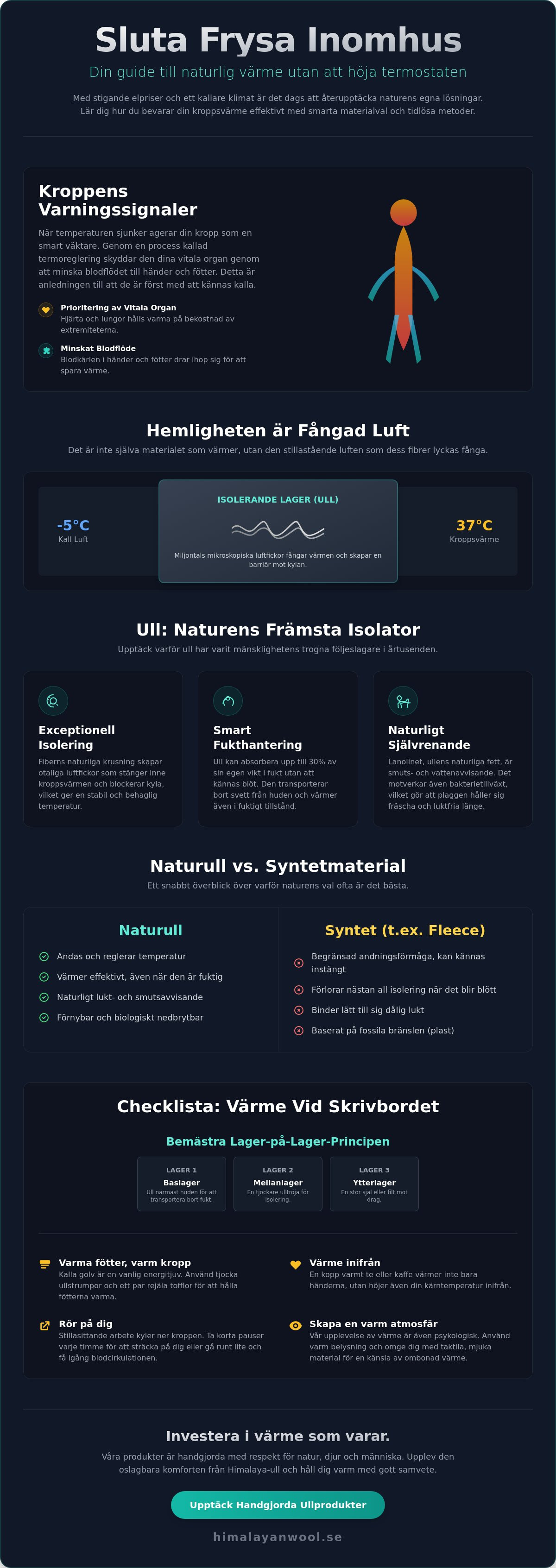
The body acts as a wise and vigilant guardian. Through a process called thermoregulation, it always prioritizes your vital organs over your hands and feet. When the surroundings cool down, blood withdraws inward to protect the heart and lungs, leaving our extremities vulnerable to the cold. But warmth is about so much more than just numbers on a thermometer. The science of thermal comfort teaches us that humidity and invisible air currents, known as drafts, play as significant a role as the actual temperature. Dry indoor air can make 21 degrees feel like 18, as moisture evaporates faster from the skin, stealing energy in the process. By listening to the body's early signals, such as slight stiffness or goosebumps, we can act before severe shivering sets in.
The Body's Natural Thermostat: An Introduction
Why do we all feel cold differently? The answer often lies in our unique biology. Muscle mass functions as the body's own heat engine, while subcutaneous fat acts as passive insulation. Individuals with higher muscle mass often generate more waste heat even at rest, making them more resistant to cool rooms. Basal metabolism acts as the body's internal glow, a continuous chemical process that converts energy into vital heat to keep your internal temperature stable.
Psychological Factors Behind Indoor Cold
Our experience of warmth is not just in our skin, but also in our mind. Research and tradition show that warm colors like deep red, burnt orange, or golden ochre can trick the brain into perceiving a room as significantly warmer than it actually is. Soft lighting from candles or lamps with warm color temperatures creates a visual sense of security that dampens the feeling of drafts. Nesting is about creating a cocoon of softness and presence. By surrounding ourselves with tactile materials and a well-thought-out atmosphere, we build a psychological defense against the cold, where the home transforms into a warm embrace rather than just four cold walls. Enjoying quality entertainment via IPTV Nord can be the icing on the cake to create that perfect feeling of indoor coziness and relaxation.
The Science Behind Sustainable Warmth: The Importance of Materials
Once we understand the body's internal priorities and how it safeguards our vital organs, the next step in our journey is to consider the protective covering we choose to wear. The choice of textiles is, in fact, at the heart of how to avoid freezing indoors in a way that feels both natural and long-lasting. It's not about forcing warmth through heavy, dense materials, but about collaborating with nature's own ingenuity to create a stable thermal environment around the skin.
The truth is that it's not the fabric itself that warms us, but the still air that the material manages to trap close to the body. By looking closer at the physics behind warm clothing, we see how the fiber structure acts as a barrier against energy loss. A highly breathable material also allows the microclimate between skin and garment to remain dry. Even when sitting completely still at a desk or in a reading chair, the body constantly emits small amounts of moisture; if this moisture gets trapped in the fabric, it quickly leads to a cooling effect that makes us shiver even though the room temperature appears correct on paper.
Wool: Nature's Foremost Insulator
Wool's greatness lies in its complex architecture. Each individual fiber has a natural crimp that creates millions of microscopic air pockets, which act as an invisible yet powerful insulation against the cold of the outside world. By exploring the properties of wool, we understand how this material can absorb up to thirty percent of its own weight in moisture without feeling wet or losing its warming ability. Lanolin, wool's natural fat, also helps garments stay clean and fresh longer, making them loyal companions through all of life's cold seasons.
Synthetics vs. Natural Materials – An Honest Comparison
In an era characterized by rapid consumption, we are often tempted by cheap synthetic alternatives like fleece or polyester. However, these materials are often made of plastic fibers that lack the ability to intelligently regulate warmth, leading us to sweat one moment and then freeze the next as the moisture cools down. A genuine wool sweater, on the other hand, is an investment in both health and the environment. While mass-produced garments often contribute to the spread of microplastics and lose their shape after a few washes, natural materials carry a history of sustainability and timeless quality. Choosing a garment created by human hands and nature's own fibers is choosing a warmth that has a soul. Perhaps it's time to wrap yourself in a soft wool poncho to truly experience the difference between merely being covered and being genuinely warm.
Strategies for Staying Warm Without Turning Up the Heaters
Creating a warm home is not about challenging the cold with technology, but about gently preserving the energy already present in the room. It is an art form that our ancestors mastered well over generations, and which we are now rediscovering in a time of changing energy prices. To understand how to avoid freezing indoors, it's not enough to just look at the thermometer; we need to review how we dress and how we interact with our furniture. By following the Swedish Energy Agency's tips for energy-smart habits, we can lower the indoor temperature by a degree or two without losing our quality of life or inner peace.
It's about working with the room's conditions rather than against them. By creating strategic warmth zones in the areas of the home where you spend the most time, you can allow the rest of the house to remain at a cooler temperature. Textiles play a crucial role here; heavy curtains can stop invisible drafts from windows, while wool rugs act as a thermal barrier against cold subfloors. These are small, conscious actions that together build a sense of security and warmth.
The Layering Principle for Indoor Use
The base layer is the foundation of your personal thermoregulation. A thin sweater of fine wool closest to the skin acts as a second skin that wicks away moisture and retains warmth close to the body. The mid-layer is about adding airy volume that insulates effectively. Here, a women's wool jacket is an excellent choice, as its handcrafted structure creates those vital air pockets that trap warmth. Finally, ponchos and large scarves act as an outer shell; they are movable blankets that you can easily wrap around yourself when moving between rooms or settling down for a moment of rest.
Insulate Your Immediate Surroundings
Cold floors are one of the most common reasons we experience discomfort indoors, as they effectively draw heat from our feet. A thick wool rug is therefore not just a beautiful interior detail, but a functional insulation that breaks contact with the cold surface. Similarly, a plastic or metal office chair can steal body heat during long workdays. By using a wool seat pad or having a proper wool blanket ready on the sofa, you ensure that your energy stays with you instead of being lost to the furniture's frame. Here are some simple steps to secure your immediate zone:
- Place rugs: Especially under the desk and in front of the sofa where your feet rest on the floor for long periods.
- Sit warmly: Use a wool scarf or a small cushion on the chair to insulate against the cold material of the furniture.
- Stop drafts: Use textiles to cover gaps at doors or window sills where cold creeps in.
By consciously choosing materials that carry a history of warmth and care, you create an environment where cold never takes hold. It is in the meeting between the quality of craftsmanship and your own knowledge of how to avoid freezing indoors that true well-being arises.
Practical Checklist: How to Avoid Freezing at Your Desk
Sedentary work in front of a screen is one of the biggest challenges for the body's natural heat regulation. When we are deeply focused, our activity level drops dramatically, causing circulation to slow down and cold to creep in from cool floors and drafty corners. Understanding how to avoid freezing indoors during the workday requires a methodical approach to both your clothing and your immediate surroundings. It's not enough to just put on an extra sweater; you need to identify the specific cold traps, such as the cold surface of a desk or the still air under the table, which steal energy from your body.
An often-overlooked factor is the thermal mass of the desk. A metal or laminate table acts as an ice pack for your forearms and wrists. By placing a natural material mat between you and the tabletop, you break the direct conduction of cold. It is in these small details that the big difference lies in maintaining a consistent and comfortable temperature throughout the workday.
Focus on Extremities: Hands and Feet
Hands and feet are the first to be sacrificed when the body conserves heat to protect the heart. At the desk, this becomes particularly noticeable when fingers begin to feel stiff against the keyboard. One of the most underestimated tools for the office worker is thin fingerless gloves or wrist warmers made of wool. They allow full mobility while retaining warmth in the wrists, which in turn helps keep fingers flexible and warm. By choosing the right winter accessories made of wool that are adapted for indoor use, you create a barrier that breathes and lives in harmony with your skin.
Feet require similar, reverent care. It is a common misconception that extra thick socks are always the best solution. If the socks are too tight or the shoes are too snug, circulation is constricted, which ironically makes you feel even colder. Instead, choose roomy, high-quality wool socks that allow air to circulate between the fibers, creating that insulating cushion we talked about earlier. A pair of sturdy wool socks from Himalayan Wool can be the crucial difference between a productive afternoon and a day characterized by frozen distractions.
Food and Drink That Warm From Within
Warmth is essentially energy, and for your internal engine to produce this energy, it needs the right fuel. Eating enough calories on cold days is fundamental; a body with an energy deficit will never prioritize keeping the fingertips warm. Spices like ginger, chili, and black pepper have long been used in traditional cultures to stimulate blood flow and awaken the body's internal glow. A steaming cup of tea is not only a physical source of warmth for your hands but a ritualistic break that signals to the mind that it's time to relax. By combining these conscious choices, you create a holistic solution for how to avoid freezing indoors, no matter how low the temperature drops outside your window.
Himalayan Wool: Handmade Warmth with a Soul
When we seek answers to how to avoid freezing indoors, we often come to the realization that the most reliable warmth comes from places where the cold is most relentless. On the wind-swept high plateaus of the Himalayas, nature has perfected a protection over millennia that no machine can replicate. Here live the animals whose wool possesses a unique ability to insulate against extreme cold while breathing in harmony with its surroundings. It is from this harsh but beautiful environment that we source the raw material for our garments; a gift from nature transformed into security in your everyday life.
Wrapping yourself in a sweater or a scarf made from this wool is more than just adding a layer of clothing. It is connecting to an ancient tradition of craftsmanship and survival. By choosing materials that originate in these extreme environments, you gain thermal comfort that lasts all day, whether you are sitting still by a drafty window or moving through a cool home. It is a warmth that not only feels against the skin but also calms the mind through its authenticity and substance.
From the Mountains of the Himalayas to Your Everyday Life
The journey for each hand-knitted garment begins with the small-scale herders and artisans in Nepal who have preserved their methods for generations. Unlike the anonymous processes of mass production, every stitch carries a human story and an artisan's pride. This artisanal production ensures that the wool's natural fibers are treated with the reverence they deserve, preserving the air pockets that are so crucial for insulation. By prioritizing ethical working conditions and fair wages, we create a chain of warmth that extends all the way from the mountain peaks to your living room.
Invest in Timelessness and Craftsmanship
Choosing a garment from us is a statement for a more sustainable future. This approach is at the core of what we call slow fashion Sweden, where we prioritize quality and meaning over fleeting trends. A high-quality wool jacket or a soft poncho is not just a temporary solution, but an investment that can keep you warm for decades if cared for properly. Wool's self-cleaning properties mean you rarely need to wash the garment; often, simply airing it out in the fresh air is enough to restore its original resilience. By choosing with your heart and investing in genuine craftsmanship, you create a home where the cold never takes hold, and where every garment becomes a lifelong companion on your journey to well-being.
Create a home of timeless warmth and presence
Embracing the cold with the right knowledge transforms the winter months from a time of hardship into a season of deeper presence and tranquility. We have seen how the interaction between the body's biology and nature's most sophisticated fibers creates a microclimate where you can thrive without burdening the planet or your finances. Mastering the art of how to avoid being cold indoors is not just about raising the temperature, but about choosing garments that carry a soul and a history of craftsmanship. Every stitch in our handmade garments from Nepal is a tribute to the slow creation process and the sustainability that only 100% natural Himalayan wool can offer.
Let your wardrobe become an extension of your home's security, where every wool sweater or poncho acts as a warm embrace during sedentary hours. Discover the warmth of our handmade wool clothing from the Himalayas and invest in a future where quality and well-being go hand in hand. We invite you to become part of our slow fashion story, where every choice is made with the heart for both people and nature. May your inner glow always be kept alive by the finest gifts from the mountain tops.
Common questions about indoor warmth and well-being
Why am I cold indoors even though the radiators are on?
Indoor cold is often due to cold surfaces such as windows and uninsulated walls drawing heat from your body through radiation, even if the air in the room is warm. This creates an imbalance in your thermal comfort where cool air currents move along the floor and steal energy from your feet. Understanding these physical laws is key to how to avoid being cold indoors without constantly having to turn up the thermostat to the highest level.
What material is best for keeping warm indoors?
Natural materials like wool are the primary choice for preserving body heat due to their ability to trap still air in their crimped fibers. By choosing artisan-crafted garments, you get living insulation that breathes and adapts to your body's needs throughout the day. Wool's unique structure carries a history of protection and security that mass-produced alternatives can never replicate, providing a genuine sense of well-being.
How should one dress in layers indoors without it becoming too bulky?
To dress smoothly in layers, one should start with a thin base layer of fine wool and add a lighter vest or an airy poncho that allows for movement. It's about creating thin but effective air gaps between the garments rather than wearing a single thick and heavy material. This method allows you to easily adjust your warmth according to activity while maintaining an elegant and timeless silhouette in your own home.
Does wearing a hat indoors really help?
Yes, wearing a thin wool hat indoors is a very effective way to regulate temperature because the head has a rich blood supply and acts as the body's chimney. By covering your head with a breathable natural material, you help your heart retain more heat for your hands and feet. It's a simple but powerful step to create a cocoon of warmth that envelops your entire being during the coldest days.
What can I eat or drink to stop being cold?
Warm drinks like ginger tea or dishes spiced with chili and black pepper stimulate your internal metabolism and awaken blood circulation to the extremities of your body. It is also important to consume enough energy, as the body's basal metabolism requires fuel to produce the waste heat that keeps you warm. Eating with reverence for the body's needs is fundamental to maintaining your inner glow and resisting the cold from the surroundings.
How do I keep my hands warm when working at the computer?
Wrist warmers or thin fingerless gloves made of wool are invaluable because they protect the superficial blood vessels at the wrists without restricting your movement at the keyboard. Insulating the desk surface itself with a mat made of natural material also prevents cold from being conducted directly from the tabletop into your arms. These small but conscious choices create a sanctuary of warmth in the midst of the workday's concentration and help you maintain focus despite cool rooms.
Is wool better than fleece for avoiding being cold?
Wool is superior to fleece because it manages moisture intelligently and warms even if it becomes damp from the skin's natural evaporation. Synthetic materials like fleece often lead to a stuffy feeling where one first sweats and then gets cold when the moisture cools against the skin. By choosing wool, you invest in a living material that respects your skin's needs and provides long-term thermal comfort without contributing to the spread of microplastics.
How does humidity affect how cold I feel at home?
The humidity in your home affects how quickly moisture evaporates from your skin, where dry air causes you to cool down faster through evaporation. Balanced humidity makes the room temperature feel softer and warmer, which is a crucial part of how to avoid being cold indoors during the cold winter months. By adding plants or a humidifier, you can create an atmosphere that feels more welcoming and naturally temperate for both body and soul.