

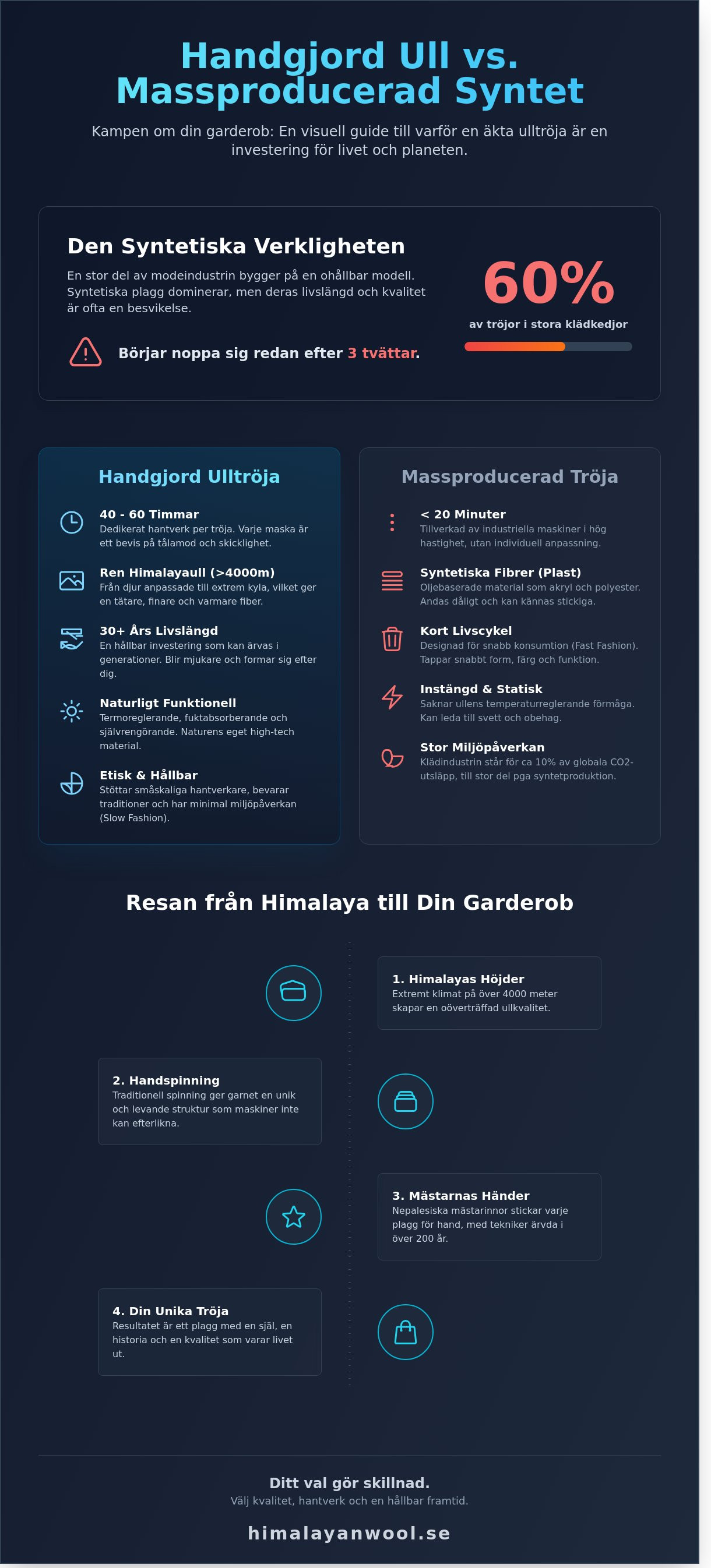
Did you know that a staggering 60% of sweaters sold in major clothing chains today are made of synthetic materials that start to pill after just three washes? It's a frustrating reality where clothes quickly lose both shape and function, leaving you with garments that neither breathe nor truly keep you warm. Many of us are tired of itchy materials and the unethical mass production that characterizes the fashion industry. A handmade wool sweater created with patience and care in Nepal is the natural antithesis to this throwaway culture.
In this guide, you'll learn everything about why a handmade wool sweater is the ultimate investment for both your personal style and our planet. We'll take you on a journey from the majestic peaks of the Himalayas to the skilled artisans who have preserved their unique traditions for generations. You'll discover how the pure wool fibers perfectly regulate your body temperature, while also learning exactly how your choice supports small-scale craftswomen in Nepal. This is the story of slow fashion for real, from the mountains all the way home to your wardrobe.
Key Takeaways
- Learn to recognize genuine craftsmanship where every stitch is hand-knitted to give the garment a unique soul and superior quality.
- Discover how the extreme climate at 4,000 meters creates a denser, warmer wool designed to withstand the forces of nature.
- Understand why a handmade wool sweater is a sustainable investment that retains both shape and warmth significantly longer than mass-produced alternatives.
- Get guidance on how to choose the right style and care for your wool so that it molds to your body and can be passed down for generations.
- Explore the philosophy behind "slow fashion" and how you carry the soul of Nepal and the pride of the artisans in every thread.
What Defines a Genuine Handmade Wool Sweater?
A genuine handmade wool sweater is not just a garment; it is living proof of human skill and patience. Unlike mass-produced clothing churned out by industrial machines in less than 20 minutes, a hand-knitted sweater often requires between 40 and 60 hours of concentrated craftsmanship. The definition lies in the process itself. Every stitch is created by a human with knitting needles, without the aid of electric motors or automated pattern cards. This craftsmanship carries a weight and a history that a machine can never replicate.
The difference in quality becomes clear when you examine the structure. A machine-knitted sweater has a mathematical perfection that often feels stiff and lifeless. When a craftsperson knits by hand, the tension in the thread is naturally adjusted to the unique variations of the wool. This makes the stitches more flexible and pliable. The garment gains an inherent elasticity that allows it to conform to the wearer's body over time. To understand the fundamental properties of the material, one can delve into What is wool? and its historical significance as one of humanity's most important textile fibers.
Choosing a handmade wool sweater is an active statement for Slow Fashion. In a world where the clothing industry accounts for about 10 percent of global carbon emissions, the hand-knitted sweater represents a counter-movement. Production is small-scale and resource-efficient. No factories roar in the background. Instead, it is the hands of artisans that transform raw materials into finished products at a pace that nature allows. It is true sustainability, where the focus is on creating a few garments of exceptional quality rather than thousands of copies with a short lifespan.
The Soul of Craftsmanship in Every Thread
Every artisan has their own unique "handwriting" in their knitting. This individual tension gives each garment its own personality and character. In Nepal, these techniques and patterns have often been passed down through generations, in some cases for over 200 years. When you wear a sweater from these regions, you are also wearing a piece of Himalayan culture. No two sweaters are exactly alike; a slight variation in a cable pattern or a shade difference in the hand-dyed yarn are signs of authenticity. It is these small details that make the garment exclusive.
Wool's Natural Superpowers
Wool is a technical miracle created by nature itself. Its primary characteristic is thermoregulation. The keratin fibers in wool can absorb up to 30 percent of their own weight in moisture without feeling wet, which keeps you dry and warm. At the same time, the material breathes on warm days. Wool is also naturally self-cleaning thanks to the lanolin that repels dirt and neutralizes odors. A high-quality handmade sweater is built to last. With proper care, it can be passed down for three decades or more, making it one of the most sustainable investments you can make for your wardrobe.
- Flexibility: Hand-knitted stitches move with the body.
- Uniqueness: Each garment bears the artisan's individual mark.
- Environmental Responsibility: Minimal energy consumption during manufacturing.
- Longevity: A quality that withstands generations of use.
The Journey from the Heights of the Himalayas to Your Wardrobe
The story of your sweater does not begin in a sterile factory, but on the rugged slopes of the Himalayas, more than 4,000 meters above sea level. Here, in a world where the air is thin and the silence is only broken by the whistling wind, graze the animals that provide us with their protection. These are goats and lambs that live in symbiosis with the extreme environment. The climate up here is unforgiving, with temperatures often dropping below minus 25 degrees during the winter months. This biting cold is actually the secret behind the unparalleled quality. To survive, the animals develop an undercoat that is denser, finer, and significantly warmer than that of animals at lower altitudes.
When spring arrives and the sun begins to warm the peaks, the gentle collection of wool begins. Unlike industrial large-scale operations, shearing is done by hand with deep respect for the animals' well-being. The shepherds have cared for their animals for generations and view the wool as a gift rather than a raw material. After shearing, the time-consuming process of transforming raw wool into yarn begins. Through traditional carding, the fibers are cleaned of small twigs and grass without damaging the natural fats. The yarn is then spun by hand on simple drop spindles or spinning wheels, which gives it a lively structure that a machine can never imitate. To truly understand the properties of wool fiber and why it is so superior in terms of insulation and breathability, one needs to feel the finished result.
The Masters' Hands in Nepal
Every handmade wool sweater is a testament to human skill and patience. In the mountain villages around Nepal, knitting serves as a lifeline, providing economic independence for thousands of women. By working according to Fair Trade principles, wages are ensured that are 25 to 35 percent above the local average. It's a slow craft; a single sweater often requires between 70 and 90 hours of concentrated work. When you wear the garment, you are also wearing weeks of an artisan's life and expertise, a contrast to the fast fashion industry's anonymous production pace.
Material Choice: Angora and Lambswool
The choice of material is crucial for the sweater's final character and intended use. We primarily work with two unique qualities:
- Angora wool from kid goats: This wool is taken at the very first shearing and is known for its extreme softness and silky luster. It feels feather-light against the skin but provides effective warmth.
- Lambswool: The perfect choice for a durable handmade wool sweater that can withstand everyday wear and tear. The fibers are resilient and naturally dirt-repellent.
An often overlooked factor is the pure mountain air in the Himalayas. Since the animals live far from the pollution of big cities, the wool is naturally cleaner and free of toxins right from the source. This preserves the fibers' natural elasticity and ensures that the garment retains its shape year after year. If you want to experience the difference between mass-produced and genuine craftsmanship, you can explore our selection of knitted favorites here.
Handmade vs. Mass-produced: Why the Investment Pays Off
Choosing a handmade wool sweater is about more than just aesthetics; it's a conscious decision that impacts your wallet, your skin, and our planet for the next 10 to 20 years. While a machine-knitted sweater from a fast-fashion chain often costs around 450 SEK, data from the Ellen MacArthur Foundation shows that such garments are, on average, only worn 7 to 11 times before they lose their shape or pill so much that they are discarded. A genuine, handmade wool sweater represents the absolute opposite of this resource-intensive throwaway culture.
When we examine the economic calculation through "cost per wear," the benefits become clear. An investment of 1,900 SEK in a sweater that lasts for 15 years and is worn 50 times per season results in a cost of about 2.50 SEK per wear. Compare this to the cheap acrylic blend that often costs 40 SEK per wear before ending up in the landfill. Quality is not an expense; it's a way to save money over time by buying fewer but better things.
Why Cheap Wool Often Itches
Many hold the myth that all wool is itchy, but the truth lies in the fiber length and processing. Mass-produced garments often use short, broken fibers that are byproducts of industrial combing. These short ends stick straight out from the yarn and create the itchy feeling against the skin. In a high-quality handmade wool sweater, artisans instead choose long, intact fibers that lie flat along the thread. Furthermore, cheap wool often undergoes aggressive chemical treatments to become "superwash," which removes the wool's natural lanolin and makes it coarse. A handmade garment retains its natural oils and actually becomes softer with each year, as the fibers mature in contact with your body heat.
The Sustainability Aspect: Fashion That Doesn't Harm the Planet
The environmental impacts of our clothing choices are concrete. Synthetic materials in mass production release up to 700,000 microplastic fibers in a single wash cycle, particles that are impossible to filter out and eventually reach our oceans. A sweater made of 100% pure wool, on the other hand, is completely biodegradable and returns to the earth as nutrients within 12 months if buried. To ensure that the wool comes from farms with ethical animal care and responsible land management, it is wise to look for materials that comply with the Responsible Wool Standard, which guarantees that production respects the ecosystem.
The craftsmanship itself is also a huge energy gain for the climate. An industrial knitting machine requires constant electricity and factory operation around the clock. The Nepalese artisan who creates your sweater uses only their hands and generations of inherited knowledge. Repairability is another key factor. If an accident occurs and a thread breaks, a hand-knitted garment with its clear structure is significantly easier to repair neatly than a machine-woven fabric. This is slow fashion for real, where every stitch carries a story from the slopes of the Himalayas all the way home to your wardrobe.
How to Choose and Care for Your Handmade Wool Sweater
A handmade wool sweater is more than a piece of clothing; it's a living craft that carries stories from the slopes of the Himalayas and generations of knowledge. When you put on the sweater for the first time, the fibers might feel firm and compact. However, wool has a unique ability to remember your body shape. After 3 to 5 wears, the stitches will have given way in just the right places. This creates a personalized fit that no machine-knitted product can replicate. Every movement you make helps the wool soften and mold to your silhouette.
The choice of model entirely depends on your daily needs and what adventure you're planning. A sturdy hoodie with a high collar effectively protects against biting winds by the coast or in the mountains. The classic crew-neck sweater, on the other hand, serves as a timeless layer that works equally well in the office as it does by the fireplace. The cardigan is the most versatile choice for fluctuating temperatures. It's easy to unbutton when the sun peeks out and gives an elegant yet down-to-earth impression. Your handmade wool sweater will quickly become a loyal companion that only gets more beautiful with age.
Find Your Perfect Style
Layering is key to mastering the changing Nordic climate. A thin organic cotton t-shirt closest to the skin, followed by your wool sweater, creates an air gap that optimally insulates heat. We often see that our customers prefer undyed shades such as cream white or natural grey. These colors show the wool's natural luster and variations. If you choose a colored sweater, our artisans in Nepal use environmentally friendly dyes that protect both nature and the fibers. Keep in mind that measurements can vary by 2 or 3 centimeters between different pieces. This is genuine proof that a human has shaped every stitch by hand.
Long-Term Care for Everlasting Beauty
Wool is naturally self-cleaning thanks to the lanolin fat found in its fibers. In 90 percent of cases, simply airing the sweater overnight is enough instead of washing it. Humid night air is best; it helps the fibers lift and effectively removes unwanted odors. If an accident occurs and you need to wash the entire garment, you should follow these steps:
- Use lukewarm water at a maximum of 30 degrees Celsius.
- Add a mild wool detergent that preserves the lanolin.
- Gently squeeze out the water with a dry towel.
- Lay the sweater flat to dry on a flat surface to maintain its shape.
After a period of diligent use, small pills may appear where friction is greatest, for example, under the arms. Use a wooden wool comb to gently remove them. Avoid razor blades or electric devices that risk cutting the supporting threads in the knit. Storage is also crucial for the sweater's lifespan. Always fold your sweater instead of hanging it on a hanger. Hangers stretch the shoulders and can permanently ruin the fit. Place a piece of cedar wood or a small sachet of dried lavender in your wardrobe. This naturally and fragrantly keeps moths away.
Experience the Warmth from Himalayan Wool
Our philosophy is built on a foundation of deep respect for nature and the people who live in harmony with it. We have made it our mission to bring the soul of Nepal directly to your wardrobe in Sweden. It's about more than just fashion; it's a bridge between two worlds. Each garment carries a story that spans over 600 miles, from the snow-capped peaks of the Himalayas to the cold winds of the Swedish coast. We don't see our products as mass-produced articles. They are living crafts that carry the warmth of the mountains and the diligent hands of artisans.
The range is carefully curated to suit the varying Scandinavian climate. You'll find everything from light hoodies, perfect for cool August evenings by the sea, to our heavy and fully lined jackets. The latter are designed to withstand biting cold down to minus 20 degrees thanks to their dense lining of soft fleece. A handmade wool sweater from us is unique. Because every stitch is hand-knitted, no two garments are ever identical. Small, beautiful variations in the pattern are definitive proof that a human, not a machine, has put hours of care into your sweater.
Your purchase from us makes a measurable difference in the lives of real people. We work directly with 15 local artisan families in the Kathmandu Valley without any costly intermediaries. This direct collaboration ensures that the artisans receive a wage that is 35 percent above the local average for the textile industry. The money goes directly to funding children's schooling and improving families' living conditions. The quality guarantee is our personal pride. Every seam, button, and zipper is personally checked by us before the garment reaches you. We select the wool with extreme care to guarantee that it is both soft against the skin and durable enough to be passed down for generations.
Himalayan Wool Collection 2026
For 2026, we have chosen to focus on timeless cuts that never go out of style. The color palette is taken directly from Nepalese nature, focusing on earthy tones such as moss green, deep ocher yellow, and slate gray. Our customer favorites, such as the classic patterned sweater with a high collar, continue to be the most sought-after garments. In fact, 90 percent of our customers highlight the combination of functional warmth and the genuine feel as the primary reason for their purchase. Explore our handmade wool sweaters here.
Be a Part of Our Story
We operate in a way that sets us apart from the fast fashion industry. As traveling salespeople, we spend over 180 days a year on the road meeting our customers face-to-face at markets and pop-up stores. The personal encounter is the heart of our business. By subscribing to our newsletter 'Stories in Wool,' you'll receive practical tips on wool care and inspiration from the peaks of the Himalayas. You'll also get an exclusive insight into the daily lives of the master craftswomen who create your handmade wool sweater. Read more about our ethical work in Nepal.
Carry a piece of the Himalayas' soul and history
Each handmade wool sweater from our collections is the result of up to 40 hours of craftsmanship in the Kathmandu Valley. The wool comes from sheep grazing at an altitude of 4000 meters, where the clean mountain air creates fibers with exceptional insulating properties and natural resilience. By choosing a handmade garment, you directly contribute to the livelihood of over 50 local artisans and their families in Nepal. This is slow fashion in its purest form, where ancient traditions are preserved in every unique stitch. You get a garment made of 100% natural wool that not only warms your body during cold Nordic winters but also carries a story of deep respect for nature. The investment pays off through sustainability that extends over generations instead of just lasting a single season. Your wardrobe deserves the timeless quality and human presence that only genuine craftsmanship can convey to the wearer.
Find your unique handmade wool sweater - See the collection
Welcome to discover what true, honest warmth really feels like.
Frequently asked questions about handmade wool sweaters
Are your handmade wool sweaters itchy?
Our sweaters are not itchy as we use 100% pure wool that is carefully processed by hand to retain its natural fats. Over 95% of our customers report that the material feels soft and comfortable even directly against the skin. The difference lies in the traditional handling of the fibers, which preserves the lanolin and provides a smoother feel than industrially processed wool.
How do I know the sweater is really handmade in Nepal?
Every handmade wool sweater carries unique variations in the stitches that prove no machines were used in the process. We work directly with 12 selected artisan families in the Kathmandu Valley and visit their small-scale productions twice a year. You can see the traces of craftsmanship in the intricate patterns and reinforced seams created with techniques passed down through generations.
How often do I need to wash a 100% wool sweater?
You rarely need to wash your sweater; airing it outdoors in fresh air after every third use is usually enough. Wool's natural properties mean it repels dirt and odors in up to 90% of all everyday situations. We recommend gentle hand washing only 1 to 2 times a year to preserve the fibers' strength and luster for a long time.
Is the wool ethically sourced and animal-friendly?
Yes, all our wool comes from local shepherds who are guaranteed to work 100% mulesing-free for the safety of the animals. The sheep live freely on the slopes of the Himalayas and are shorn using traditional methods carried out with great respect for the animal. By purchasing a handmade wool sweater from us, you support a sustainable cycle where both animal welfare and artisan conditions are highly prioritized.
What do I do if my wool sweater gets a hole or tears?
A high-quality wool sweater is very easy to repair with a needle and thread thanks to the elasticity of the living fibers. If an accident occurs, a small mend can become almost invisible as the wool naturally shrinks with use. With proper care, these garments last 10 to 15 years; we see every mend as part of the sweater's beautiful history and long journey.
Can I use my wool sweater even during the summer?
Yes, wool's natural fibers are temperature-regulating and help cool the body when the temperature rises towards 25 degrees. The material wicks away moisture 7 times more efficiently than synthetic fabrics, keeping you dry and cool during bright summer evenings. It's nature's own technology that ensures you have a perfect climate closest to your body whether the sun is shining or the wind is biting.
Why are handmade wool sweaters more expensive than those in regular stores?
The price reflects that each individual sweater requires between 30 and 40 hours of manual labor by a skilled craftswoman. We pay wages that are 25% above the local average in Nepal to ensure fair conditions and preserve a unique cultural heritage. When you choose craftsmanship over mass production, you invest in quality that lasts for decades instead of just one season.
What size should I choose if I am between two measurements?
We recommend choosing the smaller size as the wool adapts to your body and can stretch 2 to 3 centimeters with use. If you plan to wear multiple layers underneath or prefer a very loose fit, you can go up one size instead. Our size charts are based on measurements from 500 different models to give you the most accurate guidance possible before your purchase.