

Imagine yourself high up on a mountainside in Nepal, where clouds suddenly roll in and rain begins to whip against your sweater. Many hikers fear this moment, but for those wearing traditional handmade garments, a surprise awaits. A common question among outdoor enthusiasts is: does wool stay warm when wet? The answer is a resounding yes, and it's due to an almost magical biochemical process that occurs deep within the fibers.
We all know how uncomfortable it is when damp synthetic clothes cling to the skin and steal all body heat in just a few minutes. In this article, we will explore the fascinating science behind wool's unique ability to generate heat through so-called adsorption heat, a process that can raise the temperature of the material by up to 5 degrees when it absorbs moisture. You will learn how this ancient natural material protects you in extreme conditions and how to choose the right garment to feel safe regardless of the weather. We will cover everything from the chemistry of fiber structure to practical tips for your rainy adventures.
Key Takeaways
- Discover the fascinating chemical process of "Heat of Sorption" which explains how wool generates active heat when its fibers encounter moisture from the surroundings.
- Learn the scientific explanation of how wool stays warm when wet and why the material can absorb large amounts of water vapor without feeling cold against the skin.
- See the comparison that reveals how wool outperforms cotton and synthetic materials in bitter cold, making it the ultimate choice for demanding weather conditions.
- Get practical advice on how to care for your wet wool garments correctly to preserve the fibers' natural elasticity and unique properties for generations.
- Understand the secret behind Himalayan Wool and how traditional craftsmanship preserves wool's natural lanolin for superior protection from the forces of nature.
Myth or truth: Does wool stay warm when wet?
It's a question often asked when the north wind bites and rain lashes against your cheek. The answer is a resounding yes. Wool has the unique ability to generate warmth even when exposed to moisture. A wool fiber can absorb up to 30 percent of its own weight in moisture without the material feeling wet against the skin. This is no modern invention but an evolutionary gift that shepherds in the majestic Himalayas have relied on for centuries. The same wisdom was found among Nordic fishermen who braved icy seas in heavy woolen sweaters. They knew that wool was the difference between life-threatening hypothermia and comforting warmth.
In the Scandinavian slush, where rain and snow often mix into penetrating dampness, this is the material's primary strength. There is a crucial difference between being damp and being soaking wet in the world of wool. While other materials give up as soon as the first drop penetrates, wool continues to work for your body temperature. That's why wool stays warm when wet and remains the obvious choice for those who value function born of nature.
Why cotton makes you cold but wool keeps you warm
When cotton gets damp, its fibers absorb water through strong capillary action. The water forms a cold film against your skin and steals your body heat 10 times faster than air. Wool works differently. It has a naturally water-repellent surface but a core that loves moisture. This duality means that wool wicks moisture away from your body instead of binding it against the skin. To understand the depth of this mechanism, you can read more about Wool's properties: Nature's most advanced functional material. It is nature's own engineering that protects you in all weather.
Wool's ability to absorb moisture
The secret behind how the material keeps wool warm when wet lies in the concept of hygroscopy. This means that wool fibers can bind water vapor within their internal structure. When moisture binds to the fiber, a chemical reaction occurs that actually releases small amounts of heat, known as heat of sorption. The technical properties of wool mean that the surface remains dry even when humidity is extreme. You feel dry and warm even though the garment carries significant amounts of water. It is a security that synthetic materials, which often feel sticky and cold, can rarely emulate in such a genuine way.
- Wool absorbs up to 30% moisture without feeling wet.
- Sorption heat is created when wool binds moisture.
- The fiber structure retains air even in a damp state.
The science behind: How wool creates active heat (Sorption)
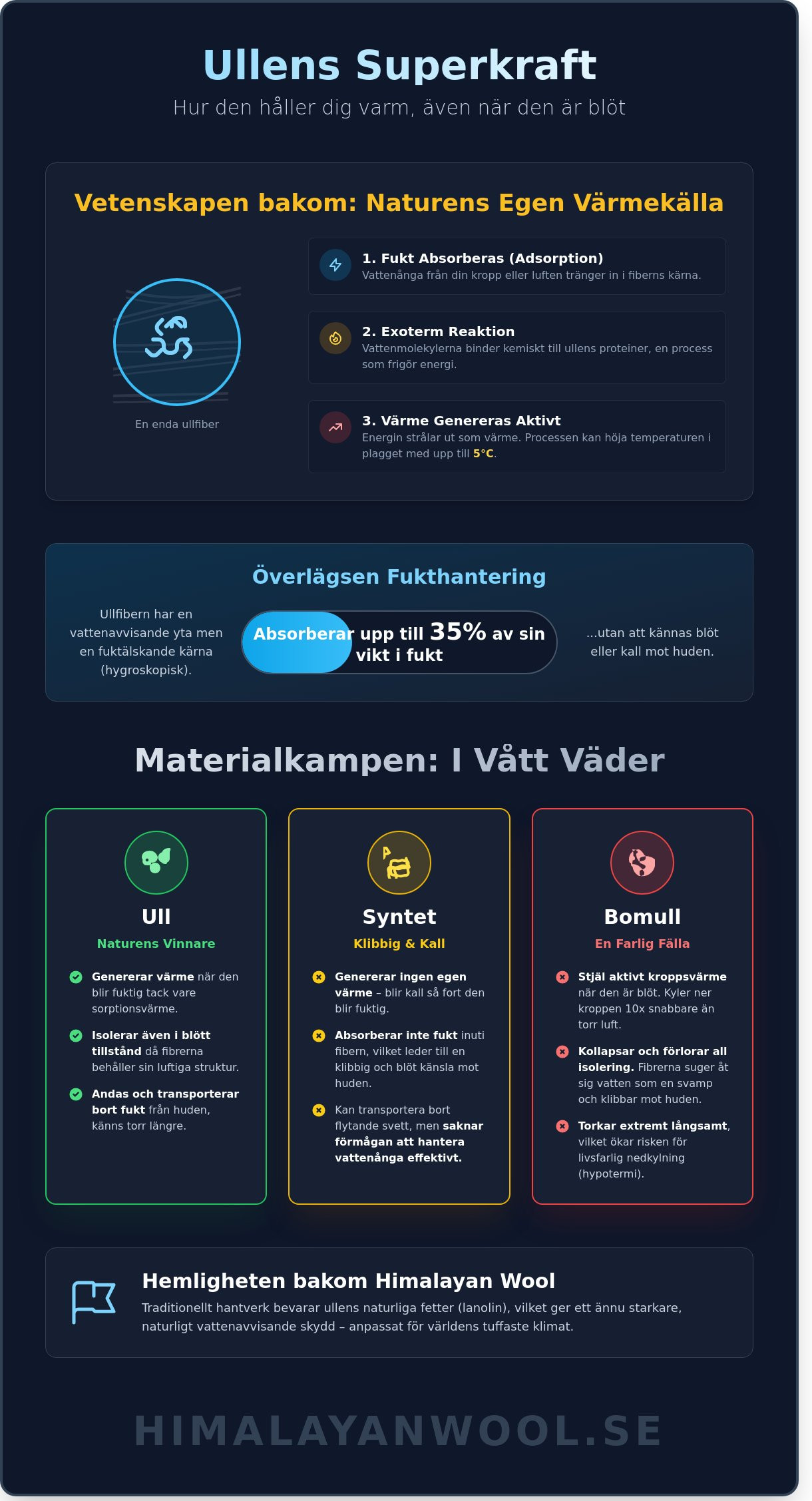
Nature has its own secrets. High up among the majestic mountain peaks of the Himalayas, animals have developed a protection that we humans can now benefit from through their soft fur. When wool encounters moisture, something magical happens at a molecular level. It's called sorption heat. It's a chemical process where water vapor binds to the inner core of the wool fiber. The science behind wool's warmth shows how these hydrogen bonds are created in the animal protein fibers. It is precisely here that we find the answer to why it is said that wool is alive, unlike dead materials such as plastic or cellulose.
During the first few hours when wool absorbs moisture, it can actually generate as much heat as a 30-watt electric blanket. The process is based on a few simple but powerful steps that occur inside the fiber:
- Water vapor penetrates the porous core of the fiber and attaches to its protein molecules.
- Hydrogen bonds are immediately created, which is an energy-releasing reaction.
- Kinetic energy is released as the rapid movement of the molecules is slowed down.
- This energy radiates towards your skin as a soft and natural warmth.
Many adventurers ask whether wool stays warm when wet, and the answer lies in these microscopic reactions that are unique to animal fibers. Synthetic materials lack this ability to chemically bind water and generate their own energy.
Exothermic reaction – nature's own heat source
Have you noticed how a pleasant warmth spreads through your sweater just as it starts to drizzle or when you start to sweat during a hike? That's the exothermic reaction at work. The wool fiber can absorb up to 35 percent of its own weight in water vapor without the material feeling damp against the skin. During this process, energy is continuously released. That's why wool stays warm when wet in a way that cotton can never replicate. This natural heat generation continues as long as the fiber absorbs moisture, providing you with reliable protection during the first few hours in changing weather conditions.
Air pockets that don't collapse
The structure of wool is an architectural masterpiece shaped by generations of adaptation to cold climates. Each fiber has a natural crimp, which creates millions of small, insulating air pockets. While synthetic fibers often stick together and lose their volume when soaked, wool retains its resilience. The air pockets do not collapse even under pressure or heavy moisture. That's why our handmade wool products continue to insulate your body heat even when the clouds gather over the mountains. Wool creates a microclimate that is both warm and breathable, a balance that only nature itself can construct with such precision.
Wool vs Synthetics vs Cotton in wet weather
Out in the wild, where rain lashes against your face and bitter cold penetrates to the bone, the choice of material becomes a matter of safety. Through millennia of evolution, nature has created solutions that laboratories are still struggling to emulate. Understanding whether wool stays warm when wet is crucial for anyone who spends time outdoors, especially when comparing it to our most common wardrobe alternatives.
Wool fibers are small architectural wonders. While synthetic fibers are often straight and smooth, wool has a natural crimp that creates thousands of tiny air pockets. When the material is 50 percent saturated with water, wool still retains about 80 percent of its insulating capacity. Synthetic materials often lose down to 30 or 40 percent at the same humidity level, as water effectively pushes the warm air out of the fabric. It is this unique property that allows us to rely on wool during the most demanding expeditions in the Himalayan mountain passes.
Many are attracted by the quick drying time of synthetic materials, but this is a trade-off that often comes at the expense of warmth during the activity itself. For a deeper analysis of these differences, you can read more about Wool vs. Synthetics: Why the natural material wins.
Limitations of synthetic materials
Synthetic garments, such as fleece, provide good warmth as long as they are dry. But as soon as moisture penetrates, the air pockets in the plastic fibers collapse. Synthetic materials are also oil-based, which means they attract skin oils and create a breeding ground for bacteria. This results in the well-known, pungent odor that often arises in wet workout clothes. The environmental aspect is also significant. With every wash of a synthetic sweater, up to 700,000 microplastic particles can detach and be flushed into our waterways, something we at Himalayan Wool consider an unsustainable path forward.
Cotton – the biggest risk in cold weather
In the outdoor world, there's a grim saying: "Cotton Kills." It sounds dramatic, but it rests on a scientific truth. Cotton fibers are hydrophilic, meaning they love water. A cotton sweater can absorb up to 25 times its own weight in moisture. Instead of insulating, the material starts to steal your body heat in an attempt to dry, leading to rapid cooling of the skin. A thin sweater of genuine wool is therefore a much safer investment for your health than a thick cotton hoodie when the clouds gather. Wool works with your body, not against it.
Practical tips: How to care for your wet wool clothes
When you step through the door after a day in biting rain or damp fog, you carry a small miracle. Even though your sweater feels heavy and the surface is damp, you probably haven't frozen during your walk. This is because the material actually keeps wool warm when wet thanks to its unique chemical structure. But for your garment to retain its essence and shape for decades, it requires proper handling after the adventure.
The first and most important advice is simple but crucial. Never wring out a wet wool garment. When the fibers are saturated with water, they are at their most vulnerable. Twisting and pulling at the fabric damages the fine scales on the fiber and can permanently distort the fit, which cannot be restored. Instead, treat the garment with the same reverence as the artisans in Nepal do when they create these timeless treasures with their own hands.
Drying step-by-step
To remove excess water without force, use the towel method. Lay your damp sweater on a dry, clean towel. Then roll up the towel with the sweater inside into a firm roll, like a Swiss roll. Gently press with your hands or press with your arms on top of the roll. This effectively absorbs moisture without straining the delicate fibers.
After this, the garment should always be flat dried on a flat surface. A wet wool sweater can weigh 30 percent more than a dry one, which means that gravity will pull out the stitches if you hang it on a hanger or line. Lay it on a drying rack with a towel underneath for air circulation. Avoid direct heat from radiators or strong sunlight. Temperatures above 40 degrees can make the wool fiber brittle and lifeless, which diminishes its natural elasticity and luster.
Air drying – wool's secret weapon
You actually rarely need to wash your wool sweater with water and soap. Nature has given sheep lanolin, a natural fat that acts as a protective shield against both dirt and odor. When your sweater becomes damp, a natural process is activated where the lanolin helps to neutralize bacteria. This is why a wet wool sweater rarely smells bad, unlike synthetic materials.
Hanging a damp sweater out in fresh air, preferably when it's a bit chilly or foggy outside, is often more effective than machine washing. The moisture in the air helps to lift away superficial dirt and straighten wrinkles naturally. It's a method that has been used for generations in the mountain villages of the Himalayas and works just as well in a modern urban environment. Only wash when you see actual stains that cannot be aired out. If you want to learn more about long-term care, you can read our in-depth guide on how to care for your wool sweater – Washing instructions that last.
By giving your garments the love and patience they deserve, you ensure they continue to protect you from the cold for many years to come. It's part of our philosophy of true slow fashion. Invest in quality that ages with dignity and that keeps wool warm when wet even after a hundred dryings.
Himalayan Wool: Adapted for the world's toughest climate
The story of our wool begins at the foot of the world's highest mountain range. Here, at altitudes often exceeding 4000 meters, nature has, over millennia, refined a material unlike any other. The animals living in these extreme environments, both goats and lambs, are daily subjected to trials that demand extraordinary protection. It is in this harsh landscape that the foundation is laid for wool's unique ability to regulate temperature.
From Nepal's mountains to your wardrobe
In the Nepalese mountains, the climate is unforgiving. Within a single day, the temperature can shift from 20 degrees Celsius in the strong mountain sun to minus 30 degrees Celsius when night falls over the peaks. To survive these extremes, the animals have developed a wool that is exceptionally dense and naturally crimped. This specific crimp creates millions of microscopic air pockets that act as effective insulation against both extreme cold and unexpected heat.
When snow melts on the animals' backs or when rain lashes against the slopes, wool's natural defenses are activated. It is precisely this robust structure that explains why the craftsmanship keeps wool warm when wet. The fibers do not collapse from moisture, but continue to encapsulate the warming air closest to the body. You can read more about this fascinating process in our article Wool clothing from the Himalayas: A complete guide.
Unlike industrially produced wool, which often undergoes harsh chemical washes that remove its natural fat, our artisans preserve the wool's essence. By spinning and knitting the garments by hand, a high content of lanolin is maintained. This natural wool fat acts as a water-repellent barrier at a molecular level. This means that a hand-knitted sweater from Nepal not only breathes better but also has built-in protection against the elements that machine-produced garments lack.
An investment in security
The Swedish winter, with its raw humidity and biting wind, demands garments that actually perform when it really matters. A robust women's wool jacket is, in this context, much more than just a beautiful garment; it is an investment in your personal security. While synthetic shell jackets often feel cold and sticky as soon as intensity increases or rain penetrates, Nepalese wool ensures that you maintain a consistent body temperature.
- Durability: A handmade garment from us is created to be worn for 20 years or more, while mass-produced fashion often loses its shape after 12 months.
- Ethics: Every stitch supports local artisans and preserves ancient traditions in Nepal.
- Function: The high lanolin content of the wool means the garment cleans itself and rarely needs washing.
By choosing true slow fashion, you move away from the throwaway culture. We invite you to explore our range and discover what it feels like to wear a garment created with love, respect, and a deep understanding of nature's forces. Let the soul of Nepal warm you on the next cold winter day.
Invest in nature's most intelligent protection
When the rain falls and the wind bites, it is wool's unique science that makes all the difference to your comfort. We have explored how this super material can absorb up to 30 percent of its own weight in moisture without feeling damp against the skin. Through the natural process of sorption, active thermal energy is created directly in the core of the fibers. This is the scientific explanation for why wool stays warm when wet.
Our collections consist of 100 percent genuine wool from animals living at over 4000 meters altitude in the harsh landscape of the Himalayas. Here, the fibers are naturally thicker to withstand extreme sub-zero temperatures. Every single garment is hand-knitted by skilled artisans in Nepal who uphold techniques passed down through generations. This is true slow fashion, created to last for 20 years or more if cared for properly. By choosing a garment from us, you carry a piece of Nepal's soul closest to your heart. Let nature's own engineering keep you safe and warm no matter what the weather forecast promises.
Discover our handmade wool sweaters that defy rain and cold
Frequently Asked Questions About Wool and Moisture
Why does wool keep you warm when wet, but cotton doesn't?
Wool fibers have a unique structure that retains their shape and traps insulating air even when exposed to moisture, unlike cotton which collapses completely. It is this specific structure that makes it said that wool keeps you warm when wet. Cotton dissipates heat from your body 25 times faster than air when damp, which quickly leads to cooling.
How much water can wool absorb before it feels wet?
Wool can absorb up to 35 percent of its own weight in moisture without the material feeling wet against your skin. This magical property is due to the moisture being drawn into the core of the fiber while the outer surface remains water-repellent. In the humid valleys of Nepal, this is a vital function that protects shepherds from the raw mountain air during long working shifts.
What is sorption and how does it create warmth?
Sorption is a chemical reaction where wool molecules release energy in the form of heat when they bind to water vapor. When the hydrogen bonds in the moisture are broken, the process can generate up to 27 kilocalories per gram of water. This means that your clothes actually produce a small amount of their own heat just as they start to get damp, providing you with an extra layer of protection against the cold.
Do wool clothes get heavier when wet?
Yes, a wool garment increases in weight in direct relation to how much water it absorbs from the surroundings. If a hand-knitted jacket weighs 1 kilo when dry, it can weigh almost 1.4 kilos after a heavy rain shower in the mountains. This weight is proof of the material's enormous absorption capacity, but it does not affect the fibers' ability to retain your body heat.
Can I use a wet wool sweater as a base layer?
You should avoid dressing in a soaking wet garment directly against the skin, but wool's properties mean that it actually keeps you warm when wet if you are already wearing it. Body heat helps to drive moisture out of the material while the internal air pockets protect you. Many artisans in the Himalayas let their sweaters dry directly on their bodies so as not to lose valuable energy on cold days.
How do I dry a soaking wet wool jacket fastest?
The fastest and gentlest way is to roll the garment in a dry towel to squeeze out the water and then lay it flat at 20 degrees Celsius. Always avoid tumble dryers or hanging heavy, wet wool clothes as they can permanently lose their shape. Expect a tightly knitted jacket to need 24 to 48 hours to dry completely due to the density of the fibers.
Does wool smell bad when it gets wet?
Wet wool has a characteristic scent of lanolin and nature, but it rarely develops the sour smell associated with synthetic materials. Lanolin acts as a natural protection against bacteria and prevents odors from taking hold in the fabric. The scent reminds us of wool's origin in the majestic mountains and it disappears completely as soon as the fibers have dried properly.
Is all wool equally good at keeping warm when wet?
No, coarser wool types from mountain sheep often have a better ability to retain their volume in moisture than very fine merino wool. The Nepalese wool we work with has robust fibers that retain about 80 percent of their insulating ability even when saturated with water. The more air that can be stored in the structure, the better the result when nature's forces test your clothes.