

What if your wardrobe consisted not just of fleeting trends, but of a living history that breathes in sync with your own body? Most of us have experienced the biting cold of a damp winter morning or the stuffy feeling of synthetic activewear that quickly starts to smell. It's easy to feel a pang of guilt about the fact that over 60 percent of the world's textiles now consist of synthetic fibers that harm our nature. By exploring all the benefits of wool clothing, you discover a path away from fast fashion towards something much more sustainable and genuine.
In this article, you'll learn how wool's unique properties improve your daily life by regulating your temperature in a way no artificial material can imitate. You'll gain a deeper understanding of why handmade natural materials are the fashion of the future and how a conscious choice can support ethical craftsmanship instead of mass production. We'll cover everything from wool's self-cleaning ability to how to choose garments that actually last for generations, so you can enjoy nature's own warmth with a completely clear conscience.
Key Takeaways
- Discover how wool's biological composition of keratin and lanolin acts as a living functional material that protects you in all climates.
- Learn the main technical benefits of wool clothing, from natural temperature regulation to its ability to absorb moisture without the garment feeling wet.
- Understand why wool is a cornerstone of "true slow fashion" due to its biodegradability and durability that spans generations.
- Get practical tips on how to use the layering principle to maximize wool's breathability during both warm summer days and cold winters.
- Explore the unique difference between machine-made and handmade craftsmanship from Nepal, where every thread carries a story and a human soul.
Why choose wool? Discover nature's most advanced functional material
Wool is a living fiber. It has been shaped over millions of years to protect animals in the Earth's most unforgiving environments. From the biting winds on the slopes of the Himalayas to the cold of the night on the high steppes, nature has created a solution that no synthetic factory can replicate. When we talk about the benefits of wool clothing, we often start with its biological composition. The fiber is made of keratin, the same protein found in our own hair, and is surrounded by a protective layer of lanolin. This natural fat makes wool repel dirt and moisture in a way that feels almost magical. If you want to deepen your knowledge, you can learn more about wool and its unique chemical properties that have made it indispensable to humans for millennia.
Choosing wool is an investment that extends far beyond the next season. It is a choice for both your personal wardrobe and for the planet. One of the main benefits of wool clothing is its extreme longevity and the fact that the material is completely biodegradable. Unlike plastic-based materials like polyester, wool does not release microplastics into our oceans. Instead, it returns to the earth when its life cycle finally ends, often after serving several generations of wearers.
Wool's unique structure: Curls and air pockets
The secret behind wool's ability to regulate temperature lies in its physical form. Each individual fiber has a natural crimp that creates millions of microscopic air pockets in the fabric. These pockets act as a thermal barrier. They retain your body heat when it's cold, but at the same time allow the skin to breathe when the temperature rises. It is this architecture that makes a thin wool sweater feel warmer than a thick synthetic jacket. For a deeper understanding of how this works, you can read more about wool's properties and its technical superiority.
The myth of itchy wool
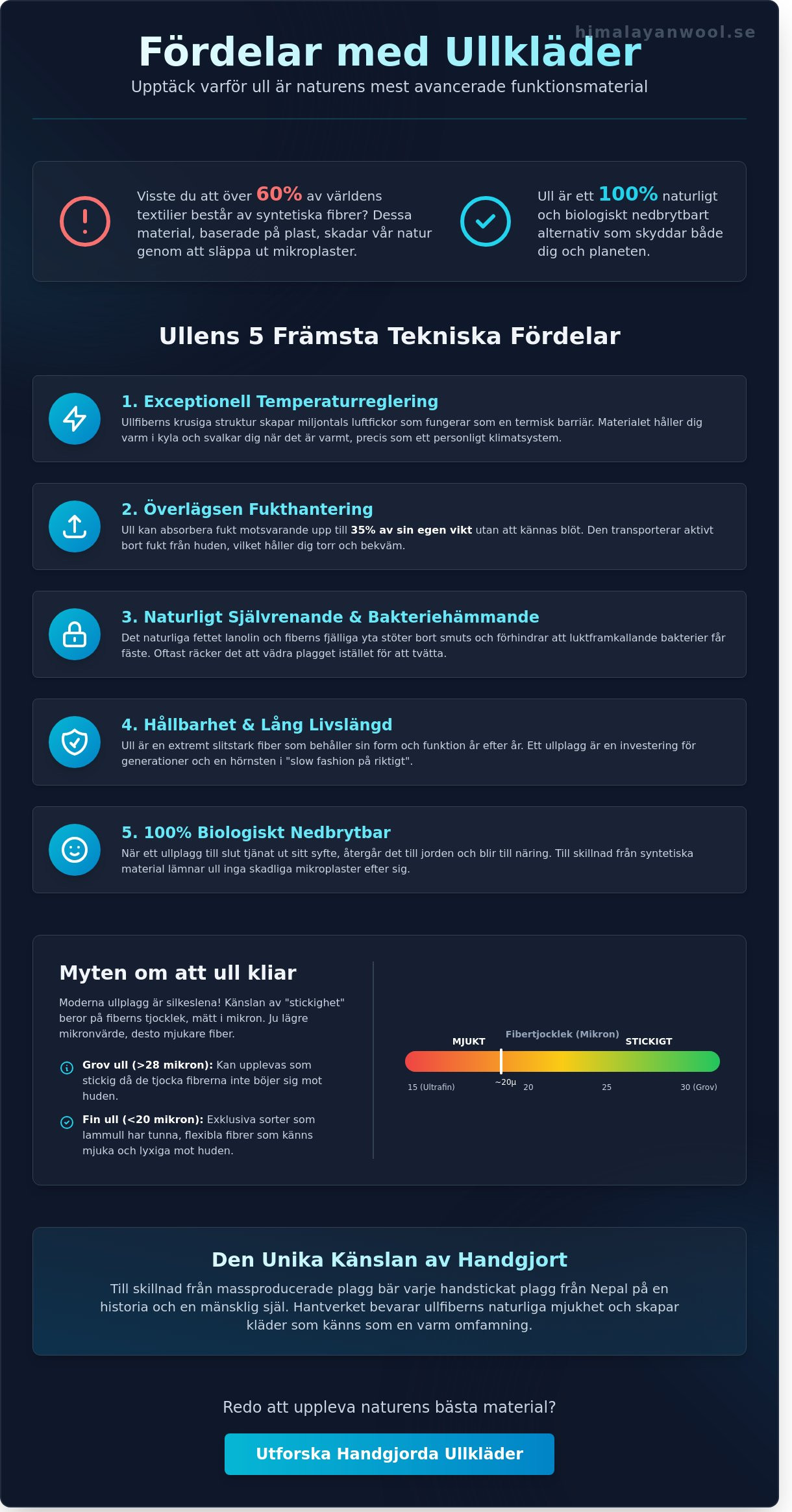
Many carry memories of scratchy sweaters from childhood, but modern wool is something else entirely. The experience of wool "stinging" depends on the fiber's thickness, the so-called micron value. Coarse wool has fibers thicker than 28 microns. These do not bend when they touch the skin but instead press against the nerve endings. Exclusive varieties like lamb's wool or cashmere have significantly lower micron values, often below 20 microns, which gives a silky feel against the body.
- Micron value determines: The lower the number, the softer the fiber.
- Processing: Modern carding removes the short, prickly fibers.
- The importance of craftsmanship: Handmade garments often retain the fiber's natural softness better than mass-produced alternatives where chemical processes can make the fiber brittle.
In our hand-knitted garments from Nepal, the wool retains its soul. By combining traditional methods with carefully selected fibers, we create clothes that not only warm but also feel like a soft embrace against the skin.
The 5 main technical benefits of wool clothing in everyday life
For millennia, nature has perfected the wool fiber to protect animals from the shifting and often merciless weather conditions of the Himalayas. There are countless benefits of wool clothing that extend far beyond the immediate warmth they provide on a chilly morning. By understanding the technical benefits of wool, one quickly realizes why this material has been the cornerstone of human clothing for generations. Wool's unique structure consists of the protein keratin and an outer layer of microscopic scales, creating a natural barrier against both moisture and dirt.
Here are the five most prominent technical properties that make wool superior:
- Temperature regulation: The wool fiber is naturally crimped and hollow, allowing it to trap large amounts of air. This creates an insulating microclimate that cools when the sun beats down and warms when the temperature drops below zero.
- Moisture management: The material transports water vapor away from the skin before it even has a chance to condense into liquid. Wool can absorb up to 35% of its own weight in moisture without the fabric feeling wet or heavy.
- Naturally antibacterial: The scaly surface of the fiber, along with its chemical composition, makes it extremely difficult for odor-causing bacteria to take hold and multiply.
- Self-cleaning properties: Lanolin, the natural fat in wool, reacts with moisture to form a kind of natural soap that breaks down dirt particles from within the fiber.
- Fire protection and UV protection: Wool has a very high ignition temperature and is naturally flame-retardant. In addition, it blocks harmful UV radiation more effectively than both cotton and synthetic fabrics.
Does wool stay warm even when wet?
When wool absorbs moisture, a fascinating chemical process called adsorption heat occurs. Energy is released in the form of heat as water molecules bind to the internal structure of the fiber. This keeps you warm even if you are caught in a light rain during your daily walk or sweat during a hike. Synthetic materials lack this ability; instead, they become cold and clammy against the skin as soon as they get damp. Wool warms. It's a simple but powerful truth that saves many chilly moments.
Wool smells less – an advantage for both you and the environment
Compared to polyester, where sweat odor often clings immediately after the first use, a wool garment remains fresh day after day. Wool's ability to resist odor makes it the perfect travel companion for those who want to travel light and consciously. Fewer washes mean you save both the garment's fibers and the planet's water resources. Most often, simply hanging your sweater out to air in the fresh air overnight is enough for it to regain its natural cleanliness. Discover how craftsmanship and function meet in our handmade wool products, designed to last for decades.
Sustainability and ethical benefits: Wool as part of slow fashion
Choosing wool is choosing a circular future where every fiber carries a story from the slopes of the Himalayas. Unlike synthetic materials, which release thousands of invisible microplastic particles into our oceans with every wash, pure wool is 100% biodegradable. When a garment finally wears out after many decades, it returns to the earth and becomes nourishment instead of waste. This is what is meant by Wool as part of slow fashion in its purest form. By understanding the unique benefits of wool clothing, we can make conscious choices that respect both the planet and the artisans who have refined the material.
A renewable raw material from nature's cycle
In the majestic mountains, animals live in harmony with nature's own changes. They graze freely on untouched land and produce a new, protective fleece every year. This natural grazing in the Himalayas is crucial for local biodiversity; the presence of animals and their natural grazing patterns help preserve the fragile high-altitude ecosystem. The wool is harvested gently using traditional methods cultivated by experienced shepherds for generations.
Here, a raw material is created that does not require finite resources or fossil fuels to emerge. The connection between animal welfare and the quality of the final product is direct and unavoidable. An animal that lives in a clean environment, with fresh mountain air and nutritious grazing, produces fibers of outstanding softness and strength. It is an ethical production where respect for the animal is central, giving the garments a soul that can never be copied by mass industry.
Durability and shape retention
One of the primary technical benefits of wool clothing is the fiber's natural elasticity. The wool fiber acts like a small spiral spring; it can be bent over 20,000 times without breaking or losing its resilience. This built-in shape retention ensures that your garments retain their beautiful silhouette year after year, even with daily use. Investing in quality means you can own fewer but better things, which is the foundation of a sustainable lifestyle.
By caring for your garments with love and utilizing wool's self-cleaning properties, you significantly reduce your climate footprint. Often, simply airing the garment in fresh air is enough for it to feel new again. For those who want to deepen their knowledge of how to build a timeless wardrobe, our complete guide on slow fashion Sweden is available. There, we explore how we can collectively transition to a fashion that values craftsmanship, origin, and longevity over fleeting trends.
From summer to winter: Wool's versatility and practical benefits
Wool is not a material limited to a specific season or climate. Rather, it is a living fiber that breathes in sync with your body and the changing surroundings. One of the most obvious benefits of wool clothing is its unique ability to regulate temperature, making it indispensable from the first cool spring winds to the deepest winter frost. By using the layering principle, you create a personal microclimate that protects against both overheating and cold. A thin wool base layer closest to the skin effectively wicks away moisture, while a thicker mid-layer traps air and insulates when the temperature drops below zero.
For those who travel frequently, wool is a quiet but reliable hero. Instead of filling your suitcase with bulky jackets and multiple changes of clothes, a thin, finely knitted wool sweater is often enough. It takes up minimal space, resists wrinkles, and stays fresh day after day without the need for washing. The natural elasticity of the fibers ensures that the garment regains its shape even after being rolled up in a tight bag during a long flight. It's slow fashion that actually works in a mobile and modern everyday life.
Wool as a mid-layer and outer garment
The choice of wool garment depends entirely on the day's activities and weather. A fully lined wool jacket acts as a powerful shield against biting wind, while a classic knitted sweater provides excellent ventilation and allows excess heat to escape during physical exertion. For those who work in the garden or move around a lot in forests and fields, a wool vest is an ingenious choice. It keeps the core of the body warm but leaves the arms free for full mobility. You can easily style a sleek wool sweater over a shirt for a professional look at the office, and then use the same garment as a warming layer under a shell jacket on a weekend hike.
Easy maintenance for the modern person
In a world where we often wash our clothes out of habit, wool offers a liberating simplicity that saves both time and the environment. Genuine wool contains lanolin, a natural fat that makes the fibers dirt-repellent and naturally inhibits bacterial growth and bad odors. Instead of wearing out the material in a washing machine, you should hang your sweater out in damp night air. The moisture causes the wool fibers to swell slightly and open up, helping the garment to "release" odors and regain its elasticity. Experience shows that a simple airing can replace up to 80 percent of all washes for quality wool. For those who want to deepen their knowledge of how to choose the right garment, we recommend our wool sweater guide for more inspiration and practical advice.
Experience the difference with craftsmanship that breathes nature and tradition by exploring our handmade wool clothing from the Himalayas.
The unique feel of handmade wool from the Himalayas
When you pull on a hand-knitted sweater from the heart of Nepal, you immediately feel the difference. It's not just the warmth of the fibers that envelops you. It's the weight of a craft refined over thousands of years. One of the primary benefits of wool clothing from this region is its extreme durability. Goats grazing at over 4,000 meters altitude develop an undercoat that protects against biting cold and whipping winds. This natural evolution results in a material that is both more insulating and more hard-wearing than ordinary sheep's wool from lower altitudes.
The journey begins on the rugged mountain slopes and ends in your wardrobe. Each garment carries a silent story of respect for nature's resources. Unlike mass-produced garments, where machines churn out identical copies every second, hand-knitted wool has a soul. This is true slow fashion. It's about an energy that can only be created when a human heart and experienced hands guide every movement.
The soul of craftsmanship in every thread
Behind every stitch stands a skilled artisan, often a woman who learned the art from her mother and grandmother. These masters possess a tactile sensitivity that no machine in the world can imitate. They see and feel the natural variations of the wool. Small, subtle variations in the knitting are not flaws. They are proof of human presence and make your garment a unique work of art. For those who want to delve deeper into the subject, there is an excellent guide on wool clothing from the Himalayas that explains the process in detail.
- Hand-spun yarn retains the natural resilience of the fibers better than industrial processing.
- Each garment often takes several days, sometimes weeks, to complete using traditional methods.
- Artisans use techniques that minimize waste and protect the local environment.
An ethical choice you can feel against your skin
Choosing handmade is an active stance for a fairer world. When you invest in a jacket or scarf from Nepal, you support local communities and ensure that traditional crafts can live on for future generations. Fair working conditions are the foundation of the entire production. This creates an almost spiritual connection between you as the wearer and the origin where the garment was born.
One of the most meaningful benefits of wool clothing of this quality is the knowledge that your investment truly makes a difference for families in remote mountain villages. It is a warmth that extends far beyond the physical material. It is secure, authentic, and deeply rooted in the Nepalese soul.
Bring the soul of the Himalayas into your wardrobe
Choosing wool means choosing a lifestyle where quality takes precedence over quantity. We have explored how its 5 main technical properties make the material superior, from its natural temperature regulation to its unique ability to stay fresh without frequent washing. By understanding all the benefits of wool clothing, one quickly realizes that this is not just a smart choice for 2026, but a long-term investment in sustainability. Our garments are crafted from genuine wool from animals grazing freely at over 4000 meters in the majestic Nepalese mountains.
Every single thread carries a living history that spans several generations of craftsmanship. This is slow fashion for real, far from the short-sightedness of mass production. When you wear a handmade garment from Nepal, you choose a material that breathes with you and can actually last for decades if cared for with love. Let nature's most advanced functional material become a natural part of your everyday life and feel the genuine difference in every fiber. Your wardrobe deserves the timeless warmth and human care that only true craftsmanship can convey.
Discover our handmade wool clothing from the Himalayas
Frequently asked questions about wool and its properties
Why is wool clothing better than synthetic materials?
Wool clothing is superior to synthetic materials because it breathes naturally and regulates your body temperature through all seasons. While synthetic fibers like polyester trap moisture, wool can absorb up to 30 percent of its own weight in water vapor without feeling damp against the skin. This is one of the biggest benefits of wool clothing that keeps you dry and comfortable whether you're hiking in the mountains or relaxing at home.
Does all wool clothing really itch against the skin?
No, modern wool clothing does not itch if the fibers are fine and soft enough. It's about the fiber's thickness; wool with a micron count below 21.5 is usually perceived as completely silky smooth against the skin. Our artisans in Nepal carefully select the softest wool to create garments that feel like a warm hug rather than a prickly material.
How often do you need to wash wool clothing?
You need to wash your wool clothes significantly less often than garments made of cotton or acrylic; often, just airing them out is enough. Wool's natural lanolin content repels dirt and breaks down odor-causing bacteria. Research shows that wool garments, on average, require 50 percent fewer washes during their lifetime, which saves both the garment and our shared environment.
Can wool clothing be used in the summer too?
Yes, wool works excellently in the summer thanks to its unique ability to insulate against both cold and heat. When the temperature rises above 25 degrees, wool fibers help transport heat away from the skin and create a cooling microclimate. This is why shepherds in the extreme Himalayan climate have used wool for generations to protect themselves from the strong summer sun.
Is wool environmentally friendly and sustainable?
Wool is one of the world's most environmentally friendly materials because it is completely renewable and biodegradable. A pure wool garment breaks down completely in the soil in about 12 months, returning nutrients to the ecosystem, unlike plastic-based clothing which can take 200 years to decompose. By choosing wool, you support a circular economy that protects the animals and the mountain air they live in.
Why is handmade wool clothing more expensive than mass-produced?
Handmade wool clothing has a higher price because it requires tens of hours of skilled human labor and fair wages. A single sweater can take up to 60 hours to hand-knit by a master artisan in Nepal, providing a quality that machines can never replicate. This is real slow fashion where every stitch carries a story and professional pride that spans several generations.
Does wool stay warm if you get sweaty or wet?
Wool is the only material that actually generates heat when it gets damp, protecting you from cooling down. Through a chemical process called adsorption heat, energy is released when wool fibers absorb moisture, keeping you warm even if the garment is 30 percent wet. This is crucial security when the weather changes quickly and an important part of all the benefits of wool clothing in a Nordic climate.
How do I best store my wool clothes to avoid moths?
You best store your wool clothes by ensuring they are clean and placed in airtight containers during the summer. Since moths are attracted to organic residues, it's wise to use cedarwood or dried lavender as a natural repellent in the wardrobe. If you don't plan to use the garment for more than 3 months, you should pack it in a vacuum bag to ensure it remains intact and beautiful.