

Imagine if your favorite jacket not only kept you warm but also carried the story of a Nepalese shepherd who had tended their wool for generations? By 2026, ethical fashion will no longer be about compromise but instead the ultimate symbol of conscious luxury. It's a movement where every thread has a purpose and every seam carries a story from majestic mountain peaks and pure mountain air.
We know it's difficult to decipher unclear labels when a recent review showed that as much as 60 percent of all sustainability claims in the fashion industry were misleading greenwashing. You want to feel confident in your choices and avoid the nagging feeling of guilt over the industry's downsides. It's often a challenge to find clothes that are both stylish, warm, and genuinely fair. We promise to teach you how to choose garments with your heart and discover the benefits of craftsmanship that respects both people and nature. We'll go through everything from the connection between price and quality to how to find those unique pieces that carry a living history.
Key Takeaways
- Learn to navigate beyond superficial labels and understand how ethical fashion prioritizes human rights and animal welfare.
- Discover how to choose timeless garments that last for generations and are completely free from harmful chemicals and plastics.
- Get concrete tools to review brand transparency and learn to identify natural materials that truly make a difference for the environment.
- Explore the three pillars - people, animals, and craftsmanship - that form the foundation for a wardrobe filled with both style and conscience.
- Be inspired by how the journey from Nepal's majestic mountains to your wardrobe preserves cultural treasures through traditional and loving craftsmanship.
What is ethical fashion? More than just a label
When we talk about clothes, the discussion often revolves around color, shape, and seasonal trends. For us at Himalayan Wool, every thread carries a much deeper story that begins long before the garment reaches your wardrobe. What is ethical fashion, really? It's a concept that extends far beyond a simple label on a price tag. While sustainable fashion primarily focuses on environmental aspects and the planet's resources, ethical fashion places humans and animals at its absolute center. It's about ensuring that the shepherd on the steep slopes of the Himalayas receives a fair wage and that the sheep live under loving conditions in the pure mountain air. It's a promise of social responsibility that permeates every step, from the first shearing of the wool to the last stitch in a finished knitted sweater.
Ethical fashion serves as a necessary counterpoint to the anonymous mass production that has dominated our world over the past decades. Instead of viewing clothes as consumables, we see them as the result of human skill and craft tradition. It's about giving the artisan a face and a voice. When we choose ethical fashion, we reject hidden exploitation and replace it with respect for life. It's slow fashion in its truest sense, where the quality of work is given the time it needs to create something that can be inherited for generations.
From Rana Plaza to today's awareness
On April 24, 2013, the fashion world changed forever when the Rana Plaza factory complex in Bangladesh collapsed. The tragedy claimed 1,134 lives and injured over 2,500 workers, prompting a global discussion about the dark side of the fashion industry. This event was the starting point for a movement where consumers began demanding answers about who made their clothes. Today, this consumer power has forced 90 percent of the world's largest clothing chains to at least start publishing lists of their suppliers. Despite these advances, we still have a long way to go to achieve full justice. According to the Fashion Transparency Index 2023, the average transparency score for the 250 largest brands is only 26 percent. This shows that the need for actors who dare to be genuinely honest is greater than ever.
Transparency: Daring to show the entire chain
The year 2026 marks a historic turning point for the industry. With the EU's new requirements for digital product passports (DPP), transparency will finally become the fashion industry's most important currency. Vague promises are no longer enough; we must be able to prove every claim. Full traceability means that you, as a customer, can follow the wool's journey from the majestic mountain peaks to the warm hands in Nepal that knit the pattern. Digital tools and QR codes help us verify origin and working conditions in real-time. For us, this is a natural extension of our philosophy. We know the names of the families we collaborate with, and we ensure that their craftsmanship is highly valued. By knowing exactly who knitted your sweater, an emotional connection is created that makes the garment more valuable than any mass-produced item from an anonymous factory could ever be.
- Human rights: Guaranteed living wages and safe working environments for all artisans.
- Animal welfare: Respectful treatment of animals and preservation of natural grazing lands.
- Social responsibility: Investments in local communities to preserve traditional methods.
- Authenticity: A transparent chain where no links are left in the shadows.
The three pillars: People, animals, and craftsmanship
For us, ethical fashion is not a superficial label. It's a promise that rests on three unshakeable pillars. The first is about the people behind each garment. In a world where the fashion industry often chases the lowest possible price at the expense of human rights, we choose a different path. When we talk about The three pillars: People, animals, and craftsmanship, we mean a direct counterpoint to the mass production that often exploits both nature and individuals for quick profit. We ensure that our artisans receive wages that are at least 25 percent above the local average in the Kathmandu Valley. Safe working environments and reasonable working hours are not perks; they are fundamental requirements for preserving the dignity of every stitch.
Social sustainability is about more than just the payroll. It's about how fashion can uplift entire local communities. By investing in small-scale ateliers, economic security is created that allows families to stay in their home villages. This counteracts urbanization and the poverty that often follows in its wake. We see the results in children who can go to school and in a local economy that thrives thanks to the pride in a profession. It's a circle of respect that begins at the loom and ends in your wardrobe.
The master's hands: The dignity of craftsmanship
A machine can produce thousands of sweaters in a day, but it lacks soul. When a woman in Nepal knits one of our cardigans, the process often takes between 15 and 20 hours of concentrated work. Time is the most exclusive ingredient in genuine ethical fashion. Every stitch carries a story from the mountains. By choosing handmade garments, we preserve knowledge that risks being erased in a digitized world. This is the true dignity of craftsmanship.
Respect for animals in the Himalayas
Our wool comes from goats and lambs that graze freely at altitudes above 3000 meters. Here, shepherds follow traditional methods and respect the animals' natural cycles. Unlike industrial animal husbandry, these creatures live in symbiosis with nature and their guardians. Genuine wool is an ethical choice when it is harvested with gentle hands during the natural shedding season of spring. We see animals as our most important partners and treat them accordingly.
Working this way requires patience. It means that we sometimes have longer delivery times because we wait for nature and the artisans to finish. We believe our customers appreciate this honesty. It's part of our identity as a wise and down-to-earth storyteller. Every garment is proof that it is possible to combine aesthetics with deep empathy for all living things. You can explore our range of locally produced wool products to see the result of this work.
- Fair wages: 25% above local standard provides economic freedom.
- Tradition: Preservation of weaving techniques used for centuries.
- Animal welfare: Free grazing in the pure mountain air of the Himalayas.
- Transparency: Full insight into the production chain from goat to finished sweater.
By choosing ethical fashion from us, you become part of a larger movement. You support not just a brand, but an entire chain of people and animals living in harmony. This is slow fashion in its truest sense. Every thread we spin is a link between the majestic peaks of the Himalayas and your everyday life. This is how we create quality that lasts for generations.
Why choose ethical fashion? Benefits for you and the world
Choosing ethical fashion is about more than just dressing in beautiful materials; it's a conscious decision to walk a path that honors both humanity and nature. When you put on a sweater handcrafted in a small workshop in Kathmandu, you feel the weight of authentic craftsmanship and the warmth of a story that spans generations. It's a radical contrast to the anonymous mass production of the fast fashion industry. By prioritizing transparency and fair conditions, we create a circle of respect that begins with the shepherd on the slopes of the Himalayas and ends in your wardrobe.
The truth is that every stitch carries a responsibility. By understanding the underlying processes in ethical practices in the fashion industry, we as consumers can contribute to systemic change. It's about valuing garments that have a soul and a clear origin, rather than filling our wardrobes with fleeting trends that deplete the planet's resources.
Quality over quantity: An investment
A handmade wool jacket from Himalayan Wool might seem more expensive at first glance than a synthetic equivalent from a large chain, but calculated in cost per wear (CPW), it's a clear win. A 100% wool jacket often lasts for 20 to 30 years if cared for properly, while a polyester jacket often loses its shape and luster after just 10 washes. Wool's natural fats, primarily lanolin, make the fibers dirt-repellent and self-cleaning; airing the garment in fresh air is often enough to clean it. This reduces the need for machine washing by up to 80%, saving both the garment's fibers and the earth's water resources. Timeless cuts also mean you never have to worry about the garment going out of style; it's fashion that transcends seasonal whims.
- Long lifespan: Natural fibers like yak wool and sheep wool have an elasticity that allows garments to retain their fit year after year.
- Financial smartness: An investment of 3000 SEK for a garment used 100 times a year for 10 years results in a cost of only 3 SEK per wear.
- Less maintenance: Wool's unique properties mean it doesn't absorb odors in the same way as synthetic materials.
Fashion that feels good: Your skin and your planet
Your skin is the body's largest organ, and it absorbs what it comes into contact with. By choosing ethical fashion in 100% natural materials, you avoid the harmful chemicals and plastics often used in the manufacturing of cheap textiles. Synthetic clothing releases up to 700,000 microplastic fibers in a single wash, particles that ultimately end up in our oceans and in the food chain. When you choose pure wool, you instead contribute to a biodegradable cycle.
There is also a deep psychological satisfaction in knowing that your purchase makes a real difference. In Nepal, where the air at 4000 meters altitude is crisp and clean, artisans work under conditions that promote their well-being and local economy. Your investment in a hand-knitted scarf helps preserve traditional methods and secures an income for families in the mountain villages. It's a connection that gives the garment an aura of security and pride; you don't just wear a sweater, you wear a piece of the Himalayas' heart and a cleaner future for us all.
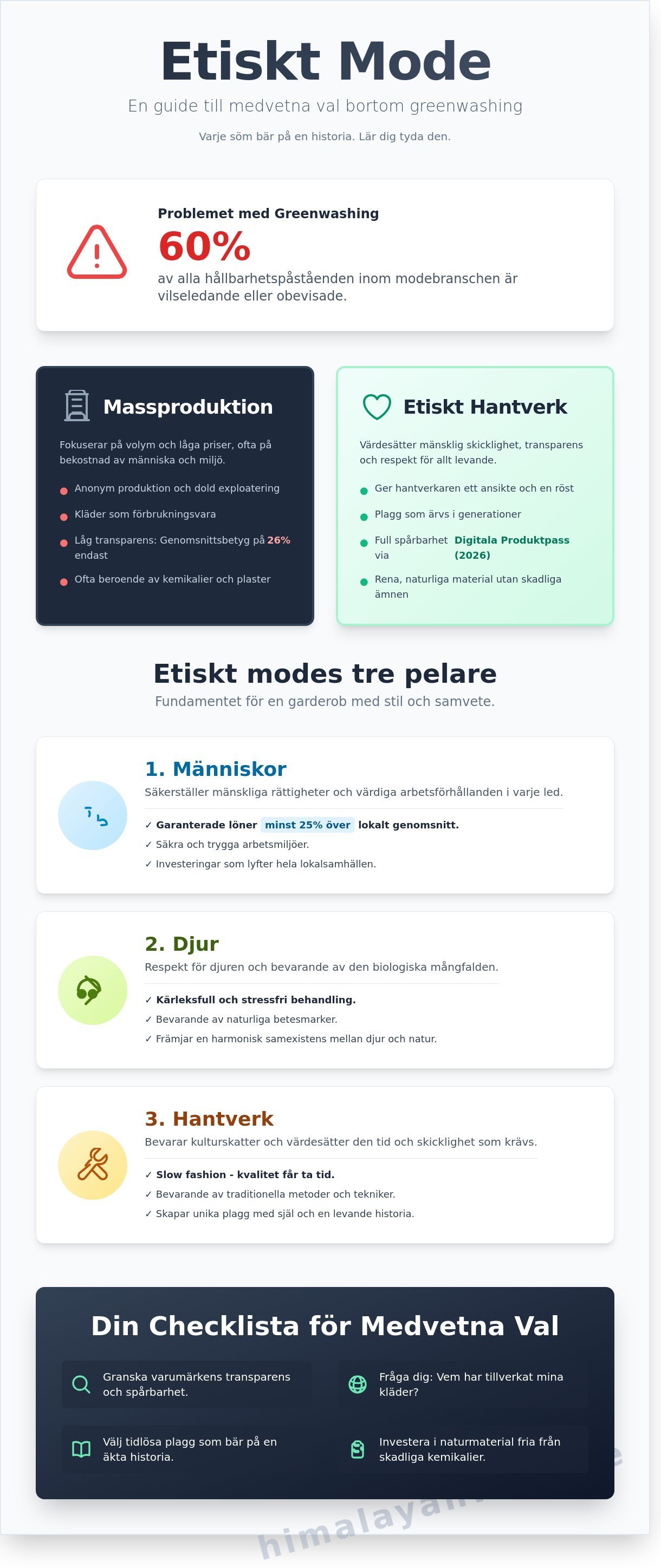
How to become a conscious consumer: Your checklist
Choosing clothes with your heart requires both knowledge and a touch of patience. In a world where the pace is often too fast, the choice of ethical fashion becomes an act of care, both for yourself and for the artisans who created the garment. It's about looking beyond the glossy surface and instead searching for the roots. When you hold a yak wool sweater from the heights of Nepal, you're not just wearing a garment; you're wearing a story that spans generations. To help you navigate correctly, we've created a simple yet powerful checklist for your next investment.
- Look for transparency: Can the brand name its producers? An honest company doesn't hide its factories behind anonymous codes. They proudly display the faces of the master craftswomen who knit each stitch.
- Examine the material: Prioritize natural materials like organic cotton, hemp, or certified wool. Remember that synthetic fibers like polyester can take up to 200 years to break down in nature.
- Ask the difficult questions: Send an email and ask about living wages and working conditions. A company passionate about ethical fashion will respond with joy and detailed information.
- Choose 'Slow Fashion': Before you buy, ask yourself if you will wear the garment at least 30 times. Invest in craftsmanship that stands the test of time rather than impulse purchases that lose their shape after two washes.
- Examine the price: If a sweater costs less than 250 SEK, there's a high risk that someone else in the chain has paid the true price with their health or poverty.
Seeing through greenwashing in 2026
As of 2026, the EU's rules on environmental claims will be tightened, making it harder for companies to use vague words like "climate neutral" without concrete evidence. Be wary of collections named "Conscious" or "Earth-friendly" if they simultaneously constitute only 5% of the company's total production. True sustainability is visible in images from the actual workshops and in transparent reporting of water consumption and dyeing processes. If a brand cannot show its daily operations in images and text, the beautiful words are often just a thin curtain.
Certifications vs. Genuine Craftsmanship
Labels like GOTS and Fair Trade are fantastic compasses, but they are not the only truth. For a small family-owned producer in Kathmandu, the cost of an international certification can amount to over 50,000 SEK per year, a sum that is often prohibitive even though their methods are completely natural. Here, you must trust your intuition and the brand's total openness. Genuine craftsmanship is felt in the texture of the fibers and is visible in the pride conveyed through their personal stories. It's about an unbroken chain of trust from the mountains to your wardrobe.
Do you want to make a difference that resonates deep within your soul? Explore our range of handmade and ethical fashion here.
Himalayan Wool: Ethical fashion for real
Our philosophy was born among the snow-capped peaks of the Himalayas, where the air is thin and silence speaks volumes. It's a journey that stretches from the rugged mountain plains of Nepal all the way to your wardrobe in the Nordics. We see every garment as a bearer of a story, not just as another product. It's about more than just clothes. It's about preserving ancient knowledge that risks being erased in a world obsessed with fast consumption and short-term trends. By choosing ethical fashion, you support a life cycle where humans, animals, and nature live in gentle harmony.
Behind every stitch, we find the master craftswomen. These are the Nepalese women and their families who transform raw, coarse wool into soft, warming works of art. We work entirely without intermediaries. This means that 100 percent of our production takes place in small, family-owned workshops in the Kathmandu Valley, where craftsmanship has been passed down through generations. We have actively opted out of anonymous mass production. The modern industry prioritizes volume over value, but we choose to go in the opposite direction to preserve invaluable cultural treasures. Every jacket or hoodie bears the traces of the hands that shaped it. This gives the garment a soul that a soulless factory can never recreate, no matter how advanced the technology becomes.
Our promise to you is as simple as it is unwavering. We offer genuine wool from sheep that graze at over 3000 meters altitude, fair conditions for the artisans, and a timeless warmth that defies seasonal changes. We never compromise on quality. If a stitch goes wrong, we start over. It's that professional pride that defines Himalayan Wool and makes our garments feel different against the skin.
Our journey through generations
Our collaboration with 15 permanent artisan families in Nepal is based on mutual respect and long-term commitment. We combine their traditional knitting techniques with a clean, Scandinavian design that suits the Nordic climate. This creates a bridge between two distant worlds. Sometimes our deliveries can take up to 14 additional days, especially during periods when monsoon rains make transportation difficult in the mountains. We do not stock enormous quantities. Instead, we wait for the craftsmanship to be completed at its own pace. This waiting is a fundamental part of what ethical fashion means in practice. It's true slow fashion, and it's worth every second when you feel the quality of the dense wool.
Find Your Ethical Favorite
Our range includes everything from robust wool jackets that block the sharpest winter wind to soft hoodies for cool summer evenings. These garments have a deeper meaning than just following a trend. For your investment to last 20 years or more, you rarely need to wash it. Wool's natural lanolin repels dirt and odors in a way that synthetic materials can never match. Often, simply airing the garment outdoors in fresh air is enough. If washing becomes necessary, use a mild wool program and let the garment dry flat. By caring for your sweater, you directly honor the artisan who spent weeks working on your specific garment.
Are you ready to wear a piece of Nepal's soul? Every purchase makes a tangible difference to the artisans' daily lives and helps us preserve a unique tradition for the future.
Explore our range of ethical craftsmanshipWear the Story of the Future Today
The path to a more conscious lifestyle is about the choices we make every day. By focusing on the three pillars: people, animals, and genuine craftsmanship, you create a wardrobe that lasts for generations. Forecasts for 2026 show that 75 percent of consumers will demand full transparency in every stitch. Choosing ethical fashion is an active stance for a world where quality trumps quantity. It's about valuing the 12 local masters in Nepal who weave each garment by hand using techniques passed down for centuries.
Here, there are no intermediaries blurring the origin. Every thread of 100 percent pure wool carries the tranquility of the clean mountain air and the artisan's pride. This is true slow fashion; a direct link between the majestic mountain peaks and your everyday life. When you wrap yourself in a garment created with love for both animals and nature, you immediately feel the difference against your skin. Let your clothes tell a story of respect and timeless beauty.
Discover our handcrafted wool clothes with a story
Your journey to a more sustainable style begins with a single, conscious choice that makes a difference for both you and the planet.
Common Questions About Ethical Fashion and Sustainability
What is the difference between ethical fashion and sustainable fashion?
Ethical fashion primarily focuses on human well-being and animal rights, while sustainable fashion prioritizes environmental health and ecological footprint. The UN's 17 Global Goals divide these into social and environmental sustainability to create a holistic approach. Ethical fashion ensures that the 75 million people working in the global textile industry earn wages they can actually live on. Sustainability is more about reducing the 92 million tons of textile waste produced annually by using materials that decompose naturally in the earth.
Why are ethical clothes more expensive than fast fashion?
The price difference is because artisans receive fair wages that are often 2 to 3 times higher than the minimum wage in producing countries like Nepal. In fast fashion, the actual labor cost often accounts for less than 2 percent of the garment's final retail price. When you choose ethical fashion, you pay for the highest quality materials and safe working environments without child labor. It's about covering the actual costs of production where neither people nor nature are exploited for short-term profit.
How do I know if a clothing brand is truly ethical?
You can verify a brand's ethics by examining their transparency regarding the supply chain and specific third-party certifications. According to the Fashion Transparency Index 2023, only 12 percent of the largest global brands disclose their raw material suppliers. A genuinely ethical brand shows pictures of its artisans and explains exactly where the wool or cotton comes from. They avoid vague promises and instead present measurable data on their working conditions directly on their website for everyone to see.
Is wool an ethical material?
Wool is an ethical material when it comes from free-roaming animals and is shorn using methods that completely exclude painful mulesing. In the Himalayan mountain regions, shepherds follow traditions spanning 5 generations, where animal welfare is crucial for the family's survival. Wool is also 100 percent biodegradable and requires 70 percent less energy for washing compared to synthetic fabrics. This makes the material one of the most responsible choices for a conscious wardrobe designed to last.
What does 'Slow Fashion' mean in practice?
Slow Fashion means producing fewer garments of higher quality that are designed to last for at least 10 to 20 years in your wardrobe. Instead of following the 52 micro-seasons launched by large chains each year, we focus on timeless design and genuine craftsmanship. It's about letting production take the time it actually needs. In Nepal, a hand-woven shawl can require 15 hours of work from a skilled master, creating a value that can never be replaced by machines.
How can I contribute to ethical fashion without buying new?
You contribute most effectively by extending the life of the clothes you already own through repair, care, and smart storage. Using a garment for just 9 extra months reduces its total carbon footprint by about 20 to 30 percent. By caring for your wool through airing instead of machine washing, you save hundreds of liters of water each year. Participating in ethical fashion is as much about valuing what already exists as it is about making the right choice when investing in something new.
Which certifications should I look for when shopping ethically?
Look for labels such as GOTS, Fair Trade, and Responsible Wool Standard (RWS) to ensure that the garment meets strict international requirements. GOTS guarantees that at least 70 percent of the fibers are organic and that social criteria are followed throughout the production chain. Fair Trade certification ensures that producers in countries like Nepal receive an extra premium invested in local schools or healthcare. These independent audits provide the security needed to make a conscious and fair purchase.
Why is craftsmanship important for social sustainability?
Craftsmanship preserves important cultural heritage and provides economic independence to local communities where modern industrial jobs are often completely absent. In Nepal, the craft sector employs over 1 million people, making it the country's second-largest employer after traditional agriculture. By supporting handmade products, we ensure that knowledge refined over 10 generations is not lost to oblivion. This creates pride for the artisan and a direct link between the consumer and the human hand behind every stitch.